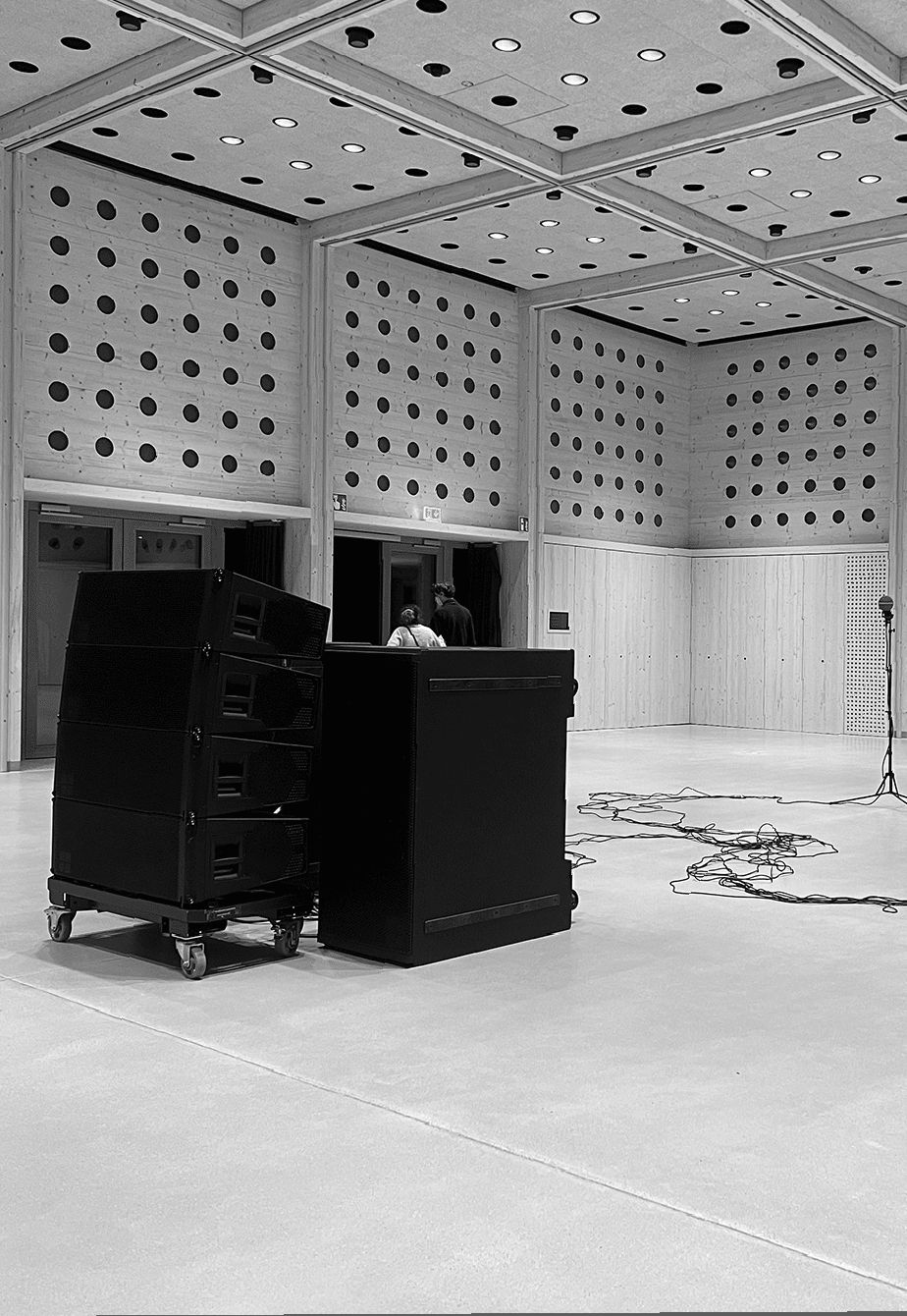
34121 is a research platform for sonic culture. It functions as a virtual and physical meeting point for faculty members and external affiliates of the Kunsthochschule Kassel, unfolding in a variety of formats—including thematic blocks, reading sessions, interviews, psychoacoustic situations, DJ sets, live performances, radio experiments, and extended listening sessions.
Founded in 2020, this platform supports and contributes to the preservation and historical analysis of sonic documents. It serves as a container to investigate how acoustic perception shapes our notion of systemic linkage, affect, poise, and agency, hosting an archive of over 10,000 titles, ranging from early avant-garde documents, industrial culture, música máquina, actionism, minimalism, dada/fluxus, ethnographical recordings, folk, psychedelia, microtonal, club, and experimental electronic music, sound art, noise, and its multiple affiliates.
34121 is the container of Direct Media, a laboratory focused on the design and production of perceptual experiences, utilising sound as a physical and semantic medium, functioning also as a publishing platform to display multiple instances of print-making, computer-controlled processes, and extensions of editorial design.
Our open call for the spring-summer 2026 is out now, more information and application here.
German intermedia artist (b. 1942) who pioneered audio art, radio plays, and text-based installations.
Roman Opałka (1931–2011) was a Polish-French painter who in 1965 began painting successive numbers on identical canvases, starting from 1. With each new canvas he added 1% white to the background, slowly approaching all-white as surface and intention converged. He also photographed himself and recorded himself reading numbers aloud, producing three parallel archives of ageing. At his death in 2011, he had reached 5,607,249.
Throbbing Gristle was a British band formed in London in 1975 by Genesis P-Orridge, Cosey Fanni Tutti, Peter Christopherson, and Chris Carter, emerging directly from the confrontational performance collective COUM Transmissions. They are widely regarded as the founders of industrial music, coining the term themselves and establishing their own label, Industrial Records, in 1976.
Their recordings — including the debut album The Second Annual Report (1977), 20 Jazz Funk Greats (1979), and Heathen Earth (1980) — combined tape manipulation, synthesizers, found sounds, and abrasive vocals to produce work that was as much a critique of mass media and social control as it was music. Live performances were deliberately provocative, confronting audiences with disturbing imagery and extreme sound.
Throbbing Gristle disbanded in 1981 and reunited several times, most notably in 2004 before Christopherson's death in 2010. Their influence extends across industrial, EBM, noise, electronic body music, and experimental electronic music. The band established a template for artists who treat music as a vehicle for political and psychological disruption.
Spanish sound artist and musician working with electronics and experimental sound.
American composer and sound artist working with multichannel audio, algorithmic composition, and room-filling installation.
Italian electronic composer (b. 1990) known for hypnotic, pattern-based synthesizer music exploring polyphony, cognition, and spiritual states.
German composer and sound artist working with extended notation, text scores, and experimental music performance.
British musician and founder of Consumer Electronics, working in power electronics and industrial sound.
Mexican-Canadian artist (b. 1967) working with large-scale interactive installations that use biometric data, surveillance, and light.
Barbara T. Smith (b. 1931) is an American performance artist whose practice since the mid-1960s has made her one of the founders and most consistently radical figures of West Coast performance art, working with the body, ritual, food, and sexuality in ways that anticipated and influenced the feminist body art movement of the 1970s. Her early work emerged from the Los Angeles art scene and Fluxus-influenced activity in Southern California, developing toward large-scale ritual performances involving durational actions and communal feeding. Feed Me (1973), in which she spent the night in a gallery room receiving visitors and offering conversation, food, cannabis, and physical intimacy, is among the most significant works in the history of intimate and relational performance. Her ongoing engagement with spiritual practice, Jungian psychology, and feminist theory has given her work an intellectual depth beyond transgression. She has collaborated with many artists of the West Coast performance tradition and continues to be recognised as a central figure whose contribution to performance art predates and in some cases exceeds the recognition she has received.
COUM Transmissions was a British performance art collective active from 1969 to 1977, founded by Genesis P-Orridge and Cosey Fanni Tutti, initially in Hull and later in London. Beginning as a loose community of artists, musicians, and performers, COUM developed increasingly confrontational performances engaging with sexuality, identity, and social limits — staged actions incorporating bodily fluids, medical instruments, and explicit erotic material.
Their most notorious project, the Prostitution exhibition at the ICA London in 1976 — featuring photos from Cosey Fanni Tutti's work as a pornographic magazine model, alongside performance documentation — caused a national scandal. Conservative MP Nicholas Fairbairn called them the wreckers of civilization in Parliament, generating enormous publicity.
COUM Transmissions disbanded in 1977 when P-Orridge and Tutti, together with Chris Carter and Peter Christopherson, formed Throbbing Gristle and established Industrial Records, translating COUM's confrontational performance into industrial music. The transition from COUM to Throbbing Gristle represents one of the more significant moments in British avant-garde art and experimental music history.
American artist and musician working in experimental and sound art contexts.
German artist working with kinetic objects, sound, and absurdist humor.
Lawrence English (b. 1976, Brisbane) is an Australian composer and curator who founded Room40, a Brisbane-based label that has become one of the most respected platforms for experimental, drone, and electroacoustic music globally. His own compositions engage with the physical and environmental dimensions of sound, often in extended duration and very gradual change. He performs internationally and has made environmental concern a recurring theme in both composition and curatorial work.
Demna Gvasalia (b. 1981, Sukhumi, Georgia) is a Georgian fashion designer who became one of the most influential figures in contemporary fashion. After fleeing Georgia during the civil conflict of the 1990s, he studied fashion design in Antwerp and at the Royal Academy of Fine Arts, which shaped the strong conceptual basis of his work.
He co-founded the collective Vetements in 2014 with his brother Guram, producing fashion that combined irony, dystopian aesthetics, and references to streetwear, workwear, and post-Soviet imagery in ways that proved enormously influential. In 2015, he became creative director of Balenciaga, where he spent a decade revitalizing the house through oversized proportions, references to internet culture, and a consistent willingness to provoke.
In March 2025, it was announced that Gvasalia would become the next creative director of Gucci. His work has consistently engaged with displacement, migration, and the aesthetics of outsider status while operating at the highest levels of luxury fashion — a productive tension that defines his particular contribution to contemporary dress culture.
Akihiro Kubota is a Japanese media artist, musician, and educator based in Tokyo. He works with computer-generated sound, video, and interactive installation, exploring the relationships between code, perception, and aesthetic experience. His practice is grounded in a technical understanding of programming and signal processing, which he applies to the production of immersive audiovisual environments.
Kubota is a professor at Tama Art University and has been a central figure in Japan's media art and experimental music communities for several decades. He is associated with the promotion of experimental music and media art in Japan, contributing to festivals and events that support these practices.
He has performed and exhibited internationally, with work presented at festivals and institutions including Transmediale in Berlin, Ars Electronica in Linz, and ICC in Tokyo. His practice engages with questions of machine perception, systems aesthetics, and the boundaries between art, science, and technology, and he is known as much for his institutional contributions as for his individual artistic work.
Vinyl-terror & -horror is a Danish duo of Camilla Sørensen (b. 1978) and Greta Christensen (b. 1977), both graduates of the Royal Danish Art Academy. Their practice centres on the systematic breakdown of sound reproduction systems: vinyl records are cut, deformed, and operated by custom contraptions; turntables modified to produce sound from records conventional playback would silence. Their performances and installations reveal the latent sonic range hidden within familiar objects.
ABADIR (Rami Abadir) is a Cairo-born music producer, sound designer, and writer active in experimental, glitch, and ambient music. Based in Egypt, he is one half of the collaborative duo 0N4B and a co-founder, alongside visual artists Nurah Farahat and Islam Shabana, of Mapping Possibilities — an audio-visual collective dedicated to promoting A/V events and cross-disciplinary practice since 2016.
His solo work has appeared on labels including Hush Hush Records, Yerevan Tapes, Kaer'Uiks, and D.M.T. Records. As 0N4B he has released on Kaer'Uiks, ANBA, and Aural Electronics, with recordings that navigate the territories between noise, ambient texture, and glitch construction.
Beyond his musical practice, Abadir is the editor of the electronic music section of Ma3azef, an Arabic music webzine, where he also writes on critical theory, music history, reviews, and interviews. His dual role as practitioner and critic places him at the center of a developing discourse around experimental and electronic music culture within the Arabic-speaking world and across the broader international experimental community.
Arie Altena is a Dutch writer, researcher, and curator working at the intersection of sound art, media art, and cultural theory. Based in the Netherlands, he has been an active contributor to the intellectual life of the Dutch and European experimental arts scene for many years, developing a body of critical and theoretical work that addresses the history and practice of sound art, electronic music, and new media.
As a writer, Altena has contributed to publications, catalogues, and online platforms focused on experimental music and media art, producing essays and analyses that situate artistic practice within broader cultural and historical frameworks. His research engages with questions of listening, attention, technology, and the changing conditions of artistic production in digital and networked culture.
He has worked as a researcher and programmer at V2_ Institute for the Unstable Media in Rotterdam and in other institutional contexts, where he has developed curatorial projects that bring experimental sound and media art to wider audiences. Altena is also a contributor to the Sonic Acts festival in Amsterdam, which addresses the interfaces between art, science, and technology.
female:pressure is an international network of female, transgender, and non-binary artists in electronic music and digital arts, founded by Electric Indigo in Vienna in 1998. Functioning as a worldwide talent resource searchable by location, profession, and style, it has grown to thousands of members. Since 2013, the Facts Survey has biannually documented the gender ratio at major electronic music festivals, providing evidence for systemic imbalance and generating significant industry discussion.
Lebanese trumpeter and cartoonist working with improvisation, extended technique, and documentary work on war and displacement.
Bad Brains is an American punk rock band formed in Washington, D.C. in 1976, originally as a jazz fusion group before pivoting to hardcore punk with extraordinary speed and intensity. The band — H.R. (Paul Hudson), vocals; Dr. Know (Gary Miller), guitar; Darryl Jennifer, bass; and Earl Hudson, drums — became one of the most influential groups in American punk and hardcore, combining ferocious technical musicianship with Rastafarian spirituality.
Their debut album Bad Brains (1982) and the subsequent Rock for Light (1983), produced by Ric Ocasek, are considered foundational documents of hardcore punk. Their live performances, documented on the bootleg ROIR cassette (1982), established a standard for speed, intensity, and musicianship unlike anything in contemporary punk.
Bad Brains were also one of the first Black punk bands to achieve wide recognition, and their combination of reggae, funk, and hardcore punk influenced artists from the Beastie Boys to Living Colour. Despite turbulent history and lineup changes, they are recognized as one of the genuinely essential groups in American rock and punk history.
Japanese sound artist working with field recordings, objects, and subtle sonic interventions.
Dariush Dolat-Shahi is an Iranian-American composer and tar player whose work bridges traditional Persian music and electroacoustic composition. He studied classical Persian music at the Tehran Conservatory before pursuing advanced training in Europe and North America, eventually earning a doctorate from the Columbia-Princeton Electronic Music Center, where he studied under Mario Davidovsky, Vladimir Ussachevsky, and Alice Shields.
His compositions integrate electronic and computer music with traditional Persian instruments, exploring the timbral and microtonal properties of Iranian classical music alongside the possibilities of studio-based electroacoustic composition. This synthesis is achieved with care for both traditions rather than as a superficial hybridization.
Dolat-Shahi is recognized as a pioneering figure in the intersection of Persian classical music and electronic composition, and his work has been performed and recorded internationally. His career represents an important model for artists navigating between non-Western musical traditions and Western-derived experimental practice, maintaining fidelity to both without subordinating either.
Experimental musician working with electronics and underground sound.
Dan Graham (1942–2022) was an American conceptual artist whose pavilions, performance videos, and critical writings addressed the intersection of media, architecture, corporate culture, and social space. Beginning in the 1960s with text-based works submitted to art magazines, including Homes for America (1966), Graham worked across many media while maintaining a consistent conceptual focus.
His video and performance work, including Present Continuous Past(s) (1974), engaged with systems of perception and surveillance, positioning the viewer as simultaneously observer and observed. His biomorphic glass pavilion sculptures — two-way mirror glass structures installed in parks, museums, and institutional settings worldwide — explore the relationship between reflection, transparency, and the body in public space.
Graham also wrote extensively on punk and rock music, organizing rock performances and contributing essays on Glenn Branca and other experimental musicians. His theoretical writings on architecture, media, and Minimalism were influential in academic art contexts. He lived in New York throughout his career and is recognized as one of the most original and multi-faceted figures in American post-conceptual art, whose practice consistently connected art with social life in productive and surprising ways.
Phill Niblock was an American composer, filmmaker, and videographer. In 1985, he was appointed director of Experimental Intermedia, a foundation for avant-garde music based in New York with a parallel branch in Ghent, Belgium. Niblock’s first musical compositions date from 1968. Unusually, even among the avant-garde composers of his generation, he had no formal musical training. His early works were all done with tape, overdubbing unprocessed recordings of precisely tuned long tones played on traditional instruments in four, eight, or sixteen tracks. His later works are correspondingly more dense in texture, sometimes involving as many as forty tracks.
Niblock also made several films and videos, including several in a series titled “The Movement of People Working”. The films look at everyday work, frequently agrarian or marine labor, and are notable for their stark realism, consistent use of long takes, limited camera movement, and striking juxtaposition of non-fiction content and vivid colors.
Niblock died in New York City in 2024.
Gaahl (born Kristian Espedal, 1975) is a Norwegian vocalist and artist best known for his work in the black metal band Gorgoroth, where his confrontational stage presence and austere philosophical statements defined a strand of theatrical black metal. He came out as gay in 2008, significant in a scene associated with hypermasculinity. He collaborated with Einar Selvik in God Seed, and creates visual art engaging with Norse heritage.
Julián Carrillo (1875–1965) was a Mexican composer and leading exponent of microtonal music, which he developed as Sonido 13 — music using intervals smaller than the semitone. He conducted intensive investigations into sixteenth tones and created a new notation system, having special instruments built including transformed harps and pianos for his microtonal works. He held major musical positions in Mexico and promoted Sonido 13 until his death.
Indonesian alternative rock band from Jakarta known for socially engaged lyrics and sophisticated arrangements.
French sound artist working with electroacoustic and experimental music.
Yasuhiro Morinaga is a Japanese sound artist and composer working with electroacoustics and installation.
Andrey Smirnov is a Russian interdisciplinary artist, curator, and writer based in Thessaloniki. He founded the Theremin Center in Moscow (1992), one of the world's leading centers for electronic music research. He is the author of Sound In Z: Experiments In Sound and Electronic Music in Early 20th Century Russia (2013) and In Search of Lost Sound (GARAGE, 2020), essential works recovering the extraordinary history of Soviet-era sound experimentation.
British musician (1962–2004) and co-founder of Coil whose work fused magic, personal mythology, and avant-garde electronics.
Polish artist working with sound installation, kinetics, and political memory.
Mexican-Cuban artist working with data, technology, and performance to investigate political and social systems.
Alejandra Pérez Nuñez is a Chilean sound artist and composer working with electroacoustic music and sonic installation. Her practice brings together composition, live electronics, and site-responsive installation to create immersive works that engage with specific places, histories, and textures of sound in architectural and geographic space.
Based in Chile, she works within a generation of Latin American artists developing rigorous experimental practices that connect local traditions of electroacoustic and sound art with broader international contexts. Her installations use spatial audio and carefully constructed sonic environments to create conditions of attentive listening, inviting audiences into reflective relationships with physical and social space.
Pérez Nuñez has presented her work at festivals and institutions in Chile and internationally, and is active within collaborative networks that connect Latin American experimental music with global electroacoustic and sound art communities. Her compositions and installations have been recognized for their sensitivity to place and memory, qualities that distinguish her approach within the landscape of contemporary Latin American sound art.
Ilan Volkov (b. 1976) is an Israeli conductor and musician who has been one of the most active champions of experimental and contemporary music within orchestral institutional contexts over the past two decades. Appointed chief conductor of the BBC Scottish Symphony Orchestra in 2003 — making him one of the youngest principal conductors of a major British orchestra — he used the position to programme an unusually adventurous range of contemporary and experimental work, bringing composers and artists including Helmut Lachenmann, Klaus Lang, and many others to Scottish audiences. He founded the Tectonics festival in Glasgow in 2012, which subsequently expanded to internationally — Reykjavik, Tel Aviv, Oslo, and beyond — creating a platform for new music, improvisation, experimental composition, and sound art that operates outside the constraints of conventional new music festivals. He has conducted premieres internationally and maintains an active collaborative practice with musicians from improvisation and experimental music as well as contemporary composition. His work as an institution-builder alongside his conducting career makes him an unusually multidimensional figure in new music.
NMO is the project between drummer Morten J. Olsen and synthesis aficionado Rubén Patiño. N.M.O. is an acronym that serves to frame the work of a rolling computerized ceremonial aerobics unit operating in a hybrid territory between club music, performance, and inventive forms of sound spatialisation.
To follow three EP releases, N.M.O. have also released a proto-techno-tinged concept 12″ on Where To Now? and a double 12″ for Powell’s Diagonal Records. Their LP Nordic Mediterranean Organization/Numerous Miscommunications Occur came out on Diagonal in October 2016, followed by the Vinyl Factory EP release, Nassau Molasses Office/ Deutsch Am Fuß in 2017.
Warthog is a hardcore punk band from New York City whose fast, aggressive, and technically precise sound situates them in a lineage of East Coast hardcore that runs from early 1980s NYHC through contemporary power violence and extreme punk. Formed in the 2010s, the band built their reputation through intense live performances in the New York underground DIY circuit before releasing records that quickly circulated in hardcore and punk communities across the United States and internationally. Their sound combines the blunt velocity of classic hardcore with a tighter, more abrasive production and a refusal of the melodic concessions of post-hardcore, placing them among the more uncompromising bands in current American hardcore. They have toured widely and released music on Katorga Works and related labels, maintaining the self-organised approach and aggressive ethics of the underground hardcore community. Their records are short, fast, and deliberately confrontational — documents of a practice that values impact over duration.
Dutch sound artist and musician working with voice, electronics, and experimental performance.
The Haters is the long-running project of G.X. Jupitter-Larsen, a Canadian-American artist active in noise and performance since the late 1970s. Working predominantly solo, Jupitter-Larsen has developed one of the most distinctive and theoretically grounded practices in harsh noise, consistently exploring themes of entropy, destruction, and physical process.
His performances and recordings frequently involve unusual materials and actions — sand, metal, deteriorating tape — used to generate sound through their own transformation and degradation rather than through conventional musical skill. The Haters has released extensively on the self-run World Ignorance label and on labels including Banned Production, Public Eyesore, and Alchemy Records.
Jupitter-Larsen is also a prolific writer and theorist, developing concepts around entropy as both aesthetic principle and physical reality. His work sits within the tradition of American noise and mail art while maintaining a deeply individual set of concerns. Active across the US and internationally, The Haters represents one of the most enduring independent voices in extreme experimental sound.
Dutch sound artist and musician working with electronics and experimental sound.
Tania Aedo is a Mexican cultural producer and curator who directed the Laboratorio Arte Alameda and the Multimedia Center of the Centro Nacional de las Artes in Mexico City — developing programs that established Mexico City as a center for media art. She is currently coordinator of the Max Aub Chair at UNAM and a CIFAR fellow. Her work has been foundational for media art infrastructure in Mexico.
Cameroonian musician, writer, and filmmaker (1929–2001) whose work blended traditional African music, classical guitar, and electronic experimentation.
Helga de la Motte-Haber (1940–2014) was a German musicologist specializing in systematic musicology, particularly music psychology and synaesthesia. Born in Ludwigshafen am Rhein, she studied psychology at the University of Mainz under Albert Wellek, a representative of Gestalt psychology, before turning her attention to the psychological study of music perception and musical emotion.
She became professor of systematic musicology at the Technische Universität Berlin, where she developed an internationally recognized research program in music psychology. She edited the multi-volume Handbuch der Musikpsychologie and contributed extensively to academic debate on the psychological and cognitive dimensions of musical experience, including the relationship between music and visual perception in synaesthetic experience.
Her scholarship helped establish music psychology and systematic musicology as serious disciplines within the German-speaking academic world and contributed to their international development. Her work on musical meaning, emotion, and perception provided a rigorous empirical counterpart to the more speculative traditions of music theory and aesthetics, and her institutional contribution to the Technische Universität Berlin shaped the careers of many subsequent scholars in the field.
Siouxsie Sioux (b. 1957, Chislehurst) is a British singer and founding member of Siouxsie and the Banshees. Formed in 1976, the Banshees combined punk energy with gothic imagery, complex rhythms, and innovative production across albums including The Scream (1978), Juju (1981), and Tinderbox (1986). Her distinctive visual presentation helped define the goth aesthetic; her voice defined the Banshees' sound. She also led the percussion-driven Creatures with drummer Budgie.
Indonesian folk and keroncong-influenced band from Jakarta known for gentle melodic songs and poetic lyrics.
Experimental music project working in noise and electronic sound.
French composer working with musique concrète, analog electronics, and the traditions of the GRM.
Valeri Scherstjanoi (b. 1950, Saratov) is a Russian-German sound poet and visual artist based in Berlin. His physically intense performances strip language of semantic content, treating the voice as pure sonic material. His extended vocal technique and breath work connects to Dada sound poetry, Lettrism, and concrete poetry while rooted in his experience of Soviet cultural life. He has performed at festivals across Europe and published visual poetry internationally.
Carsten Seiffarth (b. 1963, Berlin) has worked since 1991 as a curator and producer for sound installation art and contemporary music, becoming one of the most significant figures in the promotion and contextualization of sound art in Germany. He has curated numerous solo and group exhibitions in Germany and internationally, supporting artists working at the intersection of visual art and sound.
He served as a member of the artistic direction of the Media Art Laboratory TESLA in Berlin from 2005 to 2007, and was artistic director of Sound Exchange: Experimental Music Cultures in Central and Eastern Europe in 2011–12. From 2010 to 2021 he was curator and artistic director at bonn hoeren, a sound art program in Bonn. He has edited several books, including publications on singuhr — hoergalerie and Paul DeMarinis.
His curatorial work has consistently supported artists whose practice operates outside established institutional categories, creating frameworks in which sound art can be presented and understood on its own terms. Seiffarth lives and works in Berlin and remains an active presence in European sound art discourse.
Belgian artist working with kinetic sculpture, neural interfaces, and sound installations.
Adam Asnan is a London-based sound artist whose practice centers on field recordings, contact microphones, and acoustic phenomena. He is drawn to the threshold between noise and silence — to sounds that barely register as musical yet reward close, sustained attention. His work often involves the amplification of overlooked or incidental sonic events, transforming everyday acoustic textures into complex perceptual experiences.
Asnan is a founding member of VA AA LR, an electroacoustic trio with Vasco Alves and Louie Rice that explores the textures, physicalities, and instabilities of acoustic and electronic mediums. He has also developed a series of event scores in collaboration with Luciano Maggiore, expanding his practice into the realm of instruction-based performance.
He has released work on Hideous Replica and other experimental labels, and has performed at festivals and in venues across Europe. His practice connects to traditions of acoustic ecology, musique concrète, and lowercase sound, while maintaining a distinctly investigative and materially grounded approach. Asnan's work asks what counts as music and who gets to listen.
Peter Ablinger (b. 1959) is an Austrian composer based in Berlin whose work operates in the extreme margins of what composition can mean — pieces that approach white noise, silence, or near-inaudibility; works that instruct performers to breathe, to not play, or to listen. His ongoing series Weiss/Weisslich (White/Whitish) has explored white sound in numerous configurations since 1980, treating noise not as chaos but as a kind of absolute from which all musical material is subtracted. His Voices and Piano pieces use computer technology to translate speech into piano attacks that somehow reproduce the intelligibility of the original voice, blurring the boundary between musical instrument and speech synthesis. Ablinger engages consistently with questions of representation, threshold, and the relationship between a sound and its reproduction. He has written extensively about his own practice and its conceptual underpinnings, and his compositions have been performed by major new music ensembles across Europe and North America.
Australian sound artist and curator based in Brisbane, working with experimental music, disability, and community practice.
German sound artist and musician working in experimental and electronic contexts.
Chilean artist working with sound, performance, and political art.
Electronic music producer working in experimental and club-oriented electronic music.
Austrian guitarist and composer working in the fields of improvised, contemporary, and experimental music.
Teresa Margolles (b. 1963, Culiacán) is a Mexican artist whose work engages directly with the material reality of violent death, using bodily fluids, water from morgue washdowns, and objects from crime scenes. A former member of the collective SEMEFO, she has represented Mexico at the Venice Biennale. By making the dead present through material rather than image, her work forces confrontation with the human cost of social crisis.
Mexican sound artist and musician working with electronics and experimental practice.
Marianne Teixido is an artist, musician, and developer whose practice lies at the intersection of art, technology, and critical theory, exploring code as poetic and political material and challenging hegemonic narratives of technology through cyberfeminist and non-binary practices of creation. Her work materialises in live coding performances, electroacoustic compositions, interactive installations, and theoretical research that questions who gets to make technology, under what conditions, and to what ends. Live coding — writing and modifying code in real time as a performance act, with the code projected or otherwise made visible to the audience — has been a central method, connecting her work to the TOPLAP and algorave communities while bringing to them a political and feminist analysis rarely present in those contexts. Based in Spain and active in Latin American experimental and technology-art scenes, she has contributed to festivals, publications, and collective projects that advocate for more diverse and critical approaches to digital and sound art. Her practice models the possibility of a technological creativity that is simultaneously rigorous, poetic, and politically committed.
Romanian composer (1942–2008) who developed spectral composition and worked with unconventional tuning and extreme instrumental techniques.
Andy Warhol (1928–1987) was the defining figure of Pop Art, transforming American visual culture with Campbell's soup cans, Marilyn Monroe silkscreens, and the Factory — a studio that became a center of New York cultural life. His management of The Velvet Underground positioned him as a crucial force in experimental rock. His film work — including Empire (1964) and Chelsea Girls (1966) — pushed duration and boredom into cinematic art.
The Residents are an American avant-garde music and multimedia group who have maintained strict anonymity since forming in San Francisco in the early 1970s. Wearing eyeball masks in public, they founded Ralph Records (1972) and released a prolific catalogue including Meet the Residents (1974), Third Reich 'n Roll (1976), and The Commercial Album (1980). They were among the first artists to systematically combine audio and visual art.
Otto Mühl (1925–2013) was an Austrian artist and a central figure in Viennese Actionism whose material actions in the early 1960s — works involving food, excrement, and bodies in direct confrontation with conventional social and aesthetic norms — were among the most extreme manifestations of body art in the 20th century. His early Materialaktion pieces, developed in parallel with Hermann Nitsch, used the body as canvas and arena for processes of physical transformation and symbolic violence. In the early 1970s he dissolved his art practice into life itself, founding the Aktionsanalytische Organisation commune, which at its height involved several hundred people and operated according to a system of collective therapy and social experiment that became increasingly authoritarian under his direction. His 1991 conviction for sexual abuse of children within the commune — including minors — permanently overshadowed his artistic legacy, making his work one of the most ethically complicated cases in the history of radical art. He was released from prison in 1997 and continued to paint, but his actions remain deeply contested.
Anne Hilde Neset is a Norwegian music journalist, editor, and broadcaster who has been one of the most influential voices in writing about experimental and contemporary music for over two decades. She is best known for her long tenure at The Wire, the UK magazine dedicated to adventurous music, where she served as deputy editor and editor-in-chief.
Under her editorial direction, The Wire maintained and extended its commitment to covering experimental, improvised, and underground music in depth, providing a critical context for work that receives little coverage elsewhere. She was also a radio presenter on BBC Radio 3's Late Junction, one of the few mainstream platforms for experimental and contemporary music.
Norwegian-born and based in the UK for much of her career, Neset brings a perspective that navigates between European and global experimental music communities. She has written extensively on electronic music, free improvisation, and noise, and is recognized as a key figure in the critical infrastructure that sustains these genres internationally.
Pamela Z (b. 1956) is an American composer, performer, and media artist based in San Francisco whose work centres on the live processing and transformation of voice through electronics, combined with gestural MIDI controllers that allow her to manipulate sound through bodily movement on stage. A pioneering figure in electroacoustic vocal performance since the 1980s, she developed techniques for recording, looping, and processing voice in real time that were innovative before such tools became widely accessible. Her performances weave layers of processed speech, sung text, and electronic sound into immersive solo works that explore language, memory, cultural identity, and the nature of communication. Her work often engages with the experience of being Black in America, the textures of speech and dialect, and the ways sound carries cultural and emotional weight. She has received Guggenheim and Herb Alpert awards and collaborated with artists including Donald Byrd and Margaret Jenkins, and has been presented at major festivals and institutions internationally.
Shelley Trower is a British academic and writer based at the University of Roehampton, where she works in the English and Creative Writing department, with research interests spanning nineteenth- and twentieth-century literature and culture, oral history, and the cultural and literary history of sound and vibration. She has taught in literature departments at Birkbeck and the Universities of Westminster, Northampton, Plymouth, and Hull since 2004, and has worked in oral history from 2006 onward. Her AHRC-funded research on Mysticism, Myth, and ‘Celtic’ Nationalism at the University of Exeter (2008–2011) engaged with the intersections of spirituality, national identity, and cultural practice. Her book Senses of Vibration: A History of the Pleasure and Pain of Sound (Continuum, 2012) traces the history of how vibration has been understood — scientifically, aesthetically, and culturally — across the 19th and 20th centuries, engaging with music, medicine, technology, and literature in a work that contributes to the emerging field of sound studies from a distinctly literary-historical perspective.
Slovak artist and researcher working with digital archives, software, and networked culture.
Louie Rice is a London-based sound artist who plays electronic and acoustic systems, utilising the physicality of the medium, signal chain, and spatial context to create disruptive audio, performance, and installation. In addition to his partnership with Luciano Maggiore on event scores, he’s a member of the trio VA AA LR with Vasco Alves and Adam Asnan, a radical experimental formation that explores the textures, physicalities, and instabilities of electroacoustic mediums, expanding the concept of musique concrète. As a producer for the Hideous Replica label and one of the organisers of the Hideous Porta series of events, he has honed his tastes in electro-acoustic music, abrasive textures, and eclectic synth-based work.
Norwegian electronic musician (b. 1962) who records as Biosphere, known for ambient music inspired by Arctic landscapes.
Kali Malone (b. 1994, Colorado) is a composer based between Stockholm and Paris whose music builds on evolving harmonic cycles and historical tuning systems. Does Spring Hide Its Joy (2021), a three-hour work for pipe organ, steel guitar, and bass clarinet, established her as a leading figure in long-form modal composition. She releases on Ideologic Organ and performs in sacred spaces where architecture amplifies the resonance of her work.
Iannis Xenakis (1922–2001) was a Romanian-born Greek-French composer, architect, and engineer who pioneered the application of mathematical models — stochastic processes, set theory, game theory — to musical composition. Major works include Metastaseis (1953–54) and Pithoprakta (1955–56). He founded the EMAMu studio in Paris and developed the UPIC system, a graphic interface for electronic composition. His combination of rigorous formal thinking with architectural training produced music of unusual scale and power.
Experimental project working with electronic and noise music.
Martin Kuentz (b. 1975) is a German artist and organiser based in Berlin whose practice spans performance, radio, DIY electronics, and the building of cultural infrastructure for experimental music. In 2002 he founded Salon Bruit, a concert series dedicated to improvised, electroacoustic, and noise music that has provided a consistent platform for both emerging and established practitioners in the Berlin experimental scene. He organised the DIENSTbar event on the M.S. Stubnitz in Rotterdam in 2001 and participated in the White Ears exhibition at Expo 3000 (Lagos Art Festival). As a performer he has worked under names including Transmitting Object Behaviour (T.O.B.) and Unkuentz, conducting radio transmitting performances and engaging with free radio campaigns and the politics of broadcast media. He founded ‘apostrov recordings as a documentation platform and gives workshops across Europe in DIY micro-FM circuits and sound modules, transmitting the knowledge of low-technology sound-making directly to new practitioners. His work combines creative production with a commitment to the infrastructure and education that sustains experimental music communities.
Michael Snow (1928–2023) was a Canadian artist whose practice spanned film, sculpture, photography, painting, installation, and music in a body of work that made him one of the most internationally significant artists of his generation. His structural films — Wavelength (1967), a 45-minute zoom across a loft punctuated by a single human event; Back and Forth (1969); La Région Centrale (1971), three hours of landscape filmed by a remote-controlled camera in the Quebec wilderness — are among the defining works of structural or materialist cinema, films in which the mechanics of the medium are foregrounded as their own subject. His sculpture Walking Woman was an ongoing project across many media throughout the 1960s. His music, recorded as CCMC (Canadian Creative Music Collective) and in other improvised contexts, demonstrated a parallel commitment to the exploration of real-time sound-making. The Venetian Blind (1970) and Presents (1981) extended his film practice into questions of representation and illusionism. He received honorary doctorates from major Canadian universities and was awarded the Order of Canada. He died in Toronto at 94.
Mexican sound artist working with electronics and experimental music.
Charlotte Moorman (1933–1991) was the American cellist and performance artist who became the most visible and daring performer in the Fluxus and avant-garde orbit of 1960s New York. Trained as a classical musician, she dedicated her career to performing works by the most radical composers of her time — Nam June Paik, John Cage, Yoko Ono, Jim McWilliams — often at considerable personal risk. Her collaboration with Paik produced some of the era's most provocative performance works, including TV Bra for Living Sculpture (1969), TV Cello, and the notorious Opera Sextronique (1967), which led to her arrest for indecent exposure. She founded and directed the Annual Avant Garde Festival of New York, running it from 1963 to 1980 and bringing major international figures to the city. Diagnosed with cancer in 1979, she continued performing and organising until her death, leaving behind an extraordinary archive of courage and commitment to the experimental.
Borbetomagus is an American free jazz and noise trio formed in New York in 1979, consisting of tenor saxophonists Jim Sauter and Don Dietrich alongside guitarist Don Bugenhagen. Their music is known for its ferocious and unrelenting intensity — improvised performances in which the three players pursue individual trajectories of extreme sound simultaneously, producing dense textures of overwhelming sonic energy.
The group occupies an unusual position in experimental music: their approach is rooted in free jazz tradition but pushes that tradition into noise and industrial territory through sheer volume, extended technique, and refusal of any musical accommodation. Performances are physically exhausting for both performers and audiences.
Borbetomagus have collaborated with artists including Alan Licht, Thurston Moore, and Eugene Chadbourne, and have released recordings on labels including Agaric and Ultimo. Their influence on subsequent generations of noise and free jazz musicians has been substantial, and they remain active as one of the most extreme and committed groups in American experimental music. Their practice represents an uncompromised application of free improvisation principles to the most physically extreme sonic possibilities.
British electronic composer working with microsound, granular synthesis, and improvisation.
Colombian sound artist and musician working in experimental and electronic music contexts.
Alexandre Chanoine is a French sound artist and researcher whose practice examines the intersections of music, language, acoustics, and knowledge production. Working across sound installation, performance, and academic research, he investigates how sound organizes perception and how musical and linguistic conventions shape what we hear and understand.
His artistic work often involves the construction of systems and situations that reveal the conventions underlying musical listening — works that make audible the frameworks we bring to sound rather than simply presenting sonic material in itself. This conceptual orientation connects his artistic practice to his research interests in musicology, acoustic ecology, and sound studies.
Chanoine is active in French and international experimental music and sound art contexts, contributing both as a practitioner and as a thinker to ongoing discussions about the relationship between experimental music, sound art, and the broader field of sonic culture. His dual role as artist and researcher reflects a commitment to understanding sound as both aesthetic material and epistemological object.
Socorro Alvizar Fajardo is a Mexican multi-instrumentalist and one-man band from Michoacán who has developed a following as an internet personality through his singular approach to popular music performance. Combining harp, keyboards, voice, karaoke backing, and an eclectic repertoire that ranges from Christian songs to popular Mexican and international material, he performs solo at weddings, public events, and private celebrations with a distinctive self-taught style that exists entirely outside conventional categories of art music or vernacular entertainment. His internet presence — built through videos that showcase his performances across a range of contexts — has attracted audiences who appreciate the specificity and earnestness of his practice, finding in it something that professional entertainment rarely offers: the complete singularity of a musician who has developed their own world in relative isolation from mainstream music culture. His work speaks to a tradition of Mexican popular music-making that is rooted in community, occasion, and the service of celebration rather than in art world or industry frameworks.
British musician working with modular synthesis and improvisation in experimental music contexts.
G.X. Jupitter-Larsen is an American noise artist, writer, and performer who founded The Haters in Los Angeles in 1979, making him one of the pioneers of American noise music and among the earliest artists to work consistently with raw, unmediated noise as an aesthetic and philosophical position. His performances and recordings engage noise as a metaphor for entropy and thermodynamic decay — a commitment to the idea that all systems tend toward disorder, and that noise is the most honest artistic response to this condition. The Haters' releases, often in small editions and unusual formats, have appeared over five decades on labels including RRRecords and his own imprints. Jupitter-Larsen also writes extensively, producing essays and theoretical texts that develop his ideas about noise, physics, and social organisation. He has performed internationally at noise and experimental music festivals and collaborated with many figures in the global noise scene. His longevity in the field — sustained over nearly fifty years — makes him an irreplaceable historical link to noise music's origins.
Irish-British conceptual artist (b. 1941) whose work—especially An Oak Tree—examines language, belief, and the ontology of objects.
German sound artist and musician working with electronics and improvisation.
Venzha Christ is an Indonesian artist, researcher, and institution builder who has founded and directs a remarkable series of organizations connecting art, science, and space exploration. He is the founder of HONF Foundation, v.u.f.o.c lab, the Indonesia Space Science Society (ISSS), the International SETI Conference, and VMARS (v.u.f.o.c Mars Analogue Research Station).
In collaboration with artists, scientists, astronomers, astrophysicists, and engineers in Indonesia, he has established the ISSS as a framework for exploring space from an interdisciplinary and culturally distinctive perspective. The society actively collaborates with over forty countries and institutions including NASA, JAXA, ESA, CERN, SpaceX, SETI, and numerous universities and space agencies, situating Indonesian scientific and artistic practice within global networks of space exploration.
Christ's work represents a distinctive approach to the intersection of art and science that situates Indonesian cultural practice within the largest possible frame of reference — the cosmos itself. His institutional energy and his commitment to building lasting structures for art-science collaboration have made him one of the most significant cultural figures in Indonesia, and his work has generated genuine international scientific and artistic partnerships.
Sculpture is a British audiovisual duo of Dan Hayhurst and Reuben Sutherland, active since 2005. Their practice centres on the zoetropic picture disc — a vinyl record with printed imagery that animates under stroboscopic light as it spins — making image and sound inseparable. Releases appear on Dekorder and SM-LL as elaborate physical objects. Their performances combine rapid-cut video collage with tape-loop electronics and live mixing.
Schimpfluch-Gruppe is a Swiss actionist collective founded in Zurich in the late 1980s by Rudolf Eb.er (Runzelstirn & Gurgelstøck) and Joke Lanz (Sudden Infant), subsequently expanded to include Dave Phillips, Marc Zeier (G*Park) and Daniel Löwenbrück. Their performances and recordings combine extreme vocalisation, physical action, contact-microphone amplification, abject humour, ritual and confrontation in a lineage that extends directly from Viennese Actionism while developing a distinctly Swiss and more absurdist character.
Their practice treats the performance event as an irreducible and unrepeatable situation in which the body — its sounds, fluids and reflexes — becomes both instrument and subject. Individual members develop distinct solo practices alongside their collective activity: Eb.er's work as Runzelstirn & Gurgelstøck, Lanz's as Sudden Infant, Phillips's animal-rights-oriented noise work, and Löwenbrück's Raionbashi project. Releases appear on RRRecords, Schimpfluch Associates and other labels in the noise and extreme performance underground. They have performed extensively at noise and experimental festivals worldwide. The collective's name — a neologism blending the scatological and the aerial — captures the confrontational, boundary-testing and deliberately abject nature of their practice.
Israeli sound artist and musician working in experimental and electroacoustic contexts.
Ancient Methods is the project of German producer Michael Wollenhaupt, one of the most prominent figures in industrial techno. Based in Berlin, he established his own Methkin label and developed a sound built on brutally distorted kicks, overdriven percussion, and an industrial density that pushes techno into physically overwhelming territory.
His productions and DJ sets are known for relentless intensity and a refusal of conventional dancefloor accessibility. His label Methkin has released records not only by Ancient Methods but by other producers working in similar sonic territory, establishing an aesthetic identity that prizes extremity. He has collaborated with fellow industrial techno artists and DJs, and has performed at major clubs and festivals globally including Berghain and Tresor.
Ancient Methods' work connects the industrial electronics tradition of the 1980s with contemporary club music, demonstrating that techno's relationship with noise, power, and the body need not be softened for wide consumption. His practice represents a rigorous and uncompromising approach to club culture that values physical impact and sonic extremity above all.
Experimental collective working at the intersection of noise, drone, and ritual sound.
Mexican sound artist working with installation, performance, and the politics of listening.
Cabaret Voltaire were a Sheffield electronic group formed in 1973 by Richard H. Kirk, Stephen Mallinder, and Chris Watson, who became one of the most inventive and influential bands in the development of industrial music, electronic pop, and post-punk. Drawing on the provocations of Dada, the cut-up techniques of Burroughs, and the bleak post-industrial landscape of Sheffield, they developed a sound of tape manipulation, synthesizers, drum machines, and treated voice that was simultaneously abrasive and dance-influenced — always retaining a connection to the body and to rhythm that distinguished them from the purely confrontational. Early releases on Rough Trade, including Mix-Up (1979) and The Voice of America (1980), established their approach. Later records on Some Bizzare moved toward a more explicitly electronic and funk-influenced sound. Watson departed to found the Hafler Trio; Kirk and Mallinder continued, recording into the 1990s and incorporating house, techno, and industrial techno influences. Kirk has since continued as a solo artist while Mallinder pursued other projects. Their influence on electronic music, from industrial to post-punk to club culture, is fundamental.
Hijōkaidan (非常階段; emergency staircase) is a Japanese noise and free improvisation group with a revolving lineup that has ranged from two members to as many as fourteen in its early days. The group is the project of guitarist Jojo Hiroshige (JOJO広重), its one constant member, who is head and owner of the Osaka-based Alchemy Records. Other regulars include Jojo’s wife Junko and Toshiji Mikawa (also of Incapacitants).
Argentinian sound artist and composer working with electroacoustic and electronic music.
Vivenza is the project of French musician Jean-Marc Vivenza, active since the early 1980s, whose recordings use industrial machinery — furnaces, factories, steam engines — as primary compositional material. His approach draws explicitly on Italian Futurist celebrations of machine noise, and he has written extensively on this theoretical inheritance. A serious theorist as well as practitioner, his work integrates Futurism, Marxist theory, and French philosophy.
Swiss sound artist working with electronics and experimental music.
Bárbara Lázara was born in Mexico City in 1976 and has spent more than two decades developing a practice that moves between performative, sonorous, and discursive elements of the body, voice, and space. Her work navigates an uncertain relationship with the unspeakable — the phantasmagorical and empyrean — creating grounds for critical reflection on history, gender, and memory.
Her performances situate the audience as active receivers invited into a dialogue conducted through paths other than language's usual impositions. Drawing from feminist theory, performance art traditions, and experimental vocal practice, Lázara creates works that hold open the space between meaning and its dissolution.
She has presented live work internationally and is an active figure in Mexico City's experimental performance scene. Her practice positions the voice and body not merely as expressive instruments but as contested sites where questions of history, power, and subjectivity are played out in real time. Her sustained engagement with these questions over more than two decades marks her as one of the more serious and committed figures in Mexican experimental performance.
Berlin-based DJ and producer Mario Frischknecht, known for raw, modular-driven techno and his Hessle Audio and Ominira releases.
Experimental project working in noise and underground electronic contexts.
American curator and writer who organized pioneering video art exhibitions at MoMA from the 1970s through the 1990s.
Annea Lockwood (b. 1939, Christchurch, New Zealand) is a composer and sound artist whose work has been consistently innovative and deeply attentive to the natural world for over six decades. She studied at the Royal College of Music in London and with Gottfried Michael Koenig at Bilthoven, and taught at Vassar College in New York for many years.
Her river soundscape series — including A Sound Map of the Hudson River (1982), A Sound Map of the Danube (2005), and A Sound Map of the Housatonic River (2010) — are extended works that document entire rivers from source to mouth through field recording, producing immersive audio maps that function as both ecological document and musical composition.
Lockwood has also created scores involving plant and piano burning, worked extensively with improvisation, and collaborated with performers across the American experimental music community. Her work with fellow composers at Wesleyan University was formative for a generation of experimental musicians, and she remains a central and inspiring figure in experimental composition and sound ecology.
British tubist working with microtonality and extended technique in improvised music.
Mexican sound artist and musician working with electronics and experimental composition.
Austrian visual artist and sound practitioner whose drawings and installations map the flows between language, image, and sound.
Experimental music project working with electronic and ambient sound.
Chris Cutler (b. 1947) is a British drummer, theorist, and label founder who co-founded Henry Cow with Fred Frith in 1968. The group combined Bartók, Stockhausen, and free jazz with rock instrumentation. After Henry Cow disbanded, Cutler founded Recommended Records, an international distribution network for experimental music outside the mainstream. He has also written extensively on popular and experimental music, most notably in his essay collection File Under Popular.
American garage punk band led by Hank Wood, known for raw, amphetamine-driven recordings.
Experimental musician and sound artist.
César Bolaños (1931–2012) was a Peruvian composer and pioneer of electronic and electroacoustic music who played a foundational role in establishing experimental music in Latin America. Studying composition in Peru before receiving a scholarship to study at the Centro Latinoamericano de Altos Estudios Musicales (CLAEM) in Buenos Aires — the institution that in the 1960s became the most important centre for new music and electroacoustic composition in the region — he worked alongside Alberto Ginastera, Mario Davidovsky, and other figures who were shaping Latin American contemporary music. His own electroacoustic compositions, created with the technical facilities at CLAEM and later in Peru, represent a significant contribution to the region's experimental music history. He returned to Peru where he continued to compose and teach, working to develop the infrastructure for new music in a country with limited institutional resources. His legacy includes not only his own compositions but his contribution to the broader project of establishing electroacoustic music as a serious practice in Peru and the wider Latin American context.
Terry Fox (1943–2008) was an American performance and sound artist based in San Francisco and later Europe. From the late 1960s, his work was characterized by extreme physical endurance, duration, and a spare relationship to the body in space. He later developed a sustained sound practice focused on vibrating rods and resonating materials, exhibiting at MoMA, Documenta, and Kunsthalle Bern. He is recognized as a foundational figure in sound art.
Italian extreme metal band known for technical and progressive approaches to death metal.
Czech sound artist and musician working with electronics and improvised performance.
Screamin' Jay Hawkins (1929–2000) was an American singer, showman, and pianist from Cleveland, Ohio, who transformed a blues and R&B career into one of the most theatrical spectacles in popular music history, emerging from coffins, wielding a skull on a stick named Henry, and surrounding himself with smoke, bones, and voodoo imagery in performances that predated the shock rock tradition by decades. His recording I Put a Spell on You (1956) — recorded after a night of heavy drinking, in a state he could not fully remember — was an incantatory blues performance so extreme in its screaming and grunting that it was banned from many radio stations, becoming a cult classic of uninhibited abandon. His visual theatrics, developed over decades of touring, influenced Alice Cooper, Arthur Brown, Ozzy Osbourne, and the entire lineage of theatrical rock. He was an operatically trained vocalist of genuine technical accomplishment alongside his showmanship, and his recordings across the 1950s and 1960s document a performer of immense and unclassifiable energy. He appeared in films and continued performing until shortly before his death.
Anne Imhof (b. 1978, Giessen, Germany) is a German artist working across performance, painting, drawing, and music. Her large-scale durational performances — often involving trained performers executing slow, controlled movements in elaborately constructed environments — explore themes of power, submission, desire, and contemporary alienation.
Imhof represented Germany at the 57th Venice Biennale in 2017 with her performance Faust, for which she was awarded the Golden Lion for best national participation. The work involved performers moving through and beneath a glass floor installed in the German Pavilion, accompanied by an original music score. She has also received the Absolut Art Award (2017) and the Preis der Nationalgalerie (2015).
Based in Berlin and Frankfurt, she works with long-term collaborators including performer and partner Eliza Douglas. Her performances are widely discussed in relation to current social conditions — surveillance, bodily control, and the aesthetics of precarity — and have been presented at major institutions including Tate Modern, Stedelijk Museum, and MMK Frankfurt. Imhof also produces painting and drawing as parallel practices.
Experimental music project working in dark electronic and noise territories.
Austrian sound artist working with spatial audio, electronics, and installation.
Junko is a Japanese vocalist and longtime member of Hijokaidan, founded in 1978. Her vocal practice radically expands the human voice's expressive range — too improvisational to be punk, too chaotic to be free jazz, treating the voice as a source of unpredictable and extreme sonic material. Her work spans decades of Hijokaidan recordings and solo collaborations, and is a model for extreme vocal practice internationally.
Los Paranos emerged from the late 1970s underground, forging a beat-driven minimal synth language marked by cold wave aesthetics. Conceived by Christophe Petchanatz — also known as Klimperei — the project circulated primarily through cassette releases during the 1980s, inhabiting the world of home recording and mail art that characterized much European minimal synth production of the period.
Klimperei, Petchanatz's more widely documented project, developed in parallel — producing recordings of a whimsical, folk-inflected character quite different from Los Paranos' colder electronics. The coexistence of these two projects illustrates the range of Petchanatz's musical interests and his commitment to pursuing different aesthetic directions simultaneously.
The 2013 Vinyl on Demand release Living on a Red Line 1983–85 unearthed a significant body of rare Los Paranos recordings, reaffirming the project as an obscure yet emblematic presence in European minimal synth history. The compilation brought the project's work to contemporary listeners interested in the cassette culture and minimal synthesizer experiments of the 1980s, situating it within a broader archival recovery of overlooked European electronic music from that decade.
Arsenije Jovanovic (1932–2010) was a Serbian experimental filmmaker and sound artist associated with the underground avant-garde culture of socialist Yugoslavia. Working from Belgrade, he occupied a marginal and often embattled position within Yugoslav cultural life, producing work that combined film, sound, and performance in ways that challenged official cultural norms and the dominant aesthetic tendencies of the period.
His films and sound works drew on Surrealism, Dada, and the broader international avant-garde tradition, applying those influences within the specific social and political context of socialist-era Yugoslavia. Jovanovic's practice engaged with transgression, the body, and the limits of artistic permissibility, making him a difficult figure within official cultural frameworks but a significant one for younger generations of Yugoslav experimental artists.
His contribution to the underground scene of the 1960s and 1970s — a remarkable period of avant-garde activity in Yugoslavia that remained little known internationally — has received increasing attention in retrospective assessments of Eastern European experimental culture. Jovanovic stands as a key figure in the history of Yugoslav experimental art and film.
Canadian sound and media artist working with installation, video, and net art.
Yannick Franck is a Belgian sound artist and musician based in Brussels working with electronics and experimental music.
Helm is the project of Luke Younger, a British producer and label founder based in London who has developed a distinctive body of work across industrial texture, club rhythm structures, and esoteric source material since the late 2000s. His recordings on PAN Records — including Impossible Symmetry (2014) and Olympic Mess (2016) — combine hard-edged electronic production with deeply processed sound sources, drone, and aggressive rhythmic structures that sit at an uncomfortable angle to techno and noise alike. He also runs Alter, a London-based label releasing music by artists including Raime, Karen Gwyer, and others working in analogous territories. Younger's practice engages extensively with occult imagery, hermetic symbolism, and the dark margins of folklore and esoteric tradition, bringing these references into contact with contemporary club and experimental production aesthetics. He has performed at Berghain, Club to Club, and experimental festivals across Europe, and maintains a parallel practice as a DJ and curator contributing to the underground edges of British electronic music.
Column One is a German art collective and label founded in Berlin in the early 1990s, active in industrial, experimental, and multimedia contexts. The collective operates across music, performance, and visual art, maintaining a consistently transgressive and anti-commercial stance toward their work and its distribution.
They have released numerous recordings on their own label and in collaboration with other experimental music imprints, producing work that draws from industrial music, noise, concrete poetry, and found sound. Their performances and events engage with the politics of spectacle and the relationship between art and social control.
Column One has been active for over three decades, surviving changes in the Berlin cultural landscape while maintaining commitment to practice outside the mainstream of both commercial and institutional art. Their work represents a sustained engagement with the experimental underground traditions of European industrial music and their connection to broader currents of avant-garde and political art. They remain a reference point for the German experimental underground.
Disband was a No Wave performance group in New York City from 1978–1982. The core members were Ilona Granet, Donna Henes, Ingrid Sischy, Diane Torr, and Martha Wilson. Early band members included Barbara Ess, Daile Kaplan, April Gornick, and Barbara Kruger, who wrote a couple of their songs. The members were active in the downtown scene. Ilona Granet, Barbara Ess, and Daile Kaplan played in other bands like Static, the Y Pants, and The Gynecologists. Martha Wilson was the founder of Franklin Furnace, an exhibition space. Ingrid Sischy was editor of Artforum and Interview. Modeled after a rock band, the members were artists rather than musicians. The band’s sound was a type of a cappella No Wave.
Arnaud Rivière is a French sound artist and composer working within electroacoustic and concrete music traditions. His practice engages with the transformation of recorded and synthesized sound through the methods of musique concrète — assembling, layering, and manipulating sound material to create compositions that exist between music and sonic sculpture.
Drawing on the rich French tradition of electroacoustic composition associated with the GRM (Groupe de Recherches Musicales) and the legacy of Pierre Schaeffer, Rivière develops work that treats all sound as potential compositional material, attending to the textural and spatial dimensions of organized sound. His compositions move between dense, complex sonic environments and more sparse, carefully arranged acousmatic works.
Active in the French experimental music and sound art context, Rivière has presented work at festivals and in concert series dedicated to electroacoustic and experimental music. His engagement with both historical lineages and contemporary developments in the field places him within an ongoing tradition of rigorous French sound experimentation that continues to produce significant work across composition, installation, and performance.
Eliza Douglas is an American artist working with painting, performance, music, sculpture, and photography. Douglas is a frequent collaborator with German artist Anne Imhof. She has been a constant performer in Imhof’s work since 2016, first performing in “Angst I” at Kunsthalle Basel in 2016 and “Angst II” at the Hamburger Bahnhof also in 2016. Douglas also co-created the music and performed in “Sex”, Imhof’s 2019 piece for the Tate Modern, and “Faust”, at the 57th Venice Biennale in 2017, which won the Golden Lion. For the 2021 Carte Blanche at Palais de Tokyo, Douglas wrote and produced the music, did the art direction, casting, styling, and performed for Imhof’s artwork titled “Nature Mortes”. The music of “Faust” was published in PAN in 2019.
German music journalist, critic, and curator specializing in contemporary and experimental music.
American electronic instrument builder working with hand-drawn circuitry and experimental synthesis.
Experimental musician and sound artist.
Attila Faravelli is an Italian sound artist and musician based in Milan whose practice spans electroacoustic improvisation, installation, and experimental performance. His work engages with acoustic phenomena — resonance, feedback, the behavior of physical objects in sonic fields — often using minimal means to generate complex and unpredictable results.
Faravelli is a founding member of A.F. (along with Enrico Malatesta and Alessandro Bosetti in various configurations) and has collaborated with a range of European experimental musicians. He is closely associated with the Italian experimental scene centered on the label Aural Tools, which he co-runs, and with the broader international communities of free improvisation and sound art.
His installations investigate the acoustic properties of spaces and materials, constructing situations in which sound and object interact in ways that reveal unexpected behaviors. His performances are similarly focused on the moment of sound production — on attentiveness to acoustic detail and to the emergence of sonic events through the subtle manipulation of materials and electronics. Faravelli has performed and exhibited across Europe and internationally, establishing himself as a rigorous and distinctive voice in Italian experimental sound practice.
Víctor Nubla (b. 1953) is a Spanish musician and sound artist based in Barcelona, best known as a founding member of Macromassa — an experimental group formed in the early 1980s that became one of the most significant projects in Spanish avant-garde music. Macromassa developed a practice using prepared instruments, found objects, electroacoustics, and performance to produce work that engaged with the Spanish industrial and experimental underground.
Nubla's work with Macromassa spans recordings, installations, and performances that connect to European traditions of noise, electroacoustic music, and conceptual performance while maintaining a distinctly Spanish sensibility. The group has been active across different formations and periods, with Nubla as the consistent creative force.
He has also pursued solo projects and collaborations with artists from across the Spanish experimental scene, and has been involved in the organization and promotion of experimental music in Barcelona and internationally. His long career has made him an important figure in the documentation and development of Spanish experimental music, maintaining a practice that is both formally inventive and deeply rooted in specific cultural and institutional contexts.
British musician and co-founder of Wire (b. 1946) whose solo work explores industrial texture, rhythm, and the uncanny.
French artist and researcher working with obsolete technologies, glitch, and media archaeology under the name ReFunct Media.
Crys Cole is a Canadian sound artist and performer based in Berlin whose work occupies the quietest end of experimental music, focusing on near-silent gesture, breath, and the barely audible amplification of materials. Her performances use small objects, contact microphones, and careful listening to generate sound events of extraordinary delicacy — work that requires audiences to lean into silence and sharpen their attention to the threshold where sound becomes inaudible. Releases on labels including Crónica, Bocian Records, and Entr'acte document this practice in recorded form, though the intimacy of her performances resists full translation to the album format. She has collaborated extensively with Oren Ambarchi, James Rushford, Jim Denley, and Keith Rowe, among others, and has been a consistent presence in European and Australian experimental music circles. Her work draws on a tradition of quiet music associated with Wandelweiser composers while maintaining a distinctly physical and gestural quality, the sounds emerging as traces of action rather than composed events.
Austrian double bass player and sound artist working with improvisation and electronics.
Mexican experimental music collective working with noise and political sound.
German sound artist working with everyday sound, installation, and experimental music.
Makoto Oshiro is a Japanese sound artist and performer who has developed a distinctive practice centered on close listening, extended improvisation, and the investigation of acoustic phenomena in specific physical and social settings. Based in Japan and active internationally, his work often engages with the subtle and overlooked sounds of everyday environments, transforming attentive listening into a compositional and performative act.
He has performed at festivals and in venues associated with experimental and improvised music in Japan and internationally, and has collaborated with musicians and sound artists across different traditions. His practice connects to the broader Japanese tradition of careful sonic attention — a tradition that includes acoustic ecology, free improvisation, and the investigation of silence and ambient sound as musical material.
Oshiro's work demonstrates a commitment to slowness, attention, and the transformative possibilities of sustained listening in a world of abundant noise. His performances and recordings reward patient engagement, offering an alternative to the spectacle-driven models of much contemporary experimental music.
SPK was an Australian industrial music group formed in Sydney in 1978, initially by Graeme Revell and others associated with the psychiatric patient rights movement — the name stood variously for Surgical Penis Klinik, System Planning Korporation, and Sozialistisches Patienten-Kollektiv, each iteration reflecting a different political and aesthetic position. Their early recordings, collected on Information Overload Unit (1981) and Leichenschrei (1982), were savage power electronics drawing on medical and institutional imagery, hospital field recordings, and political texts. The group's work engaged directly with the German psychiatric reform movement, Dadaism, and information theory. Later records moved toward a more accessible industrial pop sound before Revell departed for a career as a film composer — he scored numerous Hollywood productions including The Crow (1994). Alongside Throbbing Gristle and Whitehouse, SPK's early period represents the extreme outer edge of the first-generation industrial moment, uncompromised in its confrontation of institutional power through sonic violence.
American vocalist and photographer, frontman of Los Crudos and Limp Wrist, known for radical queer punk activism.
Germano Celant (1940–2020) was an Italian art historian, critic, and curator who coined the term Arte Povera in 1967, publishing the manifesto Appunti Per Una Guerriglia in Flash Art. He served as senior curator at the Solomon R. Guggenheim Museum and organized major exhibitions on artists including Anselm Kiefer. In 2014 he curated Art or Sound at Fondazione Prada, examining the relationship between visual art and music.
Reines D'Angleterre is a French experimental trio of Ghédalia Tazartès, Jo Tanz, and Éric Cordier. The group extends Tazartès's singular vocal world — his invented languages, ritual cadences, and wandering melodic sense — into collaborative song-form with electronics and acoustic instruments. Releases include Les Kangourous and Mon Parnasse de Brume on Tanzprocesz and Hands in the Dark. They have performed at experimental music festivals across Europe.
Indonesian experimental collective working with noise, electronics, and free improvisation.
NON is the project of Boyd Rice (b. 1956), an American musician and provocateur based in Denver who has been one of the most controversial figures in industrial and noise music since the late 1970s. His early recordings — constructed from locked grooves on vandalized records that could spin at any speed — were objects as much as sounds, requiring physical manipulation by the listener to determine their pitch and tempo. These were among the earliest genuinely non-musical noise recordings in America, predating the formal development of noise music as a recognised practice. Rice's association with the early industrial scene through friendship with Genesis P-Orridge and his own label Mute (unrelated to the British label) placed him at the centre of an international network of transgressive artists. His provocations extended into visual art, occultism, and Social Darwinist ideology, making him perpetually controversial. Releases on Mute Records and Industrial Records document a career of unrelenting confrontation with audience expectation.
Pan Daijing is a Chinese artist and composer based in Berlin whose practice encompasses performance, installation, sound, and moving images. Her studio albums include Lack (2017) and Tissues (2022) — the music from her five-act opera commissioned by Tate Modern — combining voice and electronics to explore grief, intimacy, and the body. She has performed at Barbican Centre and Festival d'Automne, and is recognized as a significant voice in Chinese experimental music.
Experimental noise and performance artist working in underground contexts.
André Almurê is a Brazilian experimental musician and sound artist working with electronics and improvisation. His practice engages with the materiality of electronic sound, exploring the behavior of circuits, feedback, and synthesis in live and recorded contexts.
Based in Brazil, Almurê operates within and contributes to the active community of experimental musicians developing a distinct Brazilian approach to noise, electroacoustic improvisation, and electronic music. His work connects local traditions of experimental sound with broader international currents, participating in a network of artists who share a commitment to sound as exploratory rather than representational practice.
He has performed in experimental music contexts in Brazil and beyond, working in collaborative and solo formats that prioritize listening and sonic investigation. His recordings and performances reflect an approach to electronics not as a tool for producing conventional musical material but as a medium for exploring acoustic phenomena — the behavior of signal, interference, and the unpredictable dynamics of electronic systems in real time.
Artist and researcher working with software, biometric systems, and critical technology.
American folk and blues musician (1896–1976) who performed as a one-man band and wrote San Francisco Bay Blues.
The New Blockaders are a British noise project founded by brothers Richard and Philip Rupenus in 1982. From their earliest releases, they positioned themselves as proponents of what they called anti-music — a systematic refusal of aesthetics, form, and value, expressed through the most abrasive and structureless noise possible. Their statements and releases consistently assert that The New Blockaders aims to destroy music itself.
Early releases on Sordide Sentimental and later on Total War established their reputation in the international noise underground. They have collaborated with a wide range of artists including Whitehouse, Maurizio Bianchi, and Mauthausen Orchestra. Their catalogue is deliberately extensive, with releases on dozens of labels, but finding and hearing the work has always required effort — part of the project's inherent resistance to accessibility.
The New Blockaders remain a foundational reference point for power electronics and harsh noise, and their theoretical stance on anti-music has been influential within extreme experimental circles even among those who rarely encounter the actual recordings.
Don Bradshaw-Leather moved through the London underground of the early 1970s, leaving behind only a single, self-released double LP in 1972 entitled Distance Between Us. The record — never properly distributed and almost immediately obscure — has accumulated a legendary reputation as one of the most singular artifacts of the British experimental underground, a collision of Krautrock pulse, psychedelic drift, and avant-garde abandonment recorded outside the standard channels of the music industry.
Even without tracing the tangled stories of its making, the music stands with quiet authority. It unfolds as a one-time event, recorded with great care and commitment and then effectively abandoned, allowing the music to exist as a permanent artifact of a specific moment rather than a commercial proposition.
Like many outsiders, Bradshaw-Leather never sought a path toward proper circulation, and the record existed as a mysterious aura almost from the beginning. Its rediscovery and reissue decades later confirmed what a small circle had always known: that it represents a genuinely remarkable and irreplaceable document of what the British avant-garde was capable of achieving in conditions of productive obscurity.
German sound artist and composer whose work spans electroacoustic music and interdisciplinary performance.
Italian sound artist and musician working with electronics and improvised music.
Keiji Haino (b. 1952, Chiba) is a Japanese musician and vocalist whose output spans rock, free improvisation, noise, drone, and psychedelia across more than four decades. He formed Fushitsusha in 1978, known for extreme intensity and duration. His wordless vocal expressions are among the most extreme uses of the human voice in any genre. He has released extensively on PSF Records and collaborated internationally with Peter Brötzmann and others.
Belgian sound artist and musician working in experimental and electronic contexts.
Portuguese sound artist and musician working with electronics and experimental composition.
Sigtryggur Berg Sigmarsson (b. 1974, Reykjavík) is an Icelandic sound artist and founding member of Stilluppsteypa, the electronic trio formed in the early 1990s with Helgi Thorsson and Heimir Björgúlfsson. Stilluppsteypa's recordings on Ritornell and Ash International blend noise, found sound, and electronics. As a solo artist he appears on Helen Scarsdale Agency and Editions Mego, and has collaborated with BJ Nilsen and Leif Elggren.
Hanatarash (ハナタラシ, "sniveler") was a Japanese noise group created by Yamantaka Eye in Osaka in 1983, with Ikuo Taketani as co-founder. Performing with power tools, drills, and heavy machinery, the group created events of extreme and dangerous physical intensity. A notorious 1985 performance involving a bulldozer on stage damaged the venue and injured an audience member, effectively banning the group from many venues. Eye later co-founded the Boredoms.
American sound artist and musician working in experimental contexts.
Brion Gysin (1916–1986) was a Canadian artist, writer, and painter who worked in Tangier and Paris. With William S. Burroughs he developed the cut-up technique: cutting texts into fragments and rearranging them randomly. He extended this into sound through permutation poems as tape compositions, and invented the Dreamachine (1961), a slotted cylinder inducing hallucinations through flickering light. His calligraphic paintings merging language and image are held in major museum collections.
Dutch artist and inventor working with hand-built electronic instruments and audiovisual devices.
Sound artist and researcher working with experimental music and sonic studies.
Goodiepal is the primary alias of Parl Kristiansen (b. 1974), a Danish-Faroese musician, artist, and provocateur who has built a practice around eccentric performance, radical pedagogy, and a sustained critique of the music industry and technological culture. Born in the Faroe Islands, he has been based variously in Denmark, Berlin, and elsewhere, releasing records on Tomlab and other labels and performing in contexts ranging from experimental music festivals to art institutions. His lectures and talks — delivered in a digressive, associative style that resists academic convention — address the politics of musical reproduction, the relationship between composer and machine, and the cultural conditions of contemporary music-making. Bicycle tours across Europe with cassette players and homemade instruments have formed part of his extended practice. He taught at the Royal Danish Academy of Music before a controversial departure that generated significant debate about institutional norms. His output as a recording artist includes releases of considerable formal strangeness, combining handmade electronics with Faroese folk music and conceptual performance.
Swedish musician and co-founder of Brighter Death Now, working in power electronics and death industrial.
Okkyung Lee (b. 1975, South Korea) is a Korean-American cellist whose work with free improvisation, noise, and cross-genre collaboration has made her one of the most significant string players in contemporary experimental music. She moves from the most delicate bowing to ferocious noise within a single performance, and has collaborated with John Zorn, Zeena Parkins, and Ikue Mori. Her composition Ghil (2020) demonstrated her range in large-scale structured forms.
Neue Slowenische Kunst (NSK) is a Slovenian art collective founded in Ljubljana in 1984 by Laibach, the visual art group IRWIN, and the Scipion Nasice Sisters Theatre, who together developed a strategy of retrogardism — a tactical appropriation of totalitarian aesthetics, nationalist imagery, and ideological rhetoric deployed to expose and critique the mechanisms of both socialist Yugoslavia and Western capitalist culture. Working at a time when Slovenia was still part of Yugoslavia, NSK adopted the trappings of state power and avant-garde art history simultaneously, quoting Soviet constructivism, Nazi aesthetics, and Slovenian national romanticism in works that refused ironic distance — creating something more vertiginous than parody. In 1992 NSK declared itself a state — NSK State in Time — issuing passports to citizens who recognised its sovereignty independent of any territory, an ongoing conceptual work of considerable reach. Laibach's music, IRWIN's paintings, and the theatre group's performances each operate independently while sharing the NSK framework. Their influence on subsequent art that engages with political imagery, nationalism, and institutional critique has been significant internationally.
Günter Uecker (b. 1930) is a German artist and founding member of the ZERO group, the Düsseldorf movement alongside Heinz Mack and Otto Piene that sought art from elemental forces — light, movement, material. From 1957 he worked almost exclusively with nails hammered into surfaces in spiral or radial patterns that catch and redirect light. He nailed chairs, pianos, televisions, and bodies, transforming everyday objects into fields of texture.
Indonesian electronic duo Kasimyn and Ican Harem merging gabber, Southeast Asian club music, and local cultural forms.
Mexican musician (1952–2009) who pioneered neo-indigenous electronic music, blending pre-Columbian instruments with synthesizers.
Pakistani sound artist and musician working with electronics and experimental practice.
Ben Patterson (1934–2016) was an American Fluxus artist, bassist, and composer who was among the founding participants in the Fluxus concerts organised by George Maciunas in Wiesbaden in 1962, bringing to the movement a background in classical double bass performance and a commitment to radical simplicity in score-based instruction. His works from the early Fluxus period — including Paper Piece (1960), in which performers interact with sheets of paper, and Variations for Double-Bass (1961) — approached the performance of music as a conceptual situation rather than a technical task, dissolving the distinction between music and behavior. Patterson moved to Cologne, where he became part of the European avant-garde scene, and later worked as a cultural administrator in Germany for many years, returning to active artistic production later in life when renewed interest in Fluxus brought his early work back to prominence. His work was retrospectively exhibited at major international institutions, and he participated in major Fluxus survey exhibitions and performances in the years before his death.
Annette Wolfsberger is a Dutch-Austrian cultural producer, curator, and director active at the intersection of contemporary art, experimental music, and cultural policy. She holds an MA in Political Science from the University of Vienna and has developed her career across artistic programming, institutional leadership, and transnational cultural projects.
She is director of W139, a leading artist-driven production and presentation space for contemporary art in Amsterdam, known for its experimental programming and commitment to emerging and process-based practice. In this role she has championed ambitious, risk-taking projects that expand the boundaries of what art institutions can do.
Wolfsberger is also the project coordinator at Paradiso (Amsterdam) for Re-Imagine Europe, a transnational co-creation and circulation project linking fourteen interdisciplinary art organizations across Europe. This initiative brings together experimental music, performance, and contemporary art in collaborative frameworks that cross national and disciplinary boundaries. Her work reflects a sustained commitment to building institutional conditions in which experimental and interdisciplinary practice can flourish.
American composer and sound artist working with field recordings, orchestral scoring, and electroacoustic layering.
Swiss kinetic sculptor (1925–1991) whose noisy, self-destroying meta-mechanical machines satirized industrialism and celebrated useless motion.
Canadian artist (1949–2022) working with photography, film, and text in conceptual works that revisit historical and cultural tropes.
Stephen O'Malley (b. 1974) is the American guitarist and composer who co-founded Sunn O))) with Greg Anderson in Seattle in 1998, building from Sleep's extreme slow-metal into a practice of pure drone and volume that has become one of the most influential sound projects of the past quarter century. Named after the amplifier brand favoured by Sleep, Sunn O))) initially operated as a tribute to Earth's droning guitar minimalism, but quickly developed its own ritual aesthetic — robed performers, total volume, and glacially slow harmonic movement creating immersive live experiences of almost physical force. Albums including Black One (2005) and Monoliths & Dimensions (2009) extended the palette with orchestral instruments and choral voices. O'Malley's collaborative work is extensive: long-running projects with Oren Ambarchi, KTL with Peter Rehberg, duo recordings with Ulver, Julian Cope, Attila Csihar, and many others. He also maintains a significant practice as a visual artist and graphic designer.
Vía Láctea was a Mexican cosmic music project of the 1970s and 1980s led initially by Carlos Alvarado and Miguel Angel Nava, working in a mode strongly influenced by the German synthesizer groups Tangerine Dream and Klaus Schulze — expansive, slow-moving electronic music of a restrained and ambient character, with occasional inflections of pre-Columbian and ethnic Mexican musical culture that distinguish it from its European models. After their first album together, Nava departed and Alvarado continued as the sole constant member, collaborating on subsequent releases with fellow Mexican experimentalists Jorge Reyes and Arturo Meza, figures who formed a loose network of musicians exploring electronics and their relationship to Mexican indigenous musical traditions in a specifically Latin American context. The music exists in relative obscurity internationally despite its considerable quality, part of a broader underexplored history of electronic and experimental music in Latin America that is only gradually receiving the attention it deserves. Alvarado's project sits within the same world as Jorge Reyes's solo work and the broader 1970s–1980s Mexican underground, connecting cosmic electronics to local cultural specificity.
Austrian artist (1940–2014) associated with Viennese conceptualism and Fluxus, known for his films, texts, and quietly radical humor.
Sonido La Changa is one of Mexico City's most celebrated sonideros, founded by Ramón Rojo in 1968 in the Tepito neighbourhood. Beginning with a small vinyl collection, a single turntable, and a Radson tube amplifier, Rojo built a system using large conical "trumpet" speakers characteristic of the Mexican sonidero aesthetic. Operating continuously for over five decades, La Changa is a foundational institution of Mexico City's sound system culture.
Oscar Powell is a UK producer, DJ, and label founder who established Diagonal Records in 2011. His early EPs — including Body Music — incorporated no wave, industrial, EBM, and post-punk into a distinctive form of club music. His DJ sets blend jungle, techno, and EBM with curatorial range. Diagonal has released records by NMO, EVOL, and Raime, establishing it as a significant reference point in contemporary electronic music.
Experimental musician and producer working in electronic music.
Austrian video and sound artist working with analog electronics, feedback, and live audiovisual performance.
Mattin is a Basque noise musician and theorist based in Berlin whose practice consistently connects the noise and free improvisation traditions to Marxist social theory, proposing that the forms of experimental music — its institutions, its audiences, its modes of exchange — are themselves sites of political contradiction that must be engaged rather than ignored. His recordings, released on his own label w.m.o/r and other platforms, range from harsh laptop noise to unannounced silences, conceptual scores, and collaborative improvisations that implicate the audience in their structure. He has collaborated extensively with Bhob Rainey, Rhodri Davies, Taku Unami, and others in the European and Japanese free improvisation circuits. His book Abolishing Music, co-written with others, extends his thinking about music's relationship to social reproduction. Long associated with the Wandelweiser composer network's questioning of musical convention while maintaining a distinct political edge, he is one of the most intellectually rigorous figures in contemporary experimental music, equally active as performer, writer, and organiser.
C.C.C.C. is a Japanese noise project established by Hiroshi Hashimoto in Osaka in the late 1980s, producing extreme harsh noise and power electronics with a consistency and ferocity that has made it one of the more enduring presences in Japanese noise. Active for decades and releasing prolifically on Japanese noise labels, C.C.C.C. represents the hardcore end of a scene known for taking sonic extremity seriously.
Hashimoto's practice under the C.C.C.C. name engages with the physical dimensions of noise — volume, density, the body's response to extreme sound — in ways that connect to the broader Japanese noise tradition associated with artists including Merzbow, Incapacitants, and Government Alpha. The music is confrontational and demands active listening rather than passive reception.
C.C.C.C. releases have appeared on labels including Release Entertainment and various Japanese noise imprints, and Hashimoto has been active in the live noise community both in Japan and internationally. His sustained commitment to extreme noise as a practice represents a serious artistic position within a genre that is often dismissed as mere provocation.
Canadian sound artist (b. 1956) known for piano preparations, loudspeaker tree installations, and electronically mediated acoustic experiments.
American composer (1932–2016) whose Deep Listening practice and accordion drone music reoriented experimental music toward attention and ecology.
American sound artist and improviser based in Berlin, working with electronics, text, and performance.
Klara Lewis (b. 1993) is a Swedish electronic musician based in Berlin whose releases on Editions Mego and other labels have established her as one of the most distinctive voices in contemporary experimental electronic music. Daughter of Wire guitarist Bruce Gilbert, she brings to her practice a lineage of post-punk and experimental music that is felt in the formal rigour and emotional restraint of her work without being directly imitated. Her albums — including Ett (2014), Msuic (2015), and Too (2016) on Editions Mego — create sound worlds from electronic processing, found material, and texture in which intimate human presence and abstracted digital sound coexist in states of productive ambiguity. Her visual art practice, closely connected to her music, involves photography and moving image that similarly occupies spaces of uncertainty and arrested time. She has collaborated with Elysia Crampton and other artists working in comparable territory, and has performed at festivals and venues across Europe. Her work develops within but maintains a critical distance from the lineage of European experimental electronic music that Editions Mego has consistently published.
Maia Urstad is a Norwegian sound artist whose practice centers on radios, tape recorders, and obsolete media technology, using these devices in installation contexts that investigate memory, time, and the politics of communication. Based in Bergen, she has developed a sustained body of work that treats obsolete electronic media not as nostalgic artifacts but as active repositories of historical experience.
Her installations typically use multiple radios or tape recorders simultaneously, creating layered acoustic environments in which fragments of broadcast speech, music, and static intersect and interact. The radio — particularly shortwave radio — functions in her work as a medium connecting distant places and times, carrying traces of voices and events across the electromagnetic spectrum.
Urstad has presented work at major festivals and institutions in Norway and internationally, including participation in significant sound art exhibitions across Europe. She is recognized as one of the more thoughtful and technically accomplished practitioners of media archaeology in Scandinavian sound art, and her work contributes to ongoing conversations about the relationship between technology, memory, and the politics of communication.
Juan Blanco (1919–2008) was the first Cuban composer to work with electroacoustic music, spatial sound, and multimedia, creating an institutional infrastructure for experimental music in Cuba that remains his most enduring legacy. Working in isolation from the main centres of electroacoustic development in Europe and North America, he began creating tape music in the late 1950s and developed works for spatialised multichannel sound and mixed media that were technically and aesthetically innovative within their Cuban context. He established the ICAP Electroacoustic Music Workshop (TIME) and later the Laboratorio Nacional de Música Electroacústica (LNME), providing studios, equipment, and institutional support for Cuban composers working in the genre. His own compositions engaged with the possibilities of spatial sound diffusion, combining recorded and electronic material with visual projection and performance in multimedia works. His career spans a period of enormous cultural and political change in Cuba, and his ability to maintain and develop an experimental music practice within the Cuban revolutionary context represents a specific chapter in the broader Latin American story of electroacoustic music. His recordings are preserved and increasingly accessible through Cuban music archives.
Max Eastley is a British sound artist and improviser known for constructing aeolian harps, kinetic sculptures, and instruments activated by natural forces — wind, water, body motion — rather than electronic means. He has collaborated with David Toop in a long-running partnership exploring improvised music and natural sound. His practice treats sound as a physical and environmental phenomenon, and he is a significant figure in British experimental sound art.
Robert Filliou (1926–1987) was a French Fluxus artist, poet, and economist whose work proposed a radical reorientation of art toward life, play, and shared creative energy. After studying economics and working with the UN in Korea, he became involved with the Fluxus network in the early 1960s through George Brecht and others, contributing event scores, mail art, and poetic objects to the international avant-garde. His concept of the Eternal Network — the idea of a permanent, borderless community of artists and thinkers in ongoing creative exchange — was both a description of the Fluxus correspondence network and a philosophical proposition about the nature of human creativity. He proposed that the universe itself might be seen as a work of art in progress, with every human being a potential artist. His Principle of Poetic Economy and Teaching and Learning as Performing Arts (1970) extended these ideas into pedagogy. With his partner Marianne Staffeld, he ran the Cédille qui sourit gallery from Villefranche-sur-Mer.
Russian artist (1879–1935) whose Black Square and Suprematist paintings proposed pure abstraction as a spiritual and revolutionary act.
Richard Serra (1938–2024) was an American sculptor known for large-scale site-specific works in raw weathering steel. Major works include Tilted Arc (1981), controversially removed from New York's Federal Plaza in 1989, and the Torqued Ellipses series (from 1996), which create disorienting interior spaces. His work at the Guggenheim Bilbao is among his most celebrated. He studied at Yale, where he encountered Cage and Josef Albers.
Sound artist and musician working in experimental and electronic contexts.
Mark Fell is a multidisciplinary artist, composer, and theorist based in Rotherham, UK, whose work explores structure, rhythm, and perception through computational systems. He gained prominence through collaborations with Mat Steel as SND, an algorithmic techno duo. His solo album Multistability (2010) on Raster-Noton applied rigorous structural analysis to rhythm and pulse. He also teaches internationally and writes on music, politics, and the body.
Meredith Monk (b. 1942, Lima, Peru; raised in the United States) is a composer, vocalist, choreographer, and performance artist whose work has fundamentally reshaped the landscape of contemporary experimental music. Since the 1960s, she has developed a singular artistic language grounded in extended vocal techniques and deeply interdisciplinary practice, weaving together music, movement, theater, and film.
Her works often unfold as meditative spaces exploring memory, embodiment, and the vast expressive potential of the human voice beyond words. At the age of three she was diagnosed with strabismus and enrolled in a Dalcroze eurhythmics program — a method integrating music and physical movement — which proved formative for her entire artistic life. Her ensemble House, founded in 1969, has been the vehicle for many of her major works.
Major recordings include Dolmen Music (1981), Atlas (1991), and many others released on ECM Records. She has been recognized with the MacArthur Fellowship, multiple honorary doctorates, and numerous commissions and awards. Monk continues to create new work and perform internationally, and is recognized as one of the most significant figures in twentieth-century American experimental art.
French sound artist and composer working with electroacoustic and electronic music.
Mexican sound artist and musician working with electronics and experimental practice.
Richie Culver is a British multidisciplinary artist whose practice operates at the intersection of contemporary image culture, expanded sound, and autobiographical poetics. His work investigates memory, place, and digital subjectivity — examining how personal and collective narratives migrate across media — through painting, text, video, and music that draw heavily on his working-class background in Grimsby and subsequent experiences in London and internationally. A graduate in Painting from the Royal College of Art, he has moved beyond painting into a broader intermedial practice that uses direct, often confessional language and image-making to address class, masculinity, addiction, and the dislocations of contemporary life. His music projects, which operate alongside his visual art, engage with electronic and ambient sounds in ways that extend his visual and textual concerns into sonic territory. He has exhibited at institutions and galleries internationally and has been associated with the broader conversation about class and cultural access in British art. His work is notable for its directness and refusal of the kind of institutional art language that his training might have provided.
Argentine sound artist and musician working with electronics and experimental composition.
Polish artist and musician based in London working with hand-built electronics and noise performance.
Danish electronic musician and composer working with dark club music and experimental electronics.
EVOL is a computer music duo formed by Roc Jiménez de Cisneros (b. 1975, Barcelona) and Scottish artist Stephen Sharp. Their work considers processes of deformation applied to post-acid house culture — taking the forms and aesthetics of rave and club music and subjecting them to algorithmic distortion, excess, and conceptual reinvention.
Their recordings have been released on labels including Diagonal, Editions Mego, Presto!?, iDEAL, and Hypermedium. The music is built from the language of dance music — kicks, hi-hats, basslines — but processed and mutated to the point where the original forms become strange and unfamiliar, producing something that is simultaneously about club culture and radically estranged from it.
Jiménez de Cisneros has also been active as a theorist and writer, contributing to discussions around music and politics, and he has taught and lectured internationally. EVOL's practice connects the formal possibilities of computer music with an engagement with the social dimensions of electronic dance music, producing work that operates in a productive tension between abstraction and functionality.
Sound artist and musician working in experimental and electronic contexts.
Svetlana Maraš is a Serbian composer and sound artist based in Belgrade. Her practice spans electroacoustic composition, live electronics, and interdisciplinary performance, often engaging with questions of memory, listening, and the political dimensions of sonic experience. She works at the intersection of experimental music and contemporary art, and has performed and exhibited at festivals and institutions across Europe.
Maraš is also active as a curator and organizer within the Belgrade experimental music scene, and has been involved with the collective and label Müz. Her compositions have been performed by ensemble groups and featured in exhibitions and sound installations that challenge the boundaries between music, visual art, and social space.
Hermann Nitsch (1938–2022) was an Austrian artist and composer who spent his entire career developing the Orgien Mysterien Theater (Orgies Mysteries Theatre), a vast ritual performance work conceived as a total artwork combining painting, music, theatre, and Dionysian ceremony. Emerging from the Viennese Actionism circle of the early 1960s alongside Günter Brus, Otto Muehl, and Rudolf Schwarzkogler, Nitsch developed a practice centred on large-scale outdoor events — Aktionen — at his castle in Prinzendorf, Austria, lasting for days and involving the slaughter of animals, rivers of blood, visceral material processes, and hundreds of participants. His work drew explicitly on Catholic liturgy, Freudian theory, and Nietzschean philosophy, proposing that ritual confrontation with death, blood, and primal bodily experience was a path to catharsis and spiritual renewal. His musical compositions — dense orchestral scores for large forces — were performed at these events and increasingly in concert contexts. Nitsch exhibited and performed internationally throughout his long career despite persistent controversy.
Israeli-American electronic musician and vocalist working with real-time processing, improvisation, and interdisciplinary performance.
Los Frikis was a Cuban punk subculture from the 1980s, drawing together young people alienated from official society who were attracted to heavy metal and punk. During Cuba's Special Period, some Frikis knowingly injected themselves with HIV-positive blood — seeking community in sanitoria, economic survival, and protest against a state that excluded them. Bands formed there using improvised instruments made from cardboard, wire, and found materials.
Mexican sound artist based in Guadalajara working with noise, field recording, and electroacoustic music.
Icelandic musician working with electronics and experimental sound.
British sound artist working with field recordings and found sound in performance and installation.
Japanese sound artist working with experimental performance and electronics.
Henning Christiansen (1932–2008) was a Danish composer and Fluxus artist who produced one of the most extensive and undervalued bodies of work in post-war European experimental music, ranging from early tape pieces and electronic compositions through performance scores, film music, and large-scale collaborative actions. He was one of the founding members of the Fluxus movement in Europe, participating in the earliest Fluxus concerts in Wiesbaden in 1962, and his long friendship and collaboration with Joseph Beuys — particularly the joint actions Eurasia (1966) and other pieces in which Christiansen's music formed an integral structural element — represent a significant chapter in both artists' careers. His solo recordings, produced across five decades and only partially documented on release, cover an extraordinary range from spare electronic tone poems to complex orchestral compositions. His wife Ursula Block, founder of Gelbe Musik in Berlin, was central to preserving and distributing his work. A retrospective reassessment of his catalogue is ongoing.
Sunn O))) are a drone metal duo formed in Seattle in 1998 by guitarists Stephen O'Malley and Greg Anderson, initially conceived as a tribute to their shared influence, the drone metal group Earth. Taking their name from the Sunn amplifier brand — and adopting that brand's logo as their own — O'Malley and Anderson have built one of the most singular and physically immersive bodies of work in contemporary heavy music.
Their performances, conducted in robes amid dense dry-ice fog with the stage lit only from below, transform concerts into ritual experiences of vibration and volume. Recordings have grown to include orchestral arrangements, choir, and extended collaborations with artists including Boris, Scott Walker, Attila Csihar of Mayhem, and the late Ulver vocalist Kristoffer Rygg. Albums such as "Black One" (2005) and "Monoliths & Dimensions" (2009) are considered landmark works at the intersection of metal, minimalism, and avant-garde composition.
Peter Weibel (1944–2023) was an Austrian artist, curator, theorist, and institutional leader whose work across six decades encompassed performance and body art, video, net art, and media theory, and whose directorship of the ZKM Center for Art and Media in Karlsruhe transformed that institution into one of the world's most important platforms for media art and digital culture. Associated in the late 1960s with Viennese Actionism, he moved through expanded cinema, video art, and early computer art toward an increasingly theoretically oriented practice. His exhibitions as a curator, including several at the Venice Biennale and major international survey shows, shaped the discourse around media, science, and contemporary art globally. As director of ZKM from 1999, he built an institution that combined research, production, and exhibition of media art at unprecedented scale — housing living artists in residence, commissioning new works, and maintaining an archive of media art of international significance. His theoretical writings, ranging across cybernetics, systems theory, and the philosophy of technology, are extensive and foundational. He was one of the most polymath figures in recent art history.
David Tibet (b. 1960) is the British musician and artist who has led Current 93 since 1982, guiding it through a remarkable series of transformations — from harsh industrial noise in the early years to the devotional, apocalyptic folk music that became the project's signature sound by the late 1980s. Albums including Thunder Perfect Mind (1992), All the Pretty Little Horses (1996), and Soft Black Stars (1998) established a hallucinatory lyrical world drawing on Gnostic and mystical Christianity, William Blake, the writings of Aleister Crowley, and Tibet's own visionary imagery of childhood, animals, and the end of days. A central figure in what became known as neofolk or apocalyptic folk, he collaborated extensively with Death in June, Steven Stapleton of Nurse with Wound, Coil, and Nick Cave. He has also published several collections of poetry and visual work and is a significant scholar and collector of outsider religious literature.
Atsuhiro Ito is a Japanese artist and musician best known for the optron — a modified fluorescent tube that he plays as a musical instrument, generating harsh, buzzing electronic drones and flickering light. The instrument works by manipulating the electrical current through the fluorescent tube, producing sounds that range from low hums to intense electronic noise, while simultaneously creating unpredictable visual effects through the light's response to the same electrical interventions.
Based in Japan, Ito has performed extensively with the optron in solo concerts and collaborative settings, becoming one of the most distinctive performers in the Japanese experimental music scene. His performances combine sonic and visual elements inseparably — the fluorescent tube is simultaneously instrument and light source, and the two outputs are generated by the same actions.
His work has been presented internationally at festivals and venues dedicated to experimental sound and performance, and he has collaborated with other musicians and artists across the Japanese and international underground. The optron, as a self-designed instrument, represents an approach to performance rooted in invention and the creative modification of everyday technological objects.
Experimental noise and hip-hop-influenced artist working in underground electronic music.
Metahaven is a research and design studio founded in Amsterdam by Vinca Kruk and Daniel van der Velden whose work — both commissioned and self-directed — addresses political and social issues through graphic design, film, and media in a practice that consistently refuses the distinction between critical inquiry and aesthetic production. Their books, including Uncorporate Identity (2010), Can Jokes Bring Down Governments? (2013), and Black Transparency (2015), engage with the politics of corporate identity, internet sovereignty, transparency discourse, and state surveillance in a mode that is simultaneously theoretical and graphically realised. Their design work for organisations including WikiLeaks and their films, which engage with propaganda, internet culture, and information warfare, extend the same concerns into different media. Awarded the CoBRA Art Prize in 2013, they have been widely exhibited and have lectured at major institutions internationally. Their practice has been consistently influential on a generation of designers and artists engaged with the political dimensions of visual culture, the internet, and the image in the contemporary media landscape.
German-British artist (1926–2017) who invented auto-destructive art and was a key figure in the anti-nuclear and anti-capitalist avant-garde.
German sound artist and musician working with generative systems and live electronics.
French artist (1901–1985) who championed Art Brut and whose raw, anti-aesthetic works challenged fine art with outsider energy.
German-American sound artist based in New York working with site-specific installations, multichannel audio, and acoustic phenomena.
German artist and musician working with performance, noise, and interdisciplinary practice.
Giuseppe Ielasi (b. 1974, near Milan) is an Italian artist who began as an improvising guitarist and shifted substantially in 2007 toward studio-based composition for CDs, records, theater, and film. His performances now involve multichannel diffusion of pre-existing material. He runs Senufo Editions and has released work on 12k, Erstwhile, Alga Marghen, and Editions Mego. His practice centers on listening and composition as acts of equal primacy to performance.
Roberta Settels is an American composer and pianist working in contemporary classical and electroacoustic composition. Her pieces for chamber forces and electronics have been performed in the American new music scene. Her practice maintains an individual voice within the broad tradition of American post-war contemporary music, shaped by her pianistic background and an interest in the spatial and timbral dimensions of sound.
J. G. Ballard (1930–2009) was an English novelist born in Shanghai whose work explored the relations between psychology, technology, sex, and mass media. The Atrocity Exhibition (1970) and Crash (1973) became foundational texts for industrial and experimental artists; both were later adapted by David Cronenberg. His influence extends from Throbbing Gristle and Joy Division to contemporary artists engaging with disaster, celebrity, and technological modernity.
Frank Tovey (1956–2002), who recorded as Fad Gadget, was a British electronic musician and the first artist signed to Mute Records by Daniel Miller, releasing a series of records beginning with Back to Nature (1979) that made him a pioneer of industrial synth-pop. His recordings combined synthesizers and drum machines with a dark, sardonic lyrical sensibility and a physical performance style of unusual commitment — he was known for crawling through the audience, vomiting on stage, and other acts of bodily extremity that linked him to the performance art tradition as much as to rock or pop. Albums including Fireside Favourites (1980), Incontinent (1981), and Gag (1984) developed a distinctive sound of brittle electronics and caustic social observation that influenced subsequent generations of electronic musicians. He also recorded under his own name in a more stripped-down, folk-influenced style. A close friend and collaborator of Depeche Mode and other early Mute artists, he was a central figure in the label's development. He died of heart failure at 45, and was posthumously celebrated by a tribute from Depeche Mode.
Mexican sound artist working with electronics and experimental composition.
Arturo Hernández Alcázar is a Mexican composer and sound artist working with electroacoustic music, sonic installation, and experimental composition. His practice engages with the spatial and material dimensions of sound, developing works that explore how sound behaves in and transforms physical spaces and social contexts.
Based in Mexico, he is part of a generation of Mexican composers who have developed rigorous electroacoustic practices informed by both the European tradition of acousmatic composition and distinctly Latin American concerns — including the sonic landscapes of Mexican geography and culture, and the political dimensions of sound and listening in contemporary society.
Hernández Alcázar has presented his work at festivals and institutions in Mexico and internationally, and he is active within the networks connecting Latin American experimental music with global electroacoustic communities. His compositions for electronics and installation reflect a sustained investigation into the properties of sound as physical phenomenon and artistic medium, and he contributes to the ongoing development of experimental music culture in Mexico.
Russian sound artist and improviser working with electronics and experimental music.
Tomoko Sauvage is a Paris-based Japanese composer and artist best known for her instrumentarium of water, ceramics, and electronics. She animates ceramic bowls filled with water, making vessels vibrate and magnifying their tiny sounds through hydrophone microphones and electronic processing. The physical behavior of water becomes the primary compositional agent. She has performed at the Barbican, Palais de Tokyo, and Maerz Musik.
Italian percussionist whose work with surface sounds, objects, and minimal gesture spans improvisation and site-specific performance.
Robert Henke (b. 1969, Munich) is a German musician, artist, and software developer who co-created Ableton Live, the digital audio workstation used by most contemporary music producers. As Monolake, he has released minimal electronic work on Chain Reaction and his own label. He has also developed the Lumière series — immersive audiovisual installations using high-powered lasers and multichannel audio — presented at major international venues.
Vica Pacheco (b. 1993, Oaxaca) is a Mexican artist and musician based in Brussels who studied Fine Arts at La Esmeralda in Mexico City before graduating from Villa Arson in France in 2017. Her practice spans experimental music and composition, ceramics, and 3D animation, each medium engaged with characteristic energy and eclecticism. Inspired by mythological crossbreeding, pre-Columbian technologies, and the syncretic religious and cultural traditions of Mexico, she arranges the most heterogeneous elements — sonic, visual, tactile, digital — into performances and installations of considerable dynamism. Her sound work does not emerge from a single aesthetic tradition but from the collision of multiple influences: electronic music, folk instrumentation, ancestral memory, and the sonic possibilities of ceramics treated as resonant objects. Based in the Belgian and European experimental scene while maintaining deep roots in Mexican cultural and aesthetic traditions, she occupies a productive position of cultural and artistic multiplicity. She has presented work at festivals and institutions across Europe and Mexico.
Aya (Aya Sinclair) is a British experimental electronic producer who has emerged as one of the most significant voices in UK experimental music in recent years. She previously produced under the alias LOFT, gaining recognition for challenging, visceral music rooted in her Yorkshire upbringing and explorations of queer identity, substance use, and the desire to escape social expectations.
Her move to the Hyperdub label and the subsequent albums Im hole (2021) and hexed! (2022) brought wide critical attention. These records — dense, abrasive, emotionally direct — fuse soundsystem culture, post-hardcore intensity, and internet-era aesthetics into a form that addresses trauma, addiction, and gender with unsparing honesty. Her music refuses the separation between formal experimentation and raw personal expression.
Aya has performed extensively in the UK and internationally, establishing a reputation as a powerful live presence. Her work connects the experimental edge of UK club music with a broader experimental tradition while remaining grounded in the specific textures of contemporary queer and working-class British life. She is one of the more genuinely original figures to emerge from the UK underground in recent years.
Evil Moisture is the project of Andy Bolus, a British artist and musician who has been active in experimental and noise circles since the early 1990s, working in an irreverent DIY tradition that combines cassette-culture noise, absurdist humour, and handmade electronics. His recordings and releases, often produced in small editions and distributed through noise and underground art networks, resist easy categorisation — they move between harsh electronics, found-sound collage, and something closer to outsider music, united by a refusal of aesthetic seriousness and an embrace of the chaotic and handmade. Bolus has been part of the London and broader British experimental underground for decades, releasing material on his own Chocolate Monk label alongside recordings from other artists working in adjacent territory — the label has become one of the most distinctively curated platforms in British noise and experimental cassette culture. He has performed extensively and contributed to collaborative projects within the international noise and experimental scenes.
Atle Selnes Nielsen is a Norwegian sound artist and musician active in experimental and improvised music contexts. Based in Norway, his practice engages with the acoustic and electronic dimensions of sound, contributing to the active Scandinavian scene of experimental music that has flourished particularly since the 1990s.
Working in solo and collaborative settings, Nielsen explores the acoustic properties of instruments and spaces, often combining acoustic sound sources with electronics in performances and recordings that foreground listening as an active and transformative practice. His work reflects the Nordic experimental tradition of careful, attentive sound-making informed by both free improvisation and more composed electroacoustic approaches.
He has performed and collaborated within the networks of Norwegian and international experimental music, contributing to a scene that has produced internationally recognized figures while maintaining strong local roots. His practice participates in the ongoing development of Norwegian experimental music, which has been supported by a network of venues, festivals, and institutions dedicated to new and improvised music across Scandinavia.
British musician working with extended guitar techniques, electronics, and spectral sound exploration.
Matteo Marangoni (b. 1982, Florence) is an Italian-American artist and musician raised in a family of artists and trained across music performance, sound engineering, and cultural management before receiving a masters diploma from the ArtScience Interfaculty in The Hague in 2011. Based in the Netherlands, his performances and installations present physical processes, sensory phenomena, and machines in ways that are simultaneously musical and theatrical, combining DIY electronics, digital systems, robotics, and architectural space with living participants — human and otherwise. His practice is interested in the behaviours of systems placed in interaction, the emergent sounds and events that arise from machines, spaces, and bodies responding to each other according to their physical properties. Works have featured motors, sensors, and found materials in configurations that generate unexpected sonic and visual events over extended durations. He has exhibited and performed internationally, including at the Rewire Festival in The Hague, where he has been an active participant in the Dutch experimental music and art community for many years. He also contributes to collaborative projects and curatorial activities within the broader context of interdisciplinary European experimental art.
German sound artist working with conceptual and installation-based projects involving audio and space.
American guitarist and improviser working in experimental and noise music contexts.
Arturo Castillo is a record collector and cultural organizer based in Mexico City who founded Mexican Rarities, the first and only platform in Mexico specialized in the promotion and distribution of experimental music. Officially established in 2021 alongside Alfredo Martínez, and later joined by Víctor Garay and Juan Pablo Villegas, the platform emerged with a mission to recognize and highlight the rich musical diversity of Mexico through various formats including vinyl records, cassettes, and digital releases.
Mexican Rarities operates as both a record label and an archive, dedicating itself to the preservation and promotion of Mexican sonic heritage — obscure recordings, overlooked artists, and marginal musical traditions that exist outside the mainstream of Mexican cultural production. The project documents and distributes music that spans electronic, experimental, folk, and hybrid genres.
Castillo's work as founder and driving force behind Mexican Rarities represents a significant contribution to the infrastructure of experimental music in Mexico. By creating a dedicated institutional platform for this work, he has helped establish a more visible context for music that would otherwise circulate only through informal networks and personal collections.
French theorist (1929–2007) whose writings on simulation, hyperreality, and consumer society profoundly shaped postmodern thought and media criticism.
American sound artist and musician working in experimental and improvised contexts.
DJ Smiley Bobby is an electronic producer from Maharashtra State in western India who has developed and popularized an electronically adapted form of Dhol Tasha drum music. The Dhol Tasha tradition — originally performed on acoustic kettle drums by community ensembles in Maharashtra — was first formalized by the late Shri Appasaheb Pendse in the 1960s as a distinct style of percussion-driven ceremonial music.
Through electronic adaptation and production, DJ Smiley Bobby and peers including DJ Aasif, DJ Ammy, and DJ TSR have transformed this community practice into a contemporary electronic form, preserving the rhythmic intensity and communal energy of the original tradition while adding the production techniques and sonic possibilities of modern electronic music.
His work represents a productive transformation of a local musical tradition into new formats, addressing both community celebration and the global contexts in which Indian electronic music now circulates. The fusion of Dhol Tasha's driving percussion culture with contemporary electronic production creates a music that is simultaneously rooted in specific regional tradition and open to wider international circulation.
Alina Maldonado is a Mexican sound artist and performer whose work explores the intersections of the body, technology, and the political dimensions of sound. Working with electronics, voice, and installation, she investigates how sound shapes and is shaped by power, gender, and social space.
Her practice draws on traditions of electroacoustic music, performance art, and feminist media practice, engaging with the voice and the body as sites of political inscription and resistance. Her performances often involve live electronics and the construction of immersive sonic environments that interrogate the relationships between hearing, experience, and social structure.
Maldonado is active in the Mexican experimental music scene and in broader Latin American contexts, contributing both as a performer and as a participant in the growing networks that connect experimental sound practice with critical and activist culture in the region. Her work is attentive to the gendered and political dimensions of sonic experience, placing her within a lineage of artists who treat sound as inseparable from questions of power and embodiment.
Austrian cellist Arnold Haberl working with extended technique, electronics, and improvisation.
Populäre Mechanik is a German experimental group formed in Hamburg in the early 1980s, associated with the Geniale Dilletanten movement alongside Einstürzende Neubauten, Die Tödliche Doris, and Der Plan. Their work combined crude instrumental technique, ironic pop gestures, and political commentary in a spirit of productive amateurism. Recordings appeared on Rip Off and What's So Funny About; their music is now recognized as a document of the 1980s Hamburg underground.
Mexican sound artist and musician working with electronics and experimental practice.
American composer and musician working in experimental and computer music traditions.
Toshiro Mayuzumi (1929–1997) was a Japanese composer who studied at the Tokyo Music School and the Paris Conservatoire, where he encountered serial and electronic music. One of the most internationally engaged Japanese composers of the postwar period, he held positions including chairman of the Japan Federation of Composers. His compositions include the Nirvana Symphony (1958), which combines Buddhist ritual, traditional Japanese music, and Western orchestral forces.
Whitehouse is a British power electronics group founded by William Bennett in 1980, one of the most extreme and influential acts in noise and industrial music. Recordings on Come Org and Susan Lawly — aggressive synthesizers, distorted vocals, and deliberately provocative lyrics — are foundational texts in power electronics. Their influence on harsh noise and extreme experimental music is pervasive. Bennett also performs as Cut Hands.
Berlin-based Greek musician, producer, and founder of PAN records, a label central to contemporary experimental and club music.
Dutch sound and media artist working with electronics, software, and installation.
Oswald Wiener (1935-2021) was a radical Austrian writer, cyberneticist, and artist, known for his experimental work with the Vienna Group (Wiener Gruppe), authoring the novel Die Verbesserung von Mitteleuropa (The Improvement of Central Europe) and exploring themes of cybernetics, language, and art in complex, influential texts and projects like the “Bio-Adapter”. He studied diverse subjects, played jazz, worked in data processing for Olivetti, and later taught, leaving a legacy as a profound critic of conventional science and art. Team of Jeremy Roht, West Dawson, Yukon-Territory was released by Supposé in 2001. It refers to an experimental audio work, part of his “Animal Music / Tiermusik” project, capturing sounds of animals in the Yukon for listeners, exploring primal drives like hunger and pleasure, and questioning aesthetic experience for non-humans.
Raoul Hausmann (1886–1971) was an Austrian artist and writer, a central figure of Berlin Dada from 1918. With Hannah Höch, he was among the inventors of photomontage. His optophonetic poems — including fmsbw (1918) — are foundational sound poetry, treating typography and vocalisation as inseparable. Forced to leave Germany after 1933, he lived in Ibiza, Paris, and Limoges. His work is pivotal between historical avant-garde and post-war sound art.
Ned Sublette (b. 1951) is an American musician, writer, producer, and cultural historian whose work has consistently explored the African roots of American and Caribbean popular music with both scholarly rigor and direct musical engagement. His books Cuba and Its Music: From the First Drums to the Mambo (2004) and The World That Made New Orleans (2008) are landmark works of music history that trace the African diasporic origins of Cuban son, Louisiana jazz, and the broader popular music of the Americas through deep historical research and vivid narrative. He co-founded Qbadisc, a label dedicated to Cuban music, and has produced recordings of Cuban artists for American audiences at a time when cultural exchange was politically constrained. As a musician he has performed in country, rock, and experimental contexts, studying with La Monte Young and contributing to the New York experimental music scene. His more recent work on the antebellum South and the economics of the slave trade in Louisiana extends his cultural-historical practice into territory that challenges dominant American historical narratives.
Sound artist and performer working with electronics and voice.
Baba Ali is an Algerian-American artist based in the United States whose practice spans video, performance, installation, and text. Engaging questions of identity, cultural belonging, and institutional critique, his work addresses the position of Muslim and Arab subjects within Western cultural frameworks, using wit and absurdism to expose contradictions in contemporary multicultural societies. He has exhibited internationally and is founder of Ummah Films, a Muslim media collective.
Norwegian composer and researcher working with electroacoustic and computer music.
Swiss sound artist working with electronics and experimental music.
Edgar Válcárcel (1932–2010) was a Peruvian composer and one of the most important figures in the Latin American musical avant-garde. Born in Puno, he studied in Lima and New York, combining experimental composition with deep engagement with Andean indigenous music, graphic notation, and political expression. He taught at the National Conservatory of Music in Lima and shaped the conditions for experimental music in Peru over several decades.
American curator and sound art advocate who has organized significant experimental music events and festivals.
Mexican sound artist and musician working with electronics and performance.
Rainford Hugh Perry, known as Lee “Scratch” Perry OD, Lee “Scratch” Perry was a Jamaican producer, songwriter, singer, and DJ who helped reshape reggae music. He was among the first Jamaican producer-musician to use the studio as an instrument, and he pioneered the reggae instrumental form known as dub, in which sections of a rhythm track were removed, and others emphasized through echo, distortion, repetition, and backward tape looping. A legendary eccentric, he was known to blow marijuana smoke on his finished master tapes to give them the proper “vibe,” and he reportedly burned down Black Ark in 1980.
After scoring an instrumental hit with “The Upsetter” in the late 1960s, he named his label and band after it and played an important part in the early success of Jamaica’s biggest group, the Wailers (including Bob Marley and Peter Tosh). He began experimenting with drum machines and space-age studio effects that would usher in the dub era and influence production techniques in reggae, hip-hop, and rock for decades afterward.
Austrian artist (b. 1960) working with immersive audiovisual environments and fog installations that disorient perception.
Austrian composer and media artist working with electroacoustic music and computational systems.
Vincent Dallas is the solo harsh noise project of Dries Beernaert, an artist based in Kortrijk, Belgium. Rooted in primal feedback and a fiercely hands-on approach to pedals and circuitry, the project embraces noise as both physical force and ecstatic playfulness.
Beernaert’s performances and recordings unfold as raw confrontations with sound: crude, loud, and unapologetically tactile. Layers of distortion collapse into each other, oscillating between chaos and control, where feedback becomes a living presence rather than a by-product.
Vincent Dallas thrives on immediacy and excess—an exploration of noise as play, abrasion, and release—producing sonorities that are abrasive yet strangely euphoric, brutal yet intimate, leaving behind the residue of sound pushed to its breaking point.
American trumpeter and electronic musician based in Berlin working with extended technique and improvisation.
Arthur Russell (1951–1992) was an American cellist, vocalist, and composer who spent his career in New York producing a body of work that crossed disco, minimalism, folk, and pop with an idiosyncratic emotional directness that resisted all categorization. Born in Oskaloosa, Iowa, he studied composition in San Francisco before settling in New York, where he became embedded in the downtown experimental music scene of the late 1970s and 1980s.
Russell worked in multiple musical worlds simultaneously: he collaborated with minimalist composers at the Kitchen, produced dance music for clubs including the Paradise Garage, and recorded intimate, folklike solo material with voice and cello. His collaborative projects included the dance group Dinosaur L, and he worked with figures including Phillip Glass, Allen Ginsberg, and David Byrne.
He released little during his lifetime, and died of AIDS in 1992 before his significance was widely recognized. Posthumous releases including World of Echo (reissued), Calling Out of Context (Rough Trade, 2004), and Love Is Overtaking Me (Audika, 2008) established his reputation as one of the most original musical minds of his generation.
Jim Morrison (1943–1971) was an American poet, vocalist, and performer who led The Doors from their formation in Los Angeles in 1965 through their recording career until his death in Paris at 27. As a lyricist and vocalist he brought a sensibility formed by Rimbaud, Nietzsche, Blake, and the shamanistic performance theories of Antonin Artaud to the format of the rock group, producing music of unusual literary ambition and psychic intensity. The Doors' recordings — beginning with their debut album (1967) and including Light My Fire, The End, Riders on the Storm — combined Ray Manzarek's organ, John Densmore's jazz-influenced drumming, and Robby Krieger's guitar with Morrison's baritone and his increasingly confrontational stage presence. His performances escalated through the late 1960s toward deliberate transgression of audience expectation and public decency, culminating in his 1969 arrest in Miami for alleged indecent exposure. His collections of poetry, published in his lifetime and posthumously, demonstrate his commitment to the literary dimension of his practice. He died in a Paris bathtub, his cause of death never officially determined.
Nazia Hassan (1965–2000) was a Pakistani singer who became one of the most beloved and influential popular musicians in South Asian history, her career beginning at age fourteen with the song Aap Jaisa Koi (1980), composed by Biddu for the Bollywood film Qurbani, which became a massive hit across India, Pakistan, and the South Asian diaspora. The album Disco Deewane (1981), again produced by Biddu and blending disco production with Urdu lyrics, sold millions of copies across the region and remains one of the best-selling South Asian albums ever recorded. Hassan and her brother Zoheb Hassan became youth icons, their music bringing Western pop production values into Urdu popular music and helping define a generation's cultural identity. She received Pakistan's highest civilian honour and remained enormously popular across her short career. Diagnosed with cancer in 1995, she spent her later years in humanitarian work and philanthropy. Her death at 35 was mourned across South Asia and the wider Pakistani diaspora worldwide.
Chilean musician and sound artist working with electronics and experimental composition.
German sound artist and musician working in experimental and electronic music.
Pascal Comelade (b. 1955) is a French-Catalan composer and multi-instrumentalist based in Perpignan whose singular practice builds a miniature, deconstructed world from toy instruments, children's pianos, melodicas, and other small, imperfect sound-makers, producing music that feels simultaneously naive and deeply sophisticated, drawing on pop, folk, avant-garde composition, and the Satiesque tradition of French musical humor. Active since the 1970s, he has released a large discography on labels including Rooster, RecRec, and Discordian, developing an aesthetic that treats the limitations of his instruments as generative rather than restricting. He has collaborated with PJ Harvey, Nico, and Los Planetas, among others, bringing his approach into contact with rock and pop. His ensemble the Bel Canto Orquestra performs arrangements of his music alongside covers of pop and rock songs treated with the same miniaturist approach. Long based in the Catalonia-Roussillon borderland, his work reflects the cultural hybridity of that region, and he has been a significant figure in the Catalan alternative music scene.
Dr. Lena Ortega is a Mexican sound artist, researcher, and designer whose practice joins the concepts of resonance and embodied experience with ecological inquiry, investigating the relationships between human and non-human animals and their sonic environments. A member of the Art+Science interdisciplinary research group at UNAM (National Autonomous University of Mexico), she develops projects at the intersection of scientific research and artistic practice, engaging with questions of how bodies — human, animal, environmental — receive and respond to vibration and sound. Her radio programme Surfaceless, the skin is not the limit is dedicated to active listening practice and presents work in the fields of sound ecology, soundscape composition, and experimental music, creating a platform for the intersection of ecological attention and sonic art. Her work contributes to a growing field of artists and researchers who engage with the acoustic dimensions of ecological crisis and the relationship between sound, embodiment, and environment as both a creative and a political question.
Daniel Löwenbrück is a German performance artist and curator who founded the Berlin label Tochnit Aleph in 1994, which has become one of the most idiosyncratic and important labels in the experimental underground, publishing musique concrète, sound poetry, artist records, and noise music. His curation reflects a deeply considered aesthetic position that values the strange, the marginal, and the rigorously uncompromising.
He has performed internationally as part of the Schimpfluch-Gruppe alongside Rudolf Eb.er, Dave Phillips, and Joke Lanz — a loose collective associated with extreme, politically engaged performance that draws on traditions of Viennese Actionism and Japanese Butoh while maintaining its own distinctive logic. He also performs solo under the name Raionbashi.
Löwenbrück's work as both artist and label founder represents a dual commitment to experimental practice that few manage to sustain at the same level. Tochnit Aleph has released records by artists including Joke Lanz, Seppuku Paradigm, and many others, creating a coherent and challenging catalogue that reflects his commitment to music as a site of genuine disturbance and philosophical inquiry.
Peter Rehberg (1968–2021) was an Austrian musician, label founder, and central figure in the European experimental electronic scene whose influence operated on two parallel levels — as a recording artist and as the director of Editions Mego, the Viennese label he built into one of the most important platforms for experimental music of the 2000s and 2010s. As Pita, his recordings on Mego — including Get Out (1999) and Get Off (2000) — deployed harsh, glitching laptop electronics with a confrontational physicality that defined a generation of digital noise music. His label work, continuing the legacy of the original Mego imprint, released key recordings by Fennesz, Florian Hecker, Kevin Drumm, Hecker, and many others. He also recorded as one half of KTL alongside Stephen O'Malley, producing slow, dark drone and noise of considerable power. He was a consistent presence as curator, performer, and enabler across European experimental music until his sudden death in Marseille in 2021.
Abbas Zahedi is a British-Iranian artist working across sonic and sculptural forms, with a practice that engages questions of care, thresholds of experience, and the social architectures shaping everyday life. A former medic with training in psychiatry, he holds an MA in Contemporary Photography and Philosophy from Central Saint Martins, London.
Zahedi's installations and performances often create conditions of attentiveness — to sound, space, and the bodies that inhabit them — drawing on his medical background to explore how systems of support and vulnerability are materially structured. His work has been presented at major institutions and art fairs internationally.
He has received numerous significant awards, including the Stanley Picker Fellowship (2024), Artangel: Making Time (2023), Frieze Artist Award (2022), Paul Hamlyn Foundation Award (2021), and the Khadijah Saye Memorial Scholarship (2017). Zahedi is an Associate Lecturer at the Royal College of Art, London, and has taught widely across the UK and internationally.
Conrad Schnitzler (1937–2011) was a German electronic musician and conceptual artist who was a founding member of both Tangerine Dream and Cluster before departing both groups to pursue a solo practice of enormous and relentlessly anti-commercial productivity. A student of Joseph Beuys at the Kunstakademie Düsseldorf, he brought the ethos of conceptual and performance art to electronic music, treating his synthesizers and tape equipment as tools for continuous generation rather than polished production. He released an extraordinary number of recordings — often in small editions, cassette or vinyl, in plain sleeves with minimal information — that ranged from brutal industrial electronics to abstract drone, cosmic repetition, and radical composition, accumulating a catalogue of several hundred releases. His Berlin studio became a node in the city's experimental underground, and he collaborated with Dieter Moebius and others in the Krautrock milieu. He continued recording and releasing music until shortly before his death, maintaining his approach of production as ongoing process rather than finished artifact. His work is distributed through Bureau B and other labels.
Swiss sound artist working with field recordings, listening, and the politics of sonic space.
Jake Chapman (b. 1966) and Dinos Chapman (b. 1962) were British visual artists known as the Chapman Brothers, whose art explored deliberately shocking subject matters — from Nazi imagery to mutilated mannequins to the repainting of Goya's Disasters of War etchings. Working in sculpture, painting, drawing, and installation, they produced a body of work that engaged with evil, violence, and the limits of moral outrage with sardonic intelligence.
Their works including Hell (2000) — a vast miniature diorama of Nazi atrocities — and Fucking Hell (2008), its replacement after the original was destroyed in a fire, demonstrated both their technical ambition and their willingness to engage with the most disturbing material in visual culture. In 2008 they produced a series appropriating watercolors by Adolf Hitler, adding clown figures and flowers.
In 2022, Jake Chapman announced a solo show and disclosed that the brothers had ended their professional association, citing mutual seething disdain and a sense that the partnership had exhausted its creative possibilities. The body of collaborative work remains an important and unsettling contribution to British art of the 1990s and 2000s.
Karlheinz Stockhausen (1928–2007) was a German composer whose pioneering work in electronic, spatial, and serial music made him the most influential music innovator of the twentieth century. Key works include Gesang der Jünglinge (1956), Kontakte (1960), and Gruppen (1955–57) for three orchestras. His seven-opera cycle Licht (1977–2003) is one of the most ambitious compositional projects in history. He influenced composers, experimental rock, free jazz, and electronic music worldwide.
Mexican sound artist working with electronics and experimental composition.
Laurie Spiegel is an American composer born in 1945. She has worked at Bell Laboratories in computer graphics and is known primarily for her electronic music compositions and her algorithmic composition software “Music Mouse”. She is also a guitarist, lutenist and has been inducted into the National Women’s Hall of Fame.
She worked with Buchla and Electronic Music Laboratories synthesizers and digital systems, including Bell Labs’ GROOVE system (1973–1978), the Bell Labs Digital Synthesizer (1977), the alphaSyntauri synthesizer system for the Apple II computer (1978–1981), and the McLeyvier (1981–1985). In various pieces, Spiegel has used musical algorithms to simulate natural phenomena, emulate tonal harmony rules of earlier musical eras, and sonically represent large data sets.
Venezuelan sound artist working with electronics and noise.
Catherine Christer Hennix (b. 1948) is a Swedish mathematician, composer, and visual artist whose work occupies an extraordinary and largely uncharted territory between just intonation music, mathematical logic, and extended drone composition. A key figure in the New York and international avant-garde of the 1960s and 70s, she collaborated with La Monte Young and Tony Conrad and participated in the Fluxus movement, developing drone-based compositions of extended duration and just intonation that pursue a meditative and philosophical program through sustained sound. Her foundational work The Electric Harpsichord (1976), recently released for the first time on Blank Forms, documents a practice of enormous conceptual depth that remained largely inaccessible for decades. She was affiliated with MIT’s AI Lab in the late 1970s, worked as a research professor of mathematics at SUNY New Paltz, and collaborated with the Russian mathematician Alexander Esenin-Volpin. Her practice connects the mathematical and the musical in ways that resist easy summary — each informing and deepening the other in a lifelong project of extraordinary consistency and rigour.
Japanese sound artist and musician working with electronics and improvised sound.
Amanda Gutiérrez is a Mexican-American performance and sound artist based in New York whose practice investigates memory, migration, and the voice as a site of political resistance. Working at the intersection of performance, electronics, and installation, she develops works that situate the body — particularly the vocal body — as a medium for exploring questions of displacement, identity, and survival.
Her performances often incorporate extended vocal techniques, live electronics, and narrative material drawn from oral histories and her own experience as a Mexican woman in the United States. She engages with the politics of language and accent, and her work asks who is legible and audible in public life.
Gutiérrez has presented work at festivals and institutions in the US and internationally, and she is active in feminist and Latinx artistic networks that situate experimental practice within broader social and political contexts. Her work contributes to a growing field of experimental performance that takes seriously the connections between form, body, and political condition.
Minoru Sato (m/s or SASW, b. 1963, Tokyo) is a Japanese sound artist whose work engages with physical phenomena — resonance, standing waves, magnetic fields, thermal processes — as subject and material. He founded the WrK collective and label in 1992 alongside Toshiya Tsunoda and others, producing austere work at the intersection of sound art and acoustic research. His installations have been shown at ICC Tokyo and Yokohama Triennale.
Canadian artist working with kinetics, sound, and video to explore biophysical and environmental data.
Miriam Schickler works at the interface of sound, research, performance, and education. She studied social and cultural anthropology in London and Berlin. Her artistic practice emerged and then developed in activist and queer-feminist collective contexts and has always been based on collaboration with others. This collaborative approach is aimed at creating new forms of knowledge based on a variety of experiences and practices. The works created in this way primarily concern the connection of different spatio-temporalities and attempt to emphasize overlooked or silenced historical entanglements. Between 2016 and 2020, she co-founded and developed the “Foundation Class of Weißensee Kunsthochschule Berlin”.
Arne Nordheim (1931–2010) was a Norwegian composer who pioneered electronic and electroacoustic music in Scandinavia, becoming his country's most celebrated contemporary composer. Born in Larvik, he studied piano and composition at the Oslo Conservatory before encountering electronic music at Norwegian Broadcasting, where he became a central figure.
His early electronic works, including Epitaffio (1963) and Colorazione (1968), brought him international recognition, and he represented Norway at Expo 70 in Osaka with the large-scale installation Solitaire. He worked at IRCAM in Paris, at Warsaw's Experimental Studio, and with numerous European orchestras and institutions, establishing relationships with major performers and premiering works across the continent.
Nordheim's music spans electronic composition, orchestral works, chamber music, and music for theater and dance. His long collaboration with choreographer Carolyn Carlson produced important dance works, and his public sculptures incorporating sound — including the Listening Towers in Oslo — demonstrate his commitment to making art accessible outside concert hall contexts. He received numerous awards including the Nordic Council's Music Prize and is recognized as the most internationally significant Norwegian composer of his generation.
ASMR content creator and experimental sound practitioner working with binaural audio.
American producer and vocalist Alexandra Drewchin whose work fuses hyperpop, classical, and noise into futuristic, fractured song forms.
Alexandra Cárdenas is a Colombian composer and live coder based in Berlin. Originally trained in classical composition, she became one of the leading practitioners of live coding with TidalCycles — the pattern language developed by Alex McLean — using it to generate algorithmic music in real time at the intersection of club culture and contemporary composition.
Her work addresses the acoustic and social dimensions of electronic music, often connecting club and concert settings through a practice that is transparent about its computational means. She has performed extensively across Europe and Latin America at venues and festivals including CTM, Mutek, and Unsound, and has released recordings documenting her live coding practice.
Cárdenas is also an educator and advocate for live coding as a compositional method, teaching workshops and contributing to the international live coding community. Her practice connects feminist perspectives on technology and authorship with a genuine fluency in electronic club music, making her a distinctive and influential voice in both communities.
Australian-New Zealand art duo Honor Harger and Adam Hyde working with radio astronomy, internet radio, and sonic art.
Swiss artist Rudolf Eb.er's project working with extreme audio, performance, and transgressive body-based work.
Cromagnon was an American duo active during the late 1960s, led by multi-instrumentalist singer-songwriters Austin Grasmere and Brian Elliot. Their sole album, released as Orgasm in 1969 and later reissued as Cave Rock, stands as one of the most extraordinary and prescient documents of the psychedelic era — a record that sounds like nothing else from its time and that prefigures noise rock, industrial, and primitivist music by decades.
The record combines bagpipes, pounding percussion, blood-curdling yelps, chanting, laughing, and billowing subterranean rumblings into a soundscape of genuinely uncanny power. The production is deliberately ragged and the performances seem to transgress the boundaries of what was expected from studio recordings in 1969. At the same time, the album has an internal consistency that reveals an intentional artistic vision.
Cromagnon were not commercially successful during their brief active period, but their album's reissue and discovery by successive generations of listeners interested in extreme and experimental music has established them as a cult classic. Their willingness to deploy the most primitive sonic means in service of a genuinely disturbing and original aesthetic remains startling.
Nicolas Collins (b. 1954) is an American composer, performer, and author whose work with handmade electronics, circuit-bending, and improvisation has been a continuous thread in experimental music since the 1970s. A student of Alvin Lucier and David Behrman, he inherited a tradition of systems-based composition and live electronics that he extended through his own commitment to building and modifying instruments — gutting cheap radios, bending consumer electronics, constructing feedback systems that generate sound from their own instability. His book Handmade Electronic Music: The Art of Hardware Hacking (2006, Routledge) became a standard text for electronic music education worldwide, transmitting the DIY tradition to a new generation. He has also collaborated with the New Music America festival and numerous European experimental music institutions. A long-time resident of Chicago, he served as editor of the Leonardo Music Journal and has taught at the School of the Art Institute of Chicago and elsewhere.
Francisco Meirino is a Swiss sound artist who works under his own name and previously as Phroq, developing a practice of considerable range across harsh electronics, manipulated tape, field recording, and electro-acoustic composition. Based in Geneva, he has been active in the European experimental music scene for two decades, releasing recordings on labels including Monotype, Entr'acte, and his own Grège imprint. His work ranges from dense noise and electronics to more delicate acousmatic pieces, unified by a meticulous attention to the physical properties of sound and a consistent interest in the unstable, the degraded, and the found. Recordings constructed from malfunctioning equipment, deteriorated tape, and audio objects treated until their origins are unrecognisable place his work in dialogue with the électroacoustique tradition while maintaining connections to noise and experimental electronics. He has collaborated with many European artists and contributed to the programme of Swiss experimental institutions, and has been a consistent presence at European festivals dedicated to electroacoustic and experimental music.
Mexican composer (b. 1943) whose theoretical and compositional work addresses continuity, microtonality, and indigenous music.
Camille Norment is an American artist based in Oslo whose installations and performances engage glass armonica, voice, and electronics in explorations of dissonance, resonance, and the political and somatic dimensions of sound. The glass armonica — an instrument invented by Benjamin Franklin and associated historically with both hypnotic beauty and dangerous effects on the nervous system — is her primary instrument, its relationship to altered states and social control informing the conceptual framework of her practice. Her works create immersive sonic environments that act on the body and nervous system directly, proposing sound as a medium of social and physical power rather than mere aesthetic experience. She represented Norway at the Venice Biennale in 2015 with Rapture, an installation that filled the Norwegian Pavilion with glass armonica, electronic sound, and choral voices in a work exploring the relationship between resonance, control, and release. She has collaborated with artists and institutions across music and visual art, and has been a significant figure in the Norwegian and broader Nordic experimental music and art scenes.
Christof Migone is a Canadian sound artist, writer, and curator whose practice engages the voice, the body, and noise as sites of social and political inscription. His performances and recordings focus on the unstable edges of vocalisation — stammers, silences, involuntary sounds, breathing — locating in these marginal utterances both personal vulnerability and collective resonance. Works such as Crackers (2002) compiled thousands of knuckle-cracking sounds; Quieting (2010) addressed the relationship between sound and social space through listening and minimal vocal interventions. His writing, including the book Sonic Somatic: Performances of the Unsound Body, engages with questions of disability, noise, and the body in relation to sound art discourse. Migone has been active in the Canadian experimental music scene for several decades, collaborating with Tanya Tagaq, Alexandre St-Onge, and others, and has taught sound art and performance at institutions including the Ontario College of Art and Design. He is also a longtime contributor to and editor at the label Oral and related publications.
German musician and sound artist working in improvised and experimental contexts.
Indonesian musician and producer known for his work in jazz, electronic, and film music.
Hong Kong-based artist and musician working with sound, installation, and experimental electronics.
Barbara Bloom (b. 1951) is an American conceptual artist based in New York whose installations, books, and collections of objects investigate the systems of desire, classification, and value that determine how things are seen and kept. Working across photography, typography, exhibition design, and found material, she creates environments that feel like archives or rooms arrested in mid-thought — elegant and melancholic arrangements in which the relationship between image, text, and object is subjected to precise interrogation. Works including The Reign of Narcissism (1989), in which a museum-style installation presents images, busts, and objects all bearing the artist's own face, and Gone (1997), dealing with loss and material memory, established her as one of the most sophisticated practitioners of the late-conceptualist tradition that emerged from the Pictures Generation. She has exhibited widely in Europe and North America, collaborated with numerous artists and writers, and produced artists' books that are among the most elegantly designed of their era.
British power electronics project by Philip Best, known for confrontational performances and releases exploring violence and control.
American violinist and composer (b. 1936) working with improvisation, extended technique, and the expressive limits of the instrument.
The International Nothing is a Berlin-based duo of clarinetists Kai Fagaschinski and Michael Thieke, active since the mid-2000s. Their practice is defined by an extreme reduction of means: the duo plays only long, sustained tones on clarinet, working with the micro-differences in pitch and timbre between the two instruments to produce slowly shifting interference patterns and acoustic beating.
Their music is not improvised in the conventional sense — performances are structured through careful pre-planning and attentive listening — but it achieves an openness and fragility that aligns it with the tradition of lowercase sound. Releases on Mikroton, Absinth Records, and Ftarri have documented their ongoing investigation into what they describe as the music between the notes.
Fagaschinski and Thieke are also active individually in other contexts: Fagaschinski collaborates in the Vienna and Berlin experimental scenes, while Thieke plays with numerous improvisers and groups. As The International Nothing, however, they have developed a wholly consistent and quietly radical body of work.
Philip Corner (b. 1933, Bronx) is an American composer, pianist, trombonist, and calligrapher based in Reggio Emilia since 1992. A central Fluxus figure from its earliest years, he studied with Henry Cowell, Olivier Messiaen, and Henry Brant. His hundreds of scores include Piano Activities — the 1962 Fluxus piece in which a piano was dismantled on stage — and the long-running Gong Ensemble developed with dancer Phoebe Neville.
The Cramps were an American rock band formed in New York in 1976 by vocalist Lux Interior and guitarist Poison Ivy, active until Interior's death in 2009. Drawing from rockabilly, surf, garage, and B-movie horror filtered through punk, they established a uniquely extreme cult rock aesthetic. Albums including Songs the Lord Taught Us (1980) defined their sound: twangy reverb-drenched guitars, no-bass lineup, and unhinged vocals.
Evgeny (Eugene) Alexandrovitch Sholpo (1891–1951) was a Soviet inventor, musician, and pioneer of early electronic and optical sound technology. Born in the Pskov region of Russia, he became a leading figure in experimental sound research during the 1920s–1940s.
Sholpo is best known for inventing the Variophone, an early optical sound synthesizer that generated music by photographing drawn waveforms onto film and converting them into sound via photoelectric cells. Developed around 1930 in Leningrad, the Variophone could produce complex, polyphonic electronic music and was used in film soundtracks and experimental compositions.
Although little known outside specialist circles during his lifetime, Sholpo is now recognized as an important precursor to modern electronic music and sound synthesis.
Erin Sexton is a Canadian artist and radio amateur based in the woods near Oslo in Norway. Her practice explores dimensionality, perception, language, and psychology via sci-fi abolitionist metaphysics. Besides ionospheric radio, her work includes sculpture, installation, video, and social practice. Pentadomen is an experimental project space that she co-curates with her drag persona MacGyv’r. They dissolve boundaries and subvert hierarchies using absurdist humour, painful honesty, and shameless trolling of the ‘rich and famous’. As a curator, MacGyv’r says yes to almost everything… a real giver and party animal, sometimes to his detriment. He is also quite skilled at doing everything with almost nothing. They work closely with Sator Æris, an elven revolutionary tactician and astral architect.
Brazilian artist working with video, sound, and temporal installation.
French composer working with underwater acoustics, immersive installation, and electroacoustic music.
Jennifer Lucy Allan is a British writer, researcher, and radio presenter whose work focuses on experimental, contemporary, and adventurous music across a wide range of genres and traditions. She has written for The Guardian, The Quietus, and The Wire, where she served as online editor and contributed regularly to print coverage of experimental music.
She was a presenter on Resonance FM, the London community radio station, and in autumn 2019 became a co-host of BBC Radio 3's Late Junction — alternating with Verity Sharp — one of the few mainstream British radio programs consistently dedicated to experimental and contemporary music. Her broadcasting has brought difficult music to wider audiences with intelligence and care.
Allan's book Fog: A Novel-in-Progress is an ongoing literary project exploring the cultural, meteorological, and psychological dimensions of fog. She is also working on a book about the foghorn. Her research connects her writing practice to a broader investigation of sound, environment, and the history of listening, making her one of the more distinctive and multidisciplinary voices in contemporary British music writing.
Experimental noise and electronic music project.
Clare Cooper (b. 1981, Australia) is a musician who plays pedal harp and guzheng, based in Berlin since 2007. A founding member of the 25-piece Splitter Orchestra and guest programmer at Ausland, she has established herself in Berlin's improvised music scene. Key projects include Germ Studies with Chris Abrahams and LVSXY with Clayton Thomas. Her playing explores the resonant and timbral properties of her instruments as extended sonic resources.
Experimental music project.
Alan Courtis, better known as Anla Courtis, is an Argentine experimental musician and founding member of the legendary Buenos Aires group Reynols. Formed in 1993, Reynols — which included drummer Miguel Tomasín, who has Down syndrome, as an equal creative force — produced some of the most celebrated and mysterious music to emerge from South America, combining noise, psychedelia, folk, and free improvisation in ways that were as much conceptual as musical.
After Reynols concluded, Courtis continued as a prolific solo artist and collaborator, working with noise, drone, extended guitar techniques, and field recordings. He has collaborated internationally with a remarkable range of artists and has released extensively on labels around the world.
Courtis is also active as a curator and cultural organizer in Buenos Aires, contributing to networks that connect Argentine underground music with international experimental contexts. His long career as both Reynols member and solo artist has established him as one of the most significant and consistently adventurous figures in South American experimental music. His practice resists easy categorization and continues to surprise.
Alberto de Campo is a composer and computational artist based in Berlin, holding a professorship for Generative and Computational Art at UdK and the Edgard Varèse guest professorship at TU Berlin. His work centers on computer music, live algorithmic performance, and the sonification of scientific data. He studied in Graz, researched at UC Santa Barbara and IEM, and is active in the SuperCollider and live coding communities.
Yutaka Makino is a Japanese sound artist and composer based in New York whose practice engages electroacoustic composition, immersive installation, and performance at the intersection of acoustic phenomena and perceptual experience. His installations create sonic environments that alter the listener's awareness of space, time, and the boundaries of self, drawing on acoustic principles — resonance, diffusion, interference patterns — as compositional material. Working with multi-channel speaker arrays, digital synthesis, and spatial sound design, he builds listening environments of considerable subtlety and depth. His work has been presented at major sound art festivals and venues internationally, including in Europe, Japan, and North America. He has also developed a practice of performance and collaboration with other musicians and artists, contributing to the broader experimental music scene in New York while maintaining connections to the Japanese experimental tradition in which he was formed. His approach to installation prioritises the transformation of the listener's perceptual state over explicit formal or narrative content.
Rich Brian (b. 1999), born Brian Imanuel Soewarno in Jakarta, Indonesia, is a rapper and producer who emerged in 2016 through the viral success of his self-produced track Dat $tick, recorded and released when he was sixteen years old with no prior music industry connections, becoming one of the most striking debut moments in recent rap history. The track's combination of sharp production, confident delivery, and the novelty of its origin — a self-taught teenager from Indonesia making American-style rap — attracted immediate international attention and led to a signing with 88rising, the Asian-American music and media collective that has become one of the most significant platforms for Asian artists in global popular music. Albums including Amen (2018), The Sailor (2019), and Brightside (2022) document his development from precocious internet rapper to a more fully realised artist with a distinctive melodic and emotional range. His success has been part of a broader cultural moment in which Asian artists have achieved unprecedented visibility in global hip-hop and pop.
Carlos Giffoni is a Venezuelan experimental musician and writer living in Los Angeles. During the 2000’s he was running No Fun Fest and No Fun Productions in New York. Giffoni works with modular synthesizers, computer software, and found physical objects to create expressive abstract sonic landscapes. Giffoni also works as a sound designer for the video game industry, where he has worked on projects for League of Legends, South Park, The Daily Show, Ugly Americans, and many others. As a musician, he has toured the world performing his own electronic music compositions and has also performed live improvisations with Thurston Moore, Lee Ranaldo, Jim O’Rourke, Merzbow, and Zeena Parkins, among others.
Andrei Tarkovsky (1932–1986) was a Soviet filmmaker widely regarded as one of cinema's greatest directors. Ivan's Childhood (1962) won the Golden Lion at Venice; subsequent films — Andrei Rublev, Solaris, Mirror, Stalker, Nostalghia, and The Sacrifice — established a meditative, spiritually charged cinematic language. Sound functions in his films with precise compositional intention. His written reflections, Sculpting in Time, remain essential reading. He died in Paris in 1986.
Allen Ginsberg (1926–1997) was an American poet whose long poem Howl (1956) catalysed the Beat generation and became one of the most influential and argued-over poems of the 20th century. Its first public reading at the Six Gallery in San Francisco in October 1955 — introduced by Kenneth Rexroth, attended by Jack Kerouac and Gregory Corso — marked a definitive rupture from the formalist restraint of postwar American poetry. Its publication by City Lights the following year and the subsequent obscenity trial — which Ginsberg and his publisher Lawrence Ferlinghetti eventually won — made it a landmark of free speech as much as literature. Ginsberg's practice extended poetry into performance, recording, and political activism throughout his career: he set his poems to music, performed with Bob Dylan, chanted mantras at anti-war demonstrations, and engaged the American civil rights and anti-Vietnam movements with consistent public commitment. His Buddhist practice, developed through his relationship with Chögyam Trungpa Rinpoche, deeply influenced his later work. He co-founded the Jack Kerouac School of Disembodied Poetics at Naropa Institute in Boulder, Colorado, in 1974.
Yasunao Tone (1935–2023) was a Japanese multidisciplinary artist who worked in New York. A central member of Group Ongaku and participant in Hi-Red Center and Fluxus, he spanned multiple Japanese postwar avant-gardes. In later work he became known for deliberately damaging compact discs — scratching, puncturing, and coating them — to produce unpredictable glitch sounds, pioneering digital error as aesthetic material years before glitch music emerged as a named practice.
Richard Pinhas (b. 1951, Paris) is a French guitarist and composer, founder of Heldon, the pioneering French space rock and electronic group formed in 1974. Albums including Electronique Guérilla (1974) and Interface (1977) combined treated guitar loops with long-form synthesizer composition. After Heldon, Pinhas worked with Merzbow and Peter Brötzmann. He holds a doctorate in philosophy and has published academic work on Gilles Deleuze.
NHK'Koyxen (also known as NHK or NHK yx Koyxen) is the primary project of Kouhei Matsunaga, a Japanese electronic musician born in 1976, based in Berlin. His work combines sparse, heavily processed club rhythms, broken beat structures and acid-adjacent electronics with a distinctly subtractive, minimal aesthetic — music that feels simultaneously recognisable and alien, situated within club culture while dismantling its conventions from the inside.
He has released extensively on PAN, Editions Mego, Important Records and his own imprint, building a substantial catalogue that traces an evolving engagement with the limits of electronic music production. Collaborators have included Mika Vainio (Pan Sonic), Sensational, Merzbow, Jim O'Rourke and Conrad Schnitzler, spanning a wide range of experimental practice. His production style — characterised by extreme compression, textural reduction and precise rhythmic disruption — has influenced a generation of electronic producers working at the margins of techno, noise and ambient music. He also produces hip-hop under his own name, demonstrating an engagement with popular music that runs parallel to his experimental work. His live performances are known for their intensity and uncompromising physical directness.
American composer and musician (1940–1993) whose work—spanning rock, orchestral music, and satirical concept albums—defied categorization and challenged censorship.
Swiss sound artist and musician working with electronics and experimental performance.
Extreme noise and industrial music project.
Mieskuoro Huutajat (Shouting Men’s Choir) is a Finnish performance group founded by Petri Sirviö in Oulu in 1987 whose method is deceptively simple: texts of all kinds — political speeches, manifestos, news reports, poetry, everyday conversation — are delivered by the full choir shouting in precise unison, the discipline of choral performance applied to an act of aggressive volume rather than musical beauty. The effect is simultaneously absurd and forceful, a formal rigour that amplifies the content of whatever text is performed while adding a layer of commentary through the sheer physicality of the shouting. Their repertoire has encompassed everything from Plato and Marx to shopping lists and corporate mission statements, the uniform treatment rendering all textual material equivalent and slightly ridiculous. The group operates at the intersection of music, performance art, Dadaist humour, and social commentary, and has performed at festivals and venues internationally in both music and contemporary art contexts since the 1990s. Their performances are theatrical in the most minimal sense — suited men, precise unison, immense volume — and consistently generate surprised laughter followed by something more uncomfortable.
Luis Chispas is an Iberian experimental artist whose work circulates through small-edition releases and underground venues in Spain and Portugal. His recordings combine electronics, field-recorded material, and free improvisation, with a concern for raw texture and the sonic behaviour of materials and spaces treated as found rather than arranged. He performs across the Iberian peninsula, connected to a network including labels like Discrepant and Crónica.
Czech-British conceptual artist working with language, photography, and institutional critique.
Organum is the primary project of British composer David Jackman (b. 1946). Active since the late 1970s, he has produced a vast body of work using metal objects, strings, gongs, bells, voice, and field recordings assembled into ritualistic drone compositions of great austerity. Releases appear on LAYLAH, Die Stadt, and Siren. Collaborators include Andrew Chalk, Eddie Prévost, and Jim O'Rourke.
Laurie Anderson (b. 1947) is an American artist, composer, and filmmaker who has occupied a singular position at the intersection of the experimental and the mainstream since the 1970s. Trained as a sculptor at Barnard and Columbia, she developed a performance practice in New York centred on storytelling, technology, and the mediation of voice — creating instruments including the tape-bow violin and using vocoder processing to alter her speaking voice in live performance. O Superman (1981), an eight-minute minimalist electronic piece released on her own label, became an unexpected UK number two hit, leading to a major label deal and the album Big Science (1982). Her large-scale multimedia work United States (1983), lasting over seven hours, remains one of the most ambitious performance pieces in American art. She has continued to tour and produce work across film, installation, and music, and served briefly as NASA’s first artist in residence. Her partnership with Lou Reed lasted until his death in 2013.
American sound artist and musician working in experimental contexts.
Vomir is the project of French musician Romain Perrot, known for harsh noise wall recordings and performances in which he stands motionless — often with a plastic bag over his head — while dense, static noise plays at overwhelming volume. Perrot theorises his practice as nihiliste: noise deployed as consistent negation rather than transgression. His Harsh Noise Wall manifesto argues the form should offer nothing. He releases prolifically on his label Décombres.
Mexican composer working with electroacoustic music and orchestral composition.
Dutch artist working with hand-built electronics and experimental instruments.
German acoustician and researcher specializing in soundscape studies and the perception of environmental noise.
Santiago Sierra (b. 1966) is a Spanish artist based in Mexico City whose work since the mid-1990s has systematically exposed the mechanisms of labour exploitation by hiring marginalised people — undocumented immigrants, drug addicts, sex workers, unemployed labourers — to perform degrading, painful, or pointless actions in art contexts for the minimum wage. Works including 160 cm Line Tattooed on 4 People (1998), in which heroin-dependent sex workers had a line tattooed across their backs in exchange for the price of a fix, and Workers Who Cannot Be Paid, Remunerated to Remain Inside Cardboard Boxes (2000) render the economics of global capital legible through their bluntness. His Spanish Pavilion at the 2003 Venice Biennale — sealed, accessible only to holders of Spanish passports — made the borders of EU citizenship into an art experience. Sierra's work is designed to be uncomfortable: it refuses to aestheticise labour or poverty, presenting them in institutional contexts where their discomfort cannot be evaded. It has attracted sustained critical controversy about whether art framing exploitation becomes complicit in it — a debate the work seems intentionally to perpetuate.
Noam Chomsky (b. 1928, Philadelphia) is an American linguist and political dissident. His development of generative grammar — the theory that humans possess an innate language faculty — transformed linguistics and had profound implications for cognitive science and philosophy of mind. His political writings, including Manufacturing Consent and Profit Over People, offer sustained critiques of American foreign policy and media propaganda. He has been a professor at MIT since 1955.
Daniel Menche is an American composer and sound artist based in Portland, Oregon, whose recordings over three decades have developed a practice of stacking orchestral textures, harsh noise, and field recordings into monolithic sonic structures of considerable power and density. Initially associated with the American noise underground in the 1990s, his work quickly evolved beyond genre, incorporating live orchestral recording, nature sounds, and electronic processing into compositions that bridge the noise tradition and a broadly post-classical aesthetic. Albums including Guts (1999), Jugular (2004), and Animalize (2009) document an approach in which natural and human sonic material is subjected to extensive layering and transformation until it achieves a quality of overwhelming mass. He has released music on Alien8 Recordings, Important Records, and many other labels across a long career, and has collaborated with artists including Keiji Haino and Lasse Marhaug. His practice sustains a dual commitment to the most extreme registers of sound and to the compositional intelligence that organises raw material into coherent, if overwhelming, form.
Putri Hijau is an Indonesian singer, entertainer, internet personality, and snake performer whose practice constitutes an incomparable mix of character design, social provocation, gender discomfort, and political rebellion. Using songs, voice, feedback, risk, and extreme volume as tools for public disruption, Putri Hijau overexposes confrontational performances that challenge Indonesian social norms and expectations — performing the grotesque in a Bataillean sense, where excess, transgression, eroticism, and the abject function as mediums to break through the constraints of social propriety and achieve a kind of sovereignty beyond reason and utility. Operating partly through internet and social media channels and partly through live performance, this practice brings together the aesthetics of camp, noise performance, and political intervention in a body of work deeply embedded in Indonesian social and political context while connecting to international traditions of queer performance and transgressive art. The incorporation of live snakes into performance adds a further dimension of risk and spectacle that amplifies the confrontational character of the whole.
Mama Bär, born Andrea Katharina Ingeborg Göthling, is a German self-taught sound recordist and visual artist based in Flensburg whose prolific practice in experimental music and visual art developed entirely outside institutional training. Beginning with music in 1999 and visual art in 2006, she has produced a vast discography of releases on independent labels including Ultra Eczema, Intransitive Recordings, Nihilist Records, and Obskyr Records — a body of work of considerable range and consistent eccentricity. She frequently collaborates with her husband Kommissar Hjuler, performing and recording together as Kommissar Hjuler und Frau, a partnership that has generated many shared releases in the international experimental and noise underground. Her collaborative discography extends to shared albums with Bomis Prendin, Franz Kamin, Philip Krumm, Wolf Vostell, and others, making her practice unusually networked within the global experimental and noise community. Her visual art — collages, drawings, and photographs — shares the handmade, outsider sensibility of her music. The combination of self-taught immediacy and extensive international networking characterises a practice that operates outside the conventional art world while engaging its experimental fringes.
Louis Armstrong (1901–1971) was an American jazz trumpeter, vocalist, and bandleader from New Orleans, widely regarded as one of the most influential figures in jazz history. His recordings with the Hot Five and Hot Seven (1925–1928) documented an improvisational fluency that reshaped the trumpet and established the primacy of the soloist. His gravelly voice became equally celebrated; What a Wonderful World (1967) achieved worldwide recognition.
American sound artist and musician working with extremely quiet sound, psychoacoustics, and spatial installation.
German composer (b. 1944) whose politically committed music questions the conventions of concert life and musical material.
Dick Higgins (1938–1998) was an American artist, composer, writer, and publisher who occupied a central position in Fluxus from its founding, and whose theoretical and practical contributions to the avant-garde of the 1960s and 1970s continue to resonate. Studying with John Cage at the New School in 1958–59, he was part of the cohort that also included George Brecht, Al Hansen, and Jackson Mac Low. In 1964 he coined the term "intermedia" to describe works that exist in the conceptual space between established forms — poetry that is also visual art, music that is also theater — a term that became fundamental to understanding post-1960s experimental practice. He founded Something Else Press in 1964, publishing key works by Cage, Gertrude Stein, Emmett Williams, and many others, producing a catalogue that remains a primary archive of the era. His own practice as a composer, visual artist, and poet extended across all the forms he published, marked by an intellectual generosity and a commitment to the interdisciplinary as a political position.
Rolf Julius (1939–2011) was a German sound artist who coined the term "small music" to describe his practice: quiet sounds from small speakers embedded in materials — pigment, stones, sand, bowls of water — arranged in intimate configurations demanding close attention. He exhibited internationally at documenta, MoMA New York, and Kunstmuseum Bonn, and released recordings on Western Vinyl and Die Schachtel. His work remains a touchstone for practitioners of quiet, attentive sound.
Polish sound artist and musician active in experimental and improvised music.
Arrigo Barnabé (b. 1951, Londrina) is a Brazilian composer, singer, and multi-instrumentalist. A key figure of the Vanguarda Paulista movement, his debut album Clara Crocodilo (1980) combined twelve-tone composition with rock energy, theatrical storytelling, and jazz and classical influences, and is considered a landmark of Brazilian avant-garde. He has continued composing and performing, navigating the tension between experimental ambition and Brazilian popular music.
Diamanda Galás is a Greek-American avant-garde composer and performer whose confrontational work — combining extreme vocal technique, political urgency, and spiritual intensity — has made her one of the most significant figures in experimental music. She rose to prominence with Plague Mass and the trilogy Masque of the Red Death, addressing the AIDS crisis with ferocity. Her voice — capable of extraordinary range, controlled shrieking, and microtonal precision — is the primary instrument.
David Toop (b. 1949) is a British musician, writer, and curator whose books, recordings, and curatorial projects have been central to the broader cultural understanding of experimental music, sound art, and listening practice over five decades. As a writer, his books Ocean of Sound (1995) — tracing the history of ambient and atmospheric music from Erik Satie through ambient techno — and Haunted Weather (2004) — on improvisation, digital sound, and the experience of listening — became essential texts that reshaped how practitioners and critics understood these fields. Sinister Resonance (2010) and Into the Maelstrom (2016) extended this project. As a musician he has worked as a guitarist and flautist in free improvisation contexts, recording with Derek Bailey, John Zorn, Max Eastley, and many others. His curatorial work, including the influential Sonic Boom exhibition at the Hayward Gallery in 2000, brought sound art to wide public attention. He has taught at London College of Communication and Royal College of Art, and remains one of the most consistently illuminating voices on sound in any medium.
Italian electronic composer and guitarist working with live electronics and improvisation.
Genesis P-Orridge (1950–2020) was the British artist and musician who co-founded Throbbing Gristle in Hull in 1975, creating the industrial music genre alongside Peter Christopherson, Cosey Fanni Tutti, and Chris Carter. The group's confrontational performances and self-released recordings on Industrial Records — beginning with Second Annual Report (1977) — fused noise, electronics, found sound, and provocative imagery into an art practice that critiqued media, control, and social conditioning. After Throbbing Gristle disbanded, P-Orridge formed Psychic TV, exploring psychedelia, rave culture, and occult practice. From the 1990s onward, a long-running pandrogyny project undertaken with partner Jacqueline Breyer (Lady Jaye) sought to physically merge two bodies into one through surgery and transformation, challenging the foundations of binary identity. Heir to William S. Burroughs and Brion Gysin's cut-up method, Genesis P-Orridge was one of the most consistently transgressive artists of the late 20th century.
Swiss sound artist and musician working in experimental and electronic music.
Tony Conrad (1940–2016) was an American avant-garde musician, filmmaker, and artist who helped establish drone music as a serious practice. A founding member of the Theatre of Eternal Music with La Monte Young, John Cale, and Marian Zazeela, he played violin in extended just-intonation performances. His film Flicker (1966) subjected viewers to rapidly alternating black and white frames. Solo violin recordings appeared on Table of the Elements in 1997.
Nina García (b. 1990) is a Parisian musician who works between improvised music and noise using a minimal setup of guitar, pedal, and amplifier, developing a practice of considerable raw intensity within a small, precisely controlled sonic palette. Her debut album Bye Bye Bird, released on Ideologic Organ — Stephen O'Malley's label dedicated to experimental and minimal music — placed her work in a lineage of European experimental and drone music while demonstrating an approach grounded in the physical immediacy of feedback and extended guitar technique. She performs with Arnaud Rivière in the duo Autoreverse, a project that extends similar investigations into territory shared with free noise and drone improvisation. As a member of the ensemble Le Un she participates in collective improvisation, bringing her reductive approach into dialogue with other musicians. Her work has been presented at festivals and venues in France and internationally, and she has become a recognised voice in the French experimental music scene of the past decade, maintaining a practice of deliberate formal constraint that generates considerable sonic complexity.
Violent Onsen Geisha is the project of Japanese musician Haino Masaya, active in the Japanese noise underground since the late 1980s. The name translates roughly as Violent Hot Spring Geisha — a deliberately incongruous combination — and the music combines the approach of Japanese noise with psychedelic, abstract, and chaotic elements that distinguish it from the more systematic harsh noise of other practitioners.
Masaya has released prolifically on Japanese noise labels and internationally, producing work that ranges from extreme sonic chaos to more meditative and psychedelic territories. His approach is improvisational and unpredictable, and his recordings document a practice that prioritizes immediacy and physical impact over formal consistency.
Violent Onsen Geisha occupies an important position in the history of Japanese noise, sitting alongside Merzbow, The Gerogerigegege, and other artists who developed the distinctive Japanese noise scene of the late 1980s and 1990s. His work is recognized internationally by listeners interested in the most extreme ends of noise and experimental music, though like many Japanese noise artists he has remained more active within Japanese underground contexts than in international touring circuits.
Spanish sound artist and musician working in experimental and electronic music.
Yann Leguay is a French artist and musician based in Brussels whose practice focuses on the materiality of sound media — hard drives, magnetic tape, storage formats. Described as a "media saboteur," he opens hard drives, physically treats tape, and disrupts digital formats at the binary level, producing sounds of memory corruption, signal degradation, and system breakdown as musical material. He also curates and contributes to publications on information aesthetics.
Sten Hanson (1936–2013) was a Swedish sound poet, composer, and cultural organizer, central to Fylkingen — the Stockholm society for contemporary music — for several decades. He organized the Text-Sound Festivals (from 1968), gathering Swedish practitioners alongside international figures including Henri Chopin, Bob Cobbing, and Charles Amirkhanian, establishing Stockholm as the global center of text-sound composition. His own recordings combine phonetic manipulation, electronic processing, and political satire.
German flutist working with extended technique and improvisation in contemporary and experimental music.
Born in 1965 in Glasgow, Susan Philipsz currently lives and works in Berlin. She received a BFA in Sculpture from Duncan of Jordanstone College in Dundee, Scotland, in 1993, and an MFA from the University of Ulster in Belfast in 1994. In 2000, she completed a fellowship at MoMA PS1 in New York. She received the Turner Prize in 2010 and was awarded an OBE in 2014 for services to British art.
Since the mid-1990s, Philipsz’s sound installations have been exhibited at many prestigious institutions and public venues around the world. Installations by Philipsz were included in Skulptur Projekte Muenster in 2007, the 55th Carnegie International in 2008, and the National Gallery of Victoria Triennial in 2020.
Barasuara is an Indonesian alternative rock band formed in Jakarta in 2013, known for blending melodic rock with literary and poetic sensibilities. The group emerged from the Indonesian independent music scene and quickly established themselves as significant contributors to the contemporary indie and alternative rock landscape in Southeast Asia.
Their music draws on influences spanning post-rock, folk, and art rock, distinguished by carefully crafted songwriting that places considerable emphasis on lyrical content and melodic sophistication. The band has been praised for bringing a degree of literary ambition to Indonesian popular music that distinguishes them from more commercially oriented peers.
Barasuara has released albums that have been received positively within Indonesia and among listeners of Indonesian independent music internationally, and they have performed at major music festivals and venues across the country. Their work represents a strand of Indonesian independent music that engages seriously with questions of artistic craft and expression, contributing to the development of a more diverse and ambitious alternative music culture in Indonesia.
Gascia Ouzounian is a historian and theorist of sound working at the intersection of sound studies, architecture and urban studies, and science and technology studies. She is Associate Professor of Music at the University of Oxford and Fellow and Tutor in Music at Lady Margaret Hall. At Oxford she has taught courses on Acoustic Cities, Sound and Space, Sound Art and Environment, and the History of Experimental Music. Her research addresses the politics and aesthetics of sound in urban, architectural, and technological contexts, with particular attention to how sonic environments shape lived experience and social relations. She holds degrees in music technology and violin performance from McGill University and a doctorate in critical studies and experimental practices in music from the University of California, San Diego.
Canadian artist and researcher working with technology, performance, and political action.
Regis is the alias of Karl O'Connor, a Birmingham-based techno producer and DJ whose work on Downwards Records — co-founded with Miles Whittaker in the early 1990s — is foundational to industrial techno. His productions are characterized by extreme percussion density and industrial texture connecting Birmingham's past with the club-music present. He has also worked as Sandwell District and with female. He is a central figure in British techno history.
Austrian flutist and sound artist working with live electronics and improvisation in experimental music.
Nick Cave (b. 1957, Australia) is a musician, novelist, and screenwriter. With The Birthday Party he developed a punk-gothic abrasion; The Bad Seeds, formed in Berlin in 1984 with Blixa Bargeld, evolved toward a more literary darkness. Key albums include Murder Ballads (1996), Skeleton Tree (2016), and Ghosteen (2019). He has also written novels and screenplays, including The Proposition, establishing himself as one of contemporary music's most serious artistic figures.
Limpwrist is an American queer hardcore band led by vocalist Martin Sorrondeguy, also the frontman of Los Crudos. Formed in the late 1990s and active intermittently since, they combine ferocious hardcore energy with explicitly queer politics — confrontational, out, and refusing accommodation with homophobia within or outside the scene. Sorrondeguy is also a documentarian; his film Beyond the Screams (1999) documented the Latino hardcore scene.
Nadine Byrne (b. 1985, Stockholm) is a Swedish artist whose practice moves between textile, sculpture, video, sound and performance. Drawing on occult imagery, ritual, and medieval iconography, she has directed music videos for Anna von Hausswolff and developed her own electronic sound work. Her large woven tapestries combining craft with esoteric symbolism form a central thread connecting her disciplines. She works within the Nordic experimental scene.
Rie Nakajima is a Japanese sculptor based in London whose installations and performances fuse sound and sculpture through motorised devices and found objects that respond to the physical character of the spaces they inhabit. Her work creates kinetic sonic environments in which small motors activate objects — vibrating strings, rattling surfaces, spinning elements — generating an ambient music of unpredictable, contingent sounds that shifts with time and with the specific acoustic properties of each space. Her practice is explicitly open to chance and to the influence of others, including collaborators, audiences, and the physical environments themselves. She has exhibited and performed worldwide in gallery, festival, and museum contexts, and her frequent collaborators include David Cunningham, Keiko Yamamoto, Pierre Berthet, Marie Roux, Billy Steiger, David Toop, and Akira Sakata — a network of artists who share her interest in the boundaries between sculpture, improvisation, and installation. Her work has been presented at festivals and venues including Cafe Oto and major international sound art events. Releases on labels including Ftarri document her ongoing practice.
Spanish sound artist working with electronics and experimental performance.
Soliman Gamil (1924–2000) was an Egyptian composer and musicologist born in Cairo who devoted his life to imagining and reconstructing the music of ancient Egypt. Combining conservatory training with Egyptology, he developed a repertoire performed on reconstructed Pharaonic instruments — flutes, harps, lyres, percussion — designed on the basis of archaeological evidence and speculative reconstruction. His album The Egyptian Music (Sub Rosa, 1989) remains the key documentary recording of this singular practice.
British singer-songwriter (b. 1954) whose prolific career has moved fluidly between new wave, orchestral pop, country, and classical collaboration.
Phurpa is a Russian ritual music ensemble founded in 2003 in Moscow by Alexei Tegin, who has spent decades studying Tibetan Bön-po liturgy. The group performs Bön-po liturgical chants using overtone singing, large horns, bells, cymbals, and ritual drums with disciplined fidelity to the ritual tradition. Recordings appear on Stephen O'Malley's Ideologic Organ. Their work occupies a productive space between authentic ritual performance and contemporary experimental music.
Painjerk is the solo project of Kohei Nagaoka, a Japanese noise musician based in Osaka and also a member of Hijokaidan. His solo work produces harsh, high-density noise through layerings of feedback, distortion, circuit noise, and tape manipulation pushed to extremes of amplitude and duration. Releases appear on Hospital Productions, RRRecords, and Alchemy Records. He performs infrequently, making his live appearances significant events in the harsh noise circuit.
Janet Cardiff (b. 1957) is a Canadian artist best known for audio walks and immersive sound installations, most often created in collaboration with her partner George Bures Miller, which create uncanny, layered experiences at the boundary between fiction, memory, and physical space. In her audio walks — experienced through headphones while walking through a real location — pre-recorded narration, ambient sound, and fragments of music and story interweave with the actual sounds of the environment, creating a doubled reality in which the present moment is simultaneously occupied by another time and narrative. Works including The Missing Voice (Case Study B) (1999, London) and Her Long Black Hair (2004, New York's Central Park) have been presented internationally. Her and Miller's large-scale installations — including The Forty Part Motet (2001), in which forty speakers each carry a single voice from a Thomas Tallis choral work, allowing listeners to walk through the sound — engage audiences in physical, spatial listening of unusual intimacy. Cardiff has received the Gershon Iskowitz Prize, the Benesse Prize at Venice, and numerous other significant awards.
Experimental electronic music project.
American Fluxus artist (1931–2018) whose sky-themed works, performance events, and political activism made him central to the movement's life.
The Cybernetic Culture Research Unit (CCRU, sometimes typeset Ccru) was an experimental cultural theorist collective formed in late 1995 at the University of Warwick in England, gradually separating from academic institutions until it dissolved in the early 2000s. It developed a reputation for its idiosyncratic theory-fiction — texts incorporating philosophy, cyberpunk aesthetics, numerology, and occultism into a deliberately destabilizing form.
Its leading figures included Sadie Plant, Mark Fisher, and Nick Land, alongside a rotating cast of graduate students and collaborators. The CCRU's texts — published in small quantities and circulated in photocopied form or online — argued for an accelerationist position that embraced capitalism's own tendencies toward destabilization.
The CCRU's influence on subsequent cultural theory, electronic music, and internet culture has been substantial and complex. Mark Fisher's later work produced some of the most significant cultural criticism of the 2000s and 2010s. The CCRU's theory-fiction aesthetic has influenced artists, writers, and musicians interested in the intersection of speculative thought and contemporary politics. The group associated with the online cult following around accelerationism.
William S. Burroughs (1914–1997) was an American novelist and Beat Generation figure best known for Naked Lunch (1959) and his development, with Brion Gysin, of the cut-up technique — literally cutting and rearranging texts to produce new meanings. His spoken-word collaborations with Laurie Anderson, Tom Waits, Kurt Cobain, and Throbbing Gristle made him a major influence on experimental music. His flat, deadpan voice became an artistic instrument in itself.
Anthea Caddy is an Australian cellist based in Berlin who has been a significant figure in the European experimental music scene since relocating from Australia in the 2000s. She works primarily with extended technique and free improvisation, developing a solo and collaborative practice that treats the cello as a source of texture, noise, and micro-tonal detail rather than a vehicle for melodic expression.
Caddy has performed extensively throughout Europe and Australia and has collaborated with a wide range of improvising musicians and sound artists. She has been involved in Berlin's experimental music scene as both performer and organizer, contributing to the network of concerts and events that sustain this community.
Her approach to improvisation emphasizes listening, risk-taking, and a willingness to work in unconventional sonic territory. She has released recordings documenting her solo and collaborative work, and she represents a generation of Australian musicians who have contributed substantially to European experimental music. Caddy's practice is characterized by a distinctive physical engagement with her instrument and a commitment to the unpredictable possibilities of real-time musical decision-making.
Sound artist and musician active in experimental and noise music contexts.
Japanese sound artist based in Berlin working with objects, space, and minimal acoustic interventions.
Sound artist and musician working in experimental contexts.
Katharina Fritsch (b. 1956) is a German sculptor whose work produces objects of hyperreal precision and deeply unsettling affect, taking familiar forms — a rat, a Madonna, a display stand, a man — and reproducing them at unexpected scales and in uniform, flattened colour that drains them of individuality while amplifying their symbolic charge. The black rat (Ratte, 1981–84), reproduced at enormous scale and installed in a museum corridor, confronts the viewer with an object at once mundane and nightmarish. Mann und Maus (1991–92) presents a man and a mouse at the same scale. Elefant (1987), a grey elephant placed atop a table in a domestic scale that makes it monumental, exemplifies her ability to make familiar objects strange through calibrated manipulation of scale and presentation. Her polychrome figures, often produced in saturated single colours, remove the individuality of texture and shadow from the human body, creating archetype rather than person. She represented Germany at the Venice Biennale in 1995 and has been widely exhibited internationally. Her Hahn/Cock (2013) on the Fourth Plinth in Trafalgar Square brought her work to wide public attention.
Raymond Dijkstra is a Dutch sound artist and musician who runs Kasan Records, a label issuing each release as a unique handmade object with hand-painted covers and elaborate sculptural packaging. His recordings use voice, tape manipulation, and environmental sound to produce dense, ritualistic compositions in which physical object and sonic content are inseparable. His work sits between experimental composition, artist's book, and conceptual art.
Ataraw is an experimental music project working with noise, ritual, and underground sound. The project operates in territories where extreme sound meets ceremonial and occult aesthetics — producing music that draws on traditions of drone, harsh noise, and dark ambience within a conceptual framework informed by esoteric practice and ritualistic thought.
Circulating through the underground channels of the international noise and extreme experimental music community, Ataraw produces work in limited physical editions — typically cassettes and small-run releases — that embody the aesthetic of underground collectivity and material scarcity. This distribution approach connects the project to a long tradition of underground music that values the specific materiality and exclusivity of physical formats.
The project's work engages with sound as an instrument of altered states, exploring the use of repetition, extreme texture, and sonic density as means of inducing psychological and somatic responses in listeners. This approach connects Ataraw to a wider current within experimental music that treats noise and drone as legitimate vehicles for spiritual and philosophical inquiry.
Cristina Maldonado is a Mexican intermedia artist based in Prague who works in the fields of immersive art, participatory and relational art, video-performance, performative writing, and site-specific performance. She works with devised theater and dialogical methodologies, and she researches how art can contribute to the creation of knowledge in community-based and institutional contexts.
Maldonado is an Associate Artist of IN SITU, the European platform for artistic creation in public space, within the project (UN)COMMON SPACES co-funded by the Creative Europe Program of the European Union. She is also a member of Mexico's Sistema Nacional de Creadores del Arte for the period 2021–23, recognizing the significance of her contribution to Mexican art.
Her practice crosses borders — geographic, disciplinary, and methodological — and her work engages communities and public space as primary artistic materials. Based in Prague while maintaining strong connections to Mexican artistic networks, Maldonado occupies a transnational position that informs her interest in shared spaces, common experience, and the role of art in generating collective reflection.
Takis Kalle Laar is an artist and musician working at the intersection of sound, performance, and visual art whose practice engages with material processes, improvisation, and the physical properties of sound production. Active within experimental and interdisciplinary art contexts, he approaches sound-making through a focus on the materials and mechanisms of sound generation rather than on the purely sonic result — objects, instruments, and physical situations become the subject of investigation as much as the sounds they produce. His work appears in performance contexts, installations, and collaborative settings that bring together experimental music and visual art practices, and he has been active in European scenes that support interdisciplinary and process-based work. The physical and tactile dimension of his practice connects it to a tradition of action-based and object-based sound art, while his improvised approach maintains an openness to the unexpected and the unplanned. He has presented work at festivals and venues dedicated to experimental music and sound art across Europe.
Scottish artist (b. 1981) whose conceptual works engage geological time, cosmology, and ecological fragility.
Henry Flynt (b. 1940, Greensboro) is an American musician and philosopher who coined the term "concept art" in 1961. His career spans radical anti-art activism, hillbilly-inflected experimental music, and philosophical work on mathematics and consciousness. Drawing from Appalachian fiddle and bluegrass, he treats vernacular forms as philosophically serious material. He picketed Stockhausen concerts in the early 1960s and positioned himself outside Fluxus despite close associations.
Céleste Boursier-Mougenot (b. 1961) is a French artist based in Marseille whose installations create conditions for unexpected sonic events by placing instruments, living beings, or objects in environments where their interaction generates music without human direction. His most celebrated work, from here to ear (1999–ongoing), places an aviary of zebra finches in a gallery space where the birds perch, fly across, and interact with electric guitars and bass guitars connected to amplifiers, producing an improvised music from the birds' random movements across the strings. The work has been presented in many iterations internationally, including at the Venice Biennale (2015, French Pavilion) and Tate Modern. Other works have used resonating porcelain bowls floating in a pool, a swimming pool in which the water itself becomes an instrument, and architectural modifications that transform wind and air currents into sound. Before his career as a visual artist, Boursier-Mougenot worked as a musical director for theatre, and his deep understanding of music informs the precision of his seemingly chance-based systems.
Alvin Lucier (1931–2021) was an American composer whose work stands as one of the most original and influential bodies of music in the twentieth and twenty-first centuries. Born in Nashua, New Hampshire, he studied at Yale and Brandeis before joining the faculty at Wesleyan University, where he taught for decades.
His landmark work I Am Sitting in a Room (1969) records a spoken text in a room and re-records the playback repeatedly, until the resonant frequencies of the room overwhelm the words themselves. The piece demonstrated, with great beauty and precision, how acoustic physics could function as both compositional method and expressive material. Other major works include Music for Solo Performer (1965), using amplified brainwaves, and Bird and Person Dyning (1975).
Lucier was associated with the Sonic Arts Union alongside Robert Ashley, David Behrman, and Gordon Mumma, and his work was always technically rigorous while remaining accessible and often quietly humorous. He released extensively on Lovely Music and other labels, and is regarded as a foundational figure in acoustic and experimental music whose influence continues to grow.
Yuko Mohri (b. 1980, Tokyo) is a Japanese artist known for kinetic installations in which everyday objects are set into unpredictable motion by electrical circuits and natural phenomena — humidity, temperature, and barometric pressure triggering behaviors in systems she cannot fully control. Her work produces incidental sound and movement that cannot be predetermined. She has exhibited at the Venice Biennale and Palais de Tokyo, and won the Nam June Paik Award.
Experimental vocalist and sound artist working with extended voice techniques and noise.
Anne Gillis is a French experimental vocalist and sound artist who has been a significant presence in the French noise and industrial underground since the 1980s. Her work with voice and electronics explores extreme sonic and emotional territory — shrieking, whispering, treated and processed vocalizations that locate the voice as a site of both vulnerability and violence.
She has collaborated with artists including Thierry Müller (Ilitch) and others from the experimental underground, and has released recordings on labels including Bain Total. Her practice connects to traditions of musique concrète, free improvisation, and power electronics while remaining entirely personal and resistant to classification.
Gillis has also worked in broader cultural and media contexts, and her long career in the French underground demonstrates a sustained commitment to extreme vocal experimentation that has influenced subsequent generations. She remains an influential figure for artists working with voice in unconventional ways, particularly within European noise and industrial contexts, where her practice stands as evidence of the voice's capacity for radical transformation.
Masonna is the project of Maso Yamazaki, an Osaka-based Japanese musician who emerged from the Kansai noise scene in the late 1980s and became celebrated for live performances of legendary intensity and brevity — typically lasting between three and fifteen minutes, consisting of frenzied contact-microphone manipulation, screaming vocals, and explosive electronics that reached extraordinary volumes before abruptly stopping. His recorded output, across numerous releases on labels including Alchemy Records and RRRecords, captures something of this eruption but cannot fully convey its physical impact. Albums including Inner Mind Mystique (1996) and Shock the Pink (1995, Sub Rosa) brought him to European and American audiences. Yamazaki's approach shares lineage with the broader Japanese noise tradition of Hanatarash, Hijokaidan, and Incapacitants but occupies its own extreme position — more convulsive and vocalist-centred, emphasising the bodily dimension of noise performance. He also ran the Inner Mind Productions label and designed the visual artwork for many of his releases.
Michel Chion (b. 1947) is a French composer, filmmaker, and theorist whose writings on sound in cinema and the acousmatic tradition have become essential references for anyone working at the intersection of sound and image. A student and associate of Pierre Schaeffer at the Groupe de Recherches Musicales in Paris, he absorbed and extended Schaeffer's thinking about acousmatic listening — hearing without a visible source — while developing his own substantial theoretical framework. Audio-Vision: Sound on Screen (1990) introduced the concept of added value, describing how sound shapes the perception of moving images in ways that go beyond mere accompaniment, and coined terms including synchresis and the acousmêtre (a voice whose body is not visible on screen). His other major works include Sound: An Acoulogical Treatise and Audio-Logo-Vision. Chion has also composed acousmatic and electroacoustic music and made experimental films, maintaining a practice that bridges scholarship and creation.
Mudboy is the solo project of Tim Hill, an American musician from Providence, Rhode Island. Emerging from the Fort Thunder scene — the legendary communal art space and DIY venue that defined Providence's experimental underground until its demolition in 2001 — his work uses organs, harmoniums, tape loops, and voice to create hallucinatory recordings between drone, lo-fi psychedelia, and ritual folk. Releases have appeared on Load Records and cassette labels.
Italian sound artist and curator working with experimental music and feminist sonic practices.
Elvis Presley (1935–1977) was the American singer and performer who catalysed rock and roll as a popular phenomenon in the mid-1950s, fusing Black rhythm and blues, country, and gospel into a sound and a physical performance style that broke existing conventions of popular entertainment and permanently altered the cultural landscape. His earliest recordings at Sun Records in Memphis — beginning with That's All Right (1954) — captured a spontaneous synthesis of traditions in a voice and presence of extraordinary magnetic quality. Signed to RCA, he became the most commercially successful popular artist of his era, his records selling in hundreds of millions of copies globally. His televised performances — controversially filmed from the waist up — demonstrated the physical charge of his stage presence. Military service, Hollywood films, and the management decisions of Colonel Tom Parker took him away from live performance for years; his 1968 comeback special and Las Vegas residencies demonstrated an undiminished capability. His death at 42 in Memphis ended a career whose foundational influence remains, fifty years later, impossible to overstate.
Lucio Capece is an Argentinian saxophonist and sound artist based in Berlin. Working primarily with bass clarinet, soprano saxophone, and electronics, he explores microtonality, extended technique, and the spatial possibilities of sound in performance. His practice attends to the specific acoustic conditions of each space — room size, reflectivity, audience position — as compositional parameters. He has released recordings on Cathnor and Erstwhile and collaborated with Radu Malfatti and Klaus Filip.
Mexican sound artist and performer working with electronics, voice, and interdisciplinary practice.
Tristan Perich (b. 1981) is a New York-based composer and sound artist whose practice centres on one-bit electronics — the simplest possible form of digital sound generation, using a single bit of data to produce a square wave — as both a material constraint and a philosophical position. His recordings, most notably 1-Bit Symphony (2010), presented as a microchip embedded in a CD case that generates music directly, reject the accumulated complexity of digital audio production in favour of an extreme reductivism that finds richness within extreme limitation. His large-scale installations, including the Interval Studies series, combine hundreds or thousands of independent single-bit speakers to create spatial sound environments of considerable texture and density from the accumulation of the simplest possible sound elements. He also performs live electronic music soldering in the group Loud Objects, making the hardware construction of electronic circuits into a performance act. His work has been presented at institutions including MoMA and performed by major new music ensembles. He studied music and computer science at Columbia University and NYU Tisch.
Macedonian artist Robert Gligorov works across a variety of media: video, photography, installations, and paintings. His primary sources are all types of images: from drawings to movies, graphics or logos, and comics. The admiration for art history masters – like Matisse, Piero Della Francesca, and Bacon – also nourishes his oeuvre. Formerly more focused on the body, its metamorphosis, and performance, Gligorov’s current research focuses on social and political issues. In his own words: ‘my goal is to investigate the meaning of things and stubbornly seek beauty and seduction of things’, despite the chosen medium and content. Very often, his works provoke intentionally shocking or disturbing short circuits, leaving the viewer to reflect on existence and common suffering.
Italian sound artist working with performance, electronics, and subtle sonic interventions.
Marginal Consort is a Japanese free improvisation collective active since the early 1970s, founded by members of the Japanese experimental music underground. Known for their collective sound practice and their engagement with silence as a compositional element, the group has maintained a remarkably consistent and disciplined approach to free improvisation over five decades.
Their performances are characterized by an unusual degree of collective attention — the group listens and responds to each other with great care, producing music in which silence, barely audible sound, and sudden intensity coexist. This approach connects to a Japanese tradition of careful listening that goes beyond Western free improvisation while sharing its commitment to collective, real-time composition.
Marginal Consort has performed primarily in Japan, maintaining a relative obscurity internationally while developing a consistent practice over many years. Their recordings document an approach to free improvisation that prioritizes the collective listening experience over individual expression, making them a distinctive and underrecognized presence in the international improvised music landscape.
Aernoudt Jacobs is a Belgian sound artist and researcher based in Brussels whose work explores acoustics, vibration, and the perception of space through installation and performance. He is interested in the physics of sound and its relationship to architecture, investigating how enclosed and outdoor spaces shape and are shaped by sonic phenomena.
His installations frequently employ speaker arrays, resonating objects, and vibrating surfaces to make audible the hidden acoustic properties of architectural environments. He has presented work at institutions and festivals across Europe and beyond, including the Wiels Centre for Contemporary Art and numerous sound art festivals.
Jacobs is also a researcher, contributing to academic and artistic contexts that explore sound from interdisciplinary perspectives. His work connects the scientific study of acoustics with an aesthetic practice of listening, and his installations invite audiences into a heightened awareness of the sonic dimensions of everyday space. He collaborates regularly with other artists and is an active figure in the Belgian experimental music and sound art scene.
Brett Wagg is a Canadian-born label operator, curator, and record shop owner based in Berlin whose work across nearly two decades has been dedicated to building and maintaining physical and social infrastructure for noise and industrial music communities on both sides of the Atlantic. He founded Total Black Records in Montreal in 2012, a label dedicated to noise, industrial, and experimental music that has released material by a wide range of artists from international underground scenes. He subsequently opened Sentimental Youth, a brick-and-mortar record store in Berlin specialising in underground and experimental music, becoming one of the few independent shops in the city devoted to this territory. His commitment to physical spaces as sites of community building — record shops and concert venues as places of in-person exchange between audiences and artists — responds directly to the increasing virtualisation of music culture. He has organised and curated events since 2005, consistently creating contexts for underground music that prioritise the embodied, collective dimension of listening and community over the distributed, individualised experience of streaming and online consumption.
Robin Minard (b. 1953, Montréal) is a Canadian sound artist and composer based in Weimar, Germany. Known for large-scale installations using arrays of small piezoelectric speakers — sometimes hundreds — distributed across architectural surfaces to produce spatially diffused sonic environments of great delicacy. He has exhibited at ZKM Karlsruhe, Ars Electronica, and Akademie der Künste Berlin, and has been professor of Electroacoustic Composition at the Franz Liszt Hochschule in Weimar since 1997.
British power electronics and noise project by Gary Mundy and Anthony Di Franco, active since the early 1980s.
Al Hansen (1927–1995) was an American Fluxus artist, performance maker, and collagist who played a central role in the development of Happenings and performance art in the late 1950s and 1960s. A student of John Cage, he was involved with the earliest Fluxus activities and contributed to an ethos of art-making grounded in everyday materials, chance, and collective participation.
Hansen is best known for his assemblage works made from Venus Bar candy wrappers — collages and sculptures fashioned from the foil packaging of the candy bar, which he collected obsessively. These works, exhibited internationally, embody a Pop sensibility inflected with Dada humor and a commitment to the beauty of everyday refuse.
He was also the grandfather of musician Beck Hansen. Al Hansen taught widely and lived in New York, Cologne, and Rome at different periods of his life, maintaining connections across the international Fluxus network. His work and life were documented in the book A Prime of Happenings (1965), and he remains a key figure in the history of performance and post-war American avant-garde art.
Japanese sound artist and musician working with electronics and improvisation.
American electronic musician and artist working with industrial and experimental electronics.
Mexican sound artist and composer working with electroacoustic music and performance.
German artist working with painting, performance, and institutional critique.
Australian double bass player and composer based in Berlin, working in free improvisation and experimental music.
Swedish conceptual artist Jonas Lund's blockchain-based artwork JLT, exploring governance, speculation, and artistic autonomy.
German artist (1944–1968) whose serial assemblages of film, sound, and commercial imagery anticipated Fluxus and minimalism.
Dj Travella is a Tanzanian producer born Hamadi Hassani in Dar Es Salaam, known for injecting crackling energy into singeli — a fast-paced, polyrhythmic genre from street party culture. His album Mr Mixondo on Nyege Nyege Tapes brought his work to international attention. Through studio productions, social media documentation of street parties, and European performances, he has become a compelling figure from East Africa's electronic music explosion.
Dutch media artist working with video, sound, and installation.
The Necks are an Australian piano trio formed in Sydney in 1987, consisting of Chris Abrahams on piano, Tony Buck on drums, and Lloyd Swanton on double bass. Their practice is built almost entirely on long-form improvisation: each album is typically a single, unedited piece lasting around an hour, developed from small repeated cells that slowly accumulate and transform.
Their music resists easy categorization. It draws on jazz, minimalism, drone, and ambient music without fully belonging to any of them. The process of gradual, collective evolution produces music of unusual immersive quality, each performance unique and never repeated. Albums such as Aquifer (2001), Aether (2001), and Vertigo (2015) are widely regarded as landmarks in improvisational music.
The Necks have performed extensively across Australia, Europe, and North America, and have collaborated with musicians including Jim O'Rourke and David Shea. They release primarily on their own ReR Megacorp distributed label, Fish of Milk. Remarkably consistent over four decades, The Necks have developed a wholly distinctive approach to collective improvisation that has placed them at the center of both jazz and experimental music conversations internationally.
Stine Janvin is a Norwegian vocalist and performer based in Berlin whose work in experimental music and audiovisual performance centres on the ambiguous and unrecognisable qualities of the voice — its capacity to imitate, confuse, and exceed the categories that usually define it. Her 2018 album Fake Synthetic Music, released on PAN, brought her wide international recognition for its exploration of how the voice can be systematically decoupled from its natural, human connotations: the record features Janvin imitating melodic synthesiser sequences with her voice, the results sitting in an uncanny space between human and machine, familiar and alien. This investigation of vocal imitation and the thresholds of human and non-human sound-making extends across her live performances, which test the resonant possibilities of specific spaces — theatres, clubs, galleries, outdoor environments — using the voice as a tool for spatial and perceptual exploration. She has performed internationally and collaborated with choreographers, visual artists, and musicians across experimental music and performance art. Her work has been presented at major venues and festivals across Europe and North America.
Anne-F Jacques is a Montreal-based sound artist whose practice centres on amplification, oblique interactions between materials, and the construction of idiosyncratic systems and contraptions from low-technology components and trivial objects. Working with motors, fans, domestic appliances, found materials, and simple electronics, she builds systems whose sonic outputs are determined by physical processes of friction, vibration, and interaction rather than by compositional intention — creating installations and performances in which the sounds emerge from the behaviour of matter rather than from musical decision. Her particular aesthetic focus on unpolished sounds and cheap or discarded objects connects her practice to a DIY tradition while maintaining a rigorous attention to the sonic results. She regularly creates installations and ephemeral interventions and gives workshops on domestic appliances hacking. Her work has been presented internationally at contexts including the Tsonami Festival (Chile), Experimental Intermedia (New York), Ftarri (Tokyo), CTM (Berlin), High Zero (Baltimore), and many others, making her one of the most widely presented artists in the international experimental and sound art community.
Thomas Grill is an Austrian sound artist and researcher based in Vienna. His practice spans composition, performance, software development, and theoretical writing, with a particular focus on the intersection of computational processes and acoustic phenomena. He teaches at the University of Applied Arts Vienna and has been a leading figure in Vienna's experimental electronic music scene.
Grill is a founder and longstanding member of the artistic collective and label MOSZ, through which he has collaborated with and supported a wide range of Austrian and international experimental artists. His own work engages with texture, granular synthesis, and the temporal organization of sound, often using custom-built software tools of his own design.
As a researcher, Grill has published work on topics including auditory display and sound aesthetics. He has performed and exhibited internationally at festivals and institutions, and he contributes actively to the field through his roles as both practitioner and educator. His work represents an approach to electronic music that takes seriously both the conceptual and the sensory dimensions of sound.
Suicide were an American rock duo formed in New York City in 1970 by Alan Vega and Martin Rev. Their confrontational, minimalist sound — Rev's hypnotic drum-machine loops and primitive keyboards beneath Vega's rockabilly croon, howl, and scream — was decades ahead of its time, predating punk while operating entirely outside its conventions. Their debut album, self-titled and released on Red Star Records in 1977, remains one of the most radical and influential records in American music history.
Their live performances were notoriously confrontational, frequently descending into physical altercations with audiences who didn't know what to make of them. They toured with Elvis Costello and The Cars in the late 1970s, opening to widespread hostility. Despite limited commercial success during their lifetime, Suicide's influence has proven immeasurable: acknowledged by Bruce Springsteen, The Jesus and Mary Chain, Soft Cell, Nick Cave, and countless others as a formative encounter with what rock music could become.
Trevor Wishart (b. 1946) is a British composer and theorist whose electroacoustic works and writings have been among the most influential in the field. His VOX series, begun in the 1980s, treats the human voice as primary compositional material — transforming it through granular synthesis, spectral processing, and electronic manipulation. His theoretical books On Sonic Art (1985) and Audible Design (1994) are key texts in electroacoustic composition.
Experimental electronic musician and producer.
Richard Francis is a New Zealand sound artist based in Auckland who runs CMR (Copy for Your Records), a label documenting contemporary experimental and electroacoustic music from New Zealand and internationally. His own compositions use electronics, field recordings, and processed acoustic material in carefully structured, often minimal pieces. His curatorial work through CMR has been central to the international visibility of the contemporary New Zealand experimental scene.
British techno producer and DJ known for stark, industrial club music on Blueprint Records.
Roman Signer (b. 1938, Appenzell) is a Swiss artist whose sculptures and actions use natural forces — water, wind, fire, explosions — as artistic material. His work involves preparing a situation — a chair with rockets attached, a suitcase punctured and filled with water — then triggering an event that unfolds according to its own physical logic. Documentation of these events constitutes the artwork.
Italian composer and pianist (1946–2016) who combined new music performance with visual art and Futurist research.
Greek composer and performer working with extended flute, sound objects, and experimental scores.
Maryanne Amacher (1938–2009) was an American composer of large-scale sound installations recognized as a pioneer of sound art. Her major works — including City Links (1967) and the Music for Sound-Joined Rooms series — were highly site-specific and rarely recorded in ways that could document their full spatial and perceptual impact. The Maryanne Amacher Foundation was established in 2020 to promote and preserve her work and legacy.
German-American guitarist and sound artist working with electronics and real-time processing.
Sound artist and musician working in experimental contexts.
Norwegian sound artist (b. 1969) whose immersive recordings of underwater and underground worlds explore inaudible sonic ecologies.
Japanese sound artist working with electronics and performance.
Finnish artist and filmmaker working with expanded cinema, found footage, and sound.
Venezuelan artist based in Europe working with video, performance, and sound.
Nina Hagen (b. 1955, East Berlin) is a German singer and actress who began her career in East Germany before emigrating to Hamburg in 1976 after her stepfather Wolf Biermann’s deportation. Known as the Godmother of German Punk, she formed the Nina Hagen Band and rose to prominence during the punk and Neue Deutsche Welle movements of the late 1970s and early 1980s with her extraordinary theatrical vocals.
Berlin-based DJ and producer known for dystopian, industrial-inflected techno.
Experimental noise and industrial project.
Australian guitarist and composer based in Berlin working with just intonation, electronics, and songwriting.
Canadian sound artist and writer whose work addresses radio, documentary, and the politics of sound reproduction.
Fred Frith (b. 1949, Sussex) is a British guitarist, composer, and improviser whose solo album Guitar Solos (1974) was a landmark in prepared and extended guitar technique. A co-founder of Henry Cow with Chris Cutler in 1968, he helped develop a synthesis of experimental composition, free improvisation, rock, and political engagement. He has taught at Mills College, California, collaborated with dancers and filmmakers, and continues to record and perform internationally.
Tania Candiani is a Mexican artist whose transdisciplinary practice spans sound, text, installation, and performance. Her work investigates relationships between language, technology, the body, and listening, focusing on historical systems of communication and collective knowledge. She is a founding member of 17 Instituto de Estudios Críticos in Mexico City. Her sound installations transforming spaces into resonant environments have been presented at international institutions and biennials.
Japanese electronic musician working with noise, microsound, and ambient.
American punk musician (1956–1993) whose extreme performances and deliberate self-destruction became both legendary and notorious in underground music.
French sound artist working with site-specific installation and physical acoustics.
Chicago-based power electronics project whose work addresses violence, control, and transgression with unrelenting sonic force.
John Cage (1912–1992) was the American composer whose ideas transformed 20th-century music more thoroughly than almost any other single figure. Studying with Henry Cowell and Arnold Schoenberg, he moved early toward percussion, prepared piano, and indeterminate composition, developing chance operations through the I Ching to remove the composer's personal taste from the creative process. His 1952 piece 4'33" — in which a performer sits in silence for the duration — became the century's most argued-over musical statement, proposing that any sound in the environment constitutes music. Associated with the Black Mountain College circle and a close collaborator of Merce Cunningham, with whom he worked for decades, Cage influenced Fluxus, minimalism, and the entire tradition of experimental and conceptual art. His writings collected in Silence (1961) remain essential reading for anyone working at the intersection of art, music, and ideas.
Dave Phillips (b. 1970) is a Swiss musician, activist, and label operator whose practice has sustained an unusually direct relationship between sonic extremity and political commitment since the early 1990s. Working with noise, field recording, and electronics, his recordings engage explicitly with animal liberation, anti-civilisation politics, and ecological collapse — convictions that govern both the content and the form of his music. Early releases on Tochnit Aleph and his own Fear Drop label placed him within the European noise and power electronics scene, but his work has always operated at a distance from that scene's tendency toward transgression as aesthetics: for Phillips, the violence of noise is inseparable from the violence inflicted on animals and ecosystems. His field recordings of insects, birds, and forests appear not as ambient texture but as documentary evidence. He has organised and contributed to benefit compilations and political actions alongside his recordings, maintaining the connection between experimental music and direct political engagement.
Nico (1938–1988) was a German singer, model, and actress whose collaborations with Andy Warhol's Factory and The Velvet Underground in the mid-1960s were only the beginning of a solo career that produced some of the most extraordinary and unclassifiable recordings in 20th-century music. Born Christa Päffgen in Cologne, she was already a model and minor actress when Warhol introduced her to the Velvet Underground, contributing lead vocals to three tracks on The Velvet Underground & Nico (1967). Her solo albums, beginning with Chelsea Girl (1967) but defining themselves most fully with The Marble Index (1968), Desertshore (1970), and The End (1974) — all produced with John Cale — created a world of extraordinary severity: harmonium and gothic orchestration beneath a voice of unearthly depth and glacial expressiveness. Her later years were marked by heroin addiction and increasingly sparse performances, but she continued to tour until her death from a cerebral haemorrhage following a bicycle accident in Ibiza. Her influence on gothic rock, post-punk, and alternative music of subsequent decades has been immense.
Paul DeMarinis is an American artist and educator whose long career in media art has produced installations, performances, and interactive works that investigate the history and politics of communication technologies. Based in San Francisco and teaching at Stanford University, he has explored the telephone, the phonograph, the telegraph, and other communication media as subjects for artistic investigation and cultural critique.
His installations frequently use obsolete or misappropriated technology to create unexpected communicative situations — works that expose the assumptions embedded in familiar technologies by using them in unfamiliar ways. He is known for the Rice Cookers (2000) and other works that transform everyday devices into sites of hidden communication and unseen political meaning.
DeMarinis has exhibited at major international institutions and festivals, including extensive work in Europe through collaborators including Carsten Seiffarth, and is recognized as a pioneer of interactive and electronic installation art. His theoretical and historical writing on communication technology has been influential in academic contexts, and his teaching at Stanford has shaped the thinking of many subsequent artists working at the intersection of technology, history, and art.
Prurient is the primary project of Dominick Fernow (b. 1981), a New York-based musician, label operator, and prolific recording artist whose work has moved from confrontational harsh noise in the early 2000s through industrial, dark ambient, and electronics-heavy song structures while retaining a fundamental investment in intensity and extremity. Early recordings on Hospital Productions — the label Fernow founded — established the project within the American HNW and power electronics tradition, with performances and releases of savage physicality. Albums including Pleasure Ground (2011), Through the Window (2011), and Frozen Niagara Falls (2015) expanded the sonic palette considerably, incorporating synthesizers, drum machines, and sung and spoken vocals into complex structural forms. Fernow also records as Vatican Shadow, a project focused on dark ambient and martial industrial textures inspired by post-9/11 military aesthetics. Hospital Productions has grown into one of the most respected labels in experimental and industrial music, releasing work by many allied artists.
Mexican electroacoustic composer (b. 1963) working with computer music, acousmatic composition, and sound installation.
Experimental music project.
Madonna (b. 1958, Bay City, Michigan) is an American pop musician whose career since the early 1980s made her the most commercially successful female figure in global pop. Albums including Like a Virgin (1984), Like a Prayer (1989), and Ray of Light (1998) combined craftsmanship with provocative imagery. Her engagement with queer culture and insistence on creative control marked her as an unusually self-determining figure in the industry.
Danish experimental musician and sound artist.
Austrian sound artist working with architectural acoustics and urban sound in collaboration and installation.
American experimental musician and improviser working in noise and sound art contexts.
Sabbat is a Japanese black metal and thrash metal band formed in Tokyo in 1983 who are among the most significant figures in the history of Japanese extreme metal, having developed their approach to occult-themed black/thrash simultaneously with and independently from the European black metal scene with which they share many aesthetic characteristics. Led by vocalist Gezol and guitarist Elizaveat, the band released a substantial catalogue through the 1980s and 1990s — beginning with Sabbatical Holocaust (1988) — that documents an approach of considerable velocity and darkness, combining thrash metal’s speed with black metal atmosphere and satanic lyrical content. Albums including Satanasword (1998) demonstrated their continued commitment to the style across decades. They have maintained an active presence in underground metal globally, performing at festivals dedicated to extreme metal and black metal internationally, and are regarded with considerable reverence by collectors and participants in the international underground metal scene who recognise their foundational role in the Japanese extreme metal tradition. Their influence on subsequent generations of Japanese black and thrash metal artists has been significant.
Klaus Nomi (1944–1983) was a German countertenor and performance artist born Klaus Sperber in Immenstadt who became one of the most visually and vocally extraordinary figures in the New Wave moment of late-1970s and early-1980s New York. Moving to New York in 1972 and working as a pastry cook while developing his performance practice, he combined an operatic countertenor voice of extraordinary range and precision with a visual presentation drawn from science fiction, commedia dell'arte, and high fashion — the white-painted face, the angular black costume, the alien geometry of his appearance. He performed at the New Wave Vaudeville event in 1978, where he attracted Andy Warhol's Factory circle, and appeared on Saturday Night Live in 1979 alongside David Bowie, introducing his singular talent to a mass audience. His recordings — including Klaus Nomi (1981) and Simple Man (1982) — combined aria arrangements with synth-pop originals in a genuinely unprecedented hybrid. He died of AIDS-related illness in 1983, one of the first well-known cultural figures to die in the epidemic, his death making him an early emblem of the devastation that followed.
German artist working with found industrial materials and archaeological approaches to urban memory.
German sound artist and musician working with electronics and experimental performance.
Taeji Sawai is a Japanese sound artist and composer working with electronics, field recordings, and physical sound phenomena in a practice that explores the threshold between noise and silence, material vibration and perception, and the spatial dimensions of sonic experience. Based in Japan, she has developed a body of work that approaches sound through both its compositional and its phenomenological dimensions — attending to the way sound behaves in space and affects listening bodies as carefully as to its musical organisation. Her installations and performances have been presented in Japan and at international festivals and venues dedicated to experimental music and sound art, positioning her within a generation of Japanese artists who have continued the country's strong tradition of experimental and acousmatic practice into new territory. She engages with the materiality of sound — its physical propagation through spaces and objects — as a compositional resource, creating works in which the listener's spatial position becomes a determining factor in what is heard. Her recorded work documents a practice of considerable formal rigour and sensory subtlety.
American artist and musician (b. 1952) who pioneered circuit bending—the short-circuiting of electronic toys to create new instruments.
Greek sound artist and researcher working with listening, voice, and experimental practice.
Ulrich Eller is a German sound artist and installation artist working with wire-based sculptures that produce acoustic resonances.
Ø is the solo alias of Mika Vainio (1963–2017), the Finnish electronic musician who co-founded Pan Sonic with Ilpo Väisänen, under which name he released recordings of even greater austerity and extremism than his work with Pan Sonic allowed. While Pan Sonic's sound maintained a connection to techno rhythm and physical dancefloor energy, the Ø recordings pursued abstraction further — slow-burning electronic pieces of minimal pitch content, burning sine tones, industrial noise, and structural silence that approached the limits of what can be called music at all. Releases on Sähkö Recordings and other labels documented a solo vision of uncompromising rigour. His sudden death in April 2017 in Trouville-sur-Mer, France, where he fell from a cliff into the sea, ended a career of consistent extremism. Vainio had co-founded Pan Sonic in Turku in 1993 — originally known as Panasonic before a legal challenge from the electronics corporation — and the duo's recordings on Blast First and Mute established them as one of the defining acts of European experimental electronic music. His Ø work remains his most uncompromised artistic statement.
Roxy Music were a British art rock group formed in London in 1971 by Bryan Ferry, who assembled around himself a collection of musicians — including Brian Eno, Phil Manzanera, Andy Mackay, and Paul Thompson — capable of realising an aesthetic that combined glam rock theatricality with avant-garde musical intelligence and a sophisticated wit drawn from the worlds of fashion, cinema, and cultural theory. Their debut album (1972) and For Your Pleasure (1973) — both featuring Eno — are among the strangest and most innovative records of the era: simultaneously catchy and deeply strange, drawing on 1950s rock and roll, electronic texture, and Ferry's mannered croon. After Eno's departure, the group evolved toward a more polished art pop sound on Stranded (1973), Country Life (1974), and Siren (1975), and a second phase in the late 1970s and early 1980s — including Avalon (1982) — moved further into opulent, atmospheric production. Their influence on new wave, post-punk, and subsequent generations of art-pop musicians has been immense and continuing. The group reunited periodically and completed a farewell tour in 2022-23.
Iranian-German artist working with sound, performance, and interdisciplinary practice.
American conceptual and performance artist (1938–2011) whose body art, earthworks, and installations explored physical and psychological limits.
Miki Yui (b. 1971, Tokyo) is a Japanese artist, composer and musician based in Düsseldorf since 1994. Working across music, performance, drawing and installation, she focuses on the threshold between sound and silence. Her recordings appear on Hunchnot and Line, and from 2000 until his death she was the partner of Klaus Dinger of NEU!, collaborating with him on Japandorf and continuing to manage his archive.
Martin Howse is a British artist and researcher whose work addresses the relationship between earth, computation, and esoteric technology in performance and installation. He constructs computational devices from soil and organic materials, performing open-air experiments that make the hidden physical substrates of digital infrastructure perceptible. A significant writer and theorist of digital culture, he is based in Berlin and Scotland.
Mexican sound artist based in Berlin working with feedback, speaker systems, and spatial audio.
Raviv Ganchrow is an artist and sound researcher based in Amsterdam whose work investigates the interdependencies between sound, place, and listening through installations, writing, and the development of custom pressure-forming and vibration-sensing technologies. His practice engages with the spatial-material operations of sound in specific and extreme conditions — environmental infrasound, ocean acoustics, telluric currents, radio transmission, anechoic chambers — exploring how sound behaves in situations that challenge conventional listening and reveal dimensions of acoustic phenomena that normal experience does not expose. Recent installations employ in-situ circuits patched directly into the localities they engage, relaying features of contextual dynamics rather than bringing generic sound into a space. This site-specificity is both physical and conceptual: Ganchrow's interest is in how specific places generate specific acoustic conditions that can be made perceptible through precise technological mediation. He is a faculty member at the Institute of Sonology at the University of the Arts in The Hague, one of the most important centres for electroacoustic music research and education in Europe, where his work connects artistic practice to acoustic research and pedagogy.
John Oswald (b. 1953) is a Canadian musician, theorist, and composer based in Toronto who coined the term "plunderphonics" in a 1985 essay to describe his practice of taking existing recordings and subjecting them to transformation — slowing, speeding, layering, reversing, and recombining — to create new compositions entirely from found material. His 1989 album Plunderphonics, distributed free to avoid commercial complications, featured heavily manipulated versions of recordings by Michael Jackson, Dolly Parton, and others, leading to a legal challenge from the Canadian Recording Industry Association and the destruction of the pressing, making the record both notorious and scarce. A later commercial release demonstrated that his work engaged seriously with the musical structures of its source material rather than simply appropriating. Oswald has also composed and performed as a saxophonist and improvisers, and has collaborated with the Grateful Dead, contributing to their archival release projects. His arguments for transformative use of existing recordings anticipated by decades the legal and cultural debates around sampling that continue today.
American musician, writer, and activist (b. 1957) whose work spans improvised electronics, sampler-based composition, and political engagement.
Russian artist working as ::vtol::, creating robotic instruments, noise machines, and interactive installations.
Gaelynn Lea Tressleris (b. 1984) is an American folk singer, violinist, and disability advocate born with osteogenesis imperfecta. The condition led her to develop a unique technique holding the violin horizontally, bow like a bassist — producing a distinctive sound inseparable from her musical identity. Her songs engage themes of disability, faith, and community. She won NPR's Tiny Desk Concert competition in 2016, bringing her work to a national audience.
Alessandra Eramo is an Italian vocalist and sound artist based in Berlin whose practice centers on the voice as a site of physical, political, and poetic investigation. Working with extended vocal techniques, electroacoustics, and multimedia performance, she explores the limits and possibilities of the human voice in live and recorded contexts.
Her performances often involve the transformation of raw vocal sound through electronics, looping, and spatial audio, creating layered environments that move between song, noise, and pure sonic texture. She has developed a body of work that investigates the voice not only as a musical instrument but as a medium carrying social and cultural meaning — a container for emotion, identity, and language.
Eramo is active in the experimental music and performance art scenes in Berlin and internationally, regularly presenting work at festivals, galleries, and performance spaces across Europe. She has collaborated with artists working across sound, visual art, and theater, and has contributed to publications and symposia addressing voice, gender, and experimental practice. Her work occupies a distinctive position at the intersection of experimental music and performance art.
Billie Eilish (b. 2001, Los Angeles) is an American singer and songwriter who emerged as one of the defining pop artists of her generation. Her debut album When We All Fall Asleep, Where Do We Go? (2019), produced by her brother FINNEAS, won five Grammy Awards including Album of the Year, making her the youngest recipient. Whispered vocals, trap-influenced production, and confessional lyrics about anxiety define her sound.
Carmina Escobar is a Mexican soprano and composer based in Los Angeles whose practice explores the extended limits of vocal performance in improvised, experimental, and installation contexts. Trained as a classical singer in Mexico City before relocating to the United States, she has developed a practice of solo vocal improvisation using an extraordinary range of extended techniques — multiphonics, microtonality, electronics processing, and physical extremity — that dissolves the boundary between the classical soprano voice and experimental practice. She has collaborated widely with composers and performers including Wadada Leo Smith, Vinny Golia, and Frida Kahlo-era Mexican musical traditions, bringing her practice into dialogue with free improvisation, new music, and Latin American experimental traditions. Her compositions for voice and electronics have been performed at venues across the United States, Mexico, and Europe. She is also active as a teacher and has contributed to experimental music education in the Los Angeles area, developing programmes that bring experimental vocal practice to new audiences.
Patrick Kosk (b. 1951, Helsinki) is a Finnish composer of electroacoustic and radio art. His radiophonic compositions have been commissioned and broadcast by Yle, SR, DR, and ORF, and recognized with the Prix Italia and the Prix Futura — placing him among the leading practitioners of radio art in Europe. His practice treats radio not merely as a medium but as an artistic form with its own dramaturgical possibilities.
Mexican sound artist working with electroacoustic music and performance.
Kevin Drumm (b. 1970) is a Chicago-based musician who has moved through several distinct phases of practice — extended-technique guitar improvisation, harsh noise, dense electronics, and stark minimal drone — while maintaining a commitment to working at the edge of what sound can do. His early recordings with the guitar, including Sheer Hellish Miasma (2002), established him as one of the most technically radical improvisers working in American experimental music. From the mid-2000s he moved toward electronics and harsh noise, producing work of extreme density and physical impact. Later releases, including a long series of digital-only recordings issued through his Bandcamp, explored ambient, silence, and glacially slow structural change. Collaborators include Lasse Marhaug, Axel Dörner, and Michael Pisaro. His refusal to settle into any recognisable signature style makes him one of the most unpredictable and consistently surprising voices in American experimental music.
Gilbert & George — Gilbert Proesch (b. 1943, Italy) and George Passmore (b. 1942, England) — are a British artist duo who have worked together continuously since meeting at Saint Martin's School of Art in London in 1967, declaring themselves "living sculptures" and building one of the most consistent and provocative bodies of work in contemporary British art. Their earliest performances, including Singing Sculpture (1969), presented the two artists as animated objects, dressed formally and moving mechanically. Through the 1970s they developed their signature large-scale photomontage works: grids of colour-saturated photographs in which their suited, stern-faced selves appear alongside imagery drawn from East London streets — graffiti, urine, blood, immigrants, youth, death. Their work addresses religion, class, nationalism, and sexuality with confrontational directness, and has been consistently controversial. They represented Britain at the Venice Biennale in 2005. Their long practice in and around Spitalfields, East London, has made them inseparable from that neighbourhood's social and artistic history.
Slovak composer and Fluxus-connected artist (1946–2017) who developed graphic notation and experimental music in Central Europe.
Otim Alpha is a musician from Gulu, northern Uganda, who has developed and popularized Acholitronix — a fusion of traditional Acholi instruments and musical patterns with electronic production. Long active as a wedding singer, he maintains the communal function of music within his local context while developing a form with international resonance. His recordings appear on Nyege Nyege Tapes; he has toured extensively across Europe and Africa.
German clarinetist working with extended technique and improvisation in contemporary and experimental music.
Polish sound artist and curator working with experimental music and listening.
South African-British electronic musician (1971–2022) whose work on Warp Records fused chamber music, field recording, and electronic texture.
Salomé Voegelin is a Swiss artist, writer, and researcher whose practice and scholarship occupy a space between sound art, philosophy, and political thought. Her book Listening to Noise and Silence: Towards a Philosophy of Sound Art (2010, Continuum) made a significant contribution to the theoretical study of sound art by grounding its analysis in phenomenological experience — in what it is to listen, rather than in the abstract description of artworks — and by insisting on noise and silence as philosophically productive categories rather than mere absences or failures of music. Subsequent work including Sonic Possible Worlds (2014) and The Political Possibility of Sound (2018) extended this framework into the relationship between sound, community, and political imagination. Her own artistic practice as a sound artist and photographer addresses similar questions through material and experiential means. She has taught at the London College of Communication and elsewhere, contributing to the development of sound art as an academic discipline in British art education. She contributes regularly to publications including Wire, and has lectured widely internationally.
Experimental music project working in electronic and underground contexts.
Trevor Paglen (b. 1974, Camp Springs, Maryland) is an American artist and geographer whose work investigates state secrecy, surveillance, and the hidden landscapes of military and intelligence infrastructure. He holds a PhD in geography from the University of California, Berkeley, and brings a rigorous spatial and methodological approach to his investigations of black sites, drone bases, spy satellites, and undersea data cables.
His photographic work — made with extreme telephoto lenses to document classified military facilities from public land — produces images that are simultaneously documentary and aesthetically compelling. His projects also include satellite transmissions, machine learning investigations into computer vision and bias, and large-scale video installations.
Paglen has exhibited at major museums and institutions internationally, including the Metropolitan Museum of Art, Tate Modern, and the Museum of Modern Art. He is a recipient of MacArthur Fellowship and Guggenheim Fellowship, and his work has received wide critical recognition for the way it combines rigorous research with artistic form to reveal what governments and corporations prefer to keep invisible. His engagement with both art and geography makes him a distinctive figure in contemporary practice.
Dana Montana is a Ukrainian-born DJ and producer based in Belgium whose sets move with confidence across a wide spectrum of club music — hard techno, electro, ghettotech, and hardcore — united by a commitment to high energy and the kind of irreverent attitude the genres demand at their best. Coming up in Antwerp's underground club scene, she found her community through the nightclub Ampere and particularly through its legendary Drag Me to Hell nights, where the intersection of underground club culture and queer community provided the social context for her development as a DJ. From these beginnings in the local LGBT underground, she has developed a profile in the broader Belgian and European club circuits, playing at venues and festivals that support harder and more eclectic electronic music programming. Her sets are known for their physical energy and willingness to mix registers — the kind of programming that treats club music history as a resource to be raided rather than a canon to be respected. Her producer work extends her practice beyond the booth into the creation of original club music.
Mabe Fratti (b. 1992) is a Guatemalan cellist and vocalist based in Mexico City whose work has made her one of the most celebrated emerging voices in Latin American experimental music. Classically trained in Guatemala, she expanded her practice into experimental and improvised music after a Goethe Institute residency brought her to Mexico City in 2015, where she has remained and built a substantial artistic community. She is a member of the avant-garde collective Amor Muere alongside Héctor Tosta, with whom she also records as Titanic, and has released several critically acclaimed albums including Pies Sobre La Tierra (2019), Será que Ahora Podremos Entendernos (2021), and Se Ve Desde Aquí (2022), each demonstrating an expanding compositional range. Her approach combines extended cello technique, voice, electronics, and loop-based structures in works that are simultaneously intimate and formally ambitious. She has toured internationally and collaborated with a broad range of musicians, and has become a central figure in the fertile Mexico City experimental scene that has attracted international attention. Her records are released on Unheard of Hope and other labels.
Tomasz Sikorski (1939–1988) was a Polish composer whose music stands apart for its extreme asceticism — slow, unvarying repetitions of small musical cells that predate minimalism yet arrive at it through a distinctly Central European existential sensibility. Key works include Senza Espressione (1963) and Holzwege (1972). He cited Giacometti and Beckett as influences. A sustained reassessment beginning in the 2010s, including reissues on Bocian Records, has established his importance.
Jennifer Walshe (b. 1974, Dublin) is an Irish composer whose work operates in the spaces between composition, performance, visual art, and media culture. She studied composition with John Maxwell Geddes at the Royal Scottish Academy of Music and Drama, Kevin Volans in Dublin, and completed a doctoral degree in composition at Northwestern University, Chicago in 2002. She is currently professor of composition at the University of Oxford.
Her compositions frequently incorporate video, found text, collaborative performance, and engagement with contemporary media aesthetics. She coined the term New Discipline to describe a tendency in experimental music that takes seriously the forms and aesthetics of digital culture — memes, social media, YouTube — as compositional material rather than treating them as noise to be filtered out.
Walshe has performed internationally as a vocalist and composer, and has collaborated with artists across experimental music, theater, and visual art. Her recordings have been released on Cathnor and other labels, and she has received commissions from major European contemporary music institutions. She is recognized as one of the most intellectually engaged and formally inventive figures in contemporary composition.
Sound artist and musician working in experimental and electronic music.
Douglas Kahn (b. 1951, Australia) is a historian and theoretician of sound in the arts, whose scholarship has been foundational in establishing sound studies as an academic discipline. His books include Noise Water Meat: A History of Sound in the Arts (1999) and Earth Sound Earth Signal (2013). He has taught at the University of California Davis and the University of New South Wales, and edited Leonardo Music Journal.
Dieter Roth (1930–1998) was a Swiss-German artist born in Hannover, restlessly prolific across artist's books, prints, sculpture, and film. His sculptures made from perishable food — chocolate, sausage, cheese — incorporated entropy and biological decay as aesthetic processes. He was a member of Selten Gehörte Musik, recording an enormous archive of collective improvisation from 1973 to 1978. His integration of time, decay, and everyday material into art was enormously influential.
Mexican sound artist and composer working with electroacoustic music and sonic installation.
SS was a Japanese punk band formed in 1977 in Kyoto. The band was part of the Kansai no wave scene and was later regarded as the first Japanese hardcore punk band.
SS consisted of Tommy SS on vocals, Jun SS on guitar, Tsuyoshi SS on bass, and Takami SS on drums. The entire recorded output of SS consisted of two live albums, both released years after the performances. The songs on both albums are less than a minute long, with only a single track clocking in at more than two minutes. Most of the songs on these albums are originals, except for covers of “Blitzkrieg Bop” by The Ramones (played at both performances) and “First Time” by The Boys. Both songs were played faster than the original version.
Italian-American sculptor and designer (1915–1978) whose Sonambient sculptures—metal rods that vibrate and ring—produced immersive sonic environments.
Mexican curator and art critic who has been a central figure in contemporary Mexican art since the 1990s.
J.H. Guraj is the nom de plume of Dominique Vaccaro, a musician active in the field of improvisation on analogue devices, guitar, and reel-to-reel recorders since 2000, based in Bologna. Under the J.H. Guraj alias, Vaccaro offers vibrant, deep, and resonant melodic music that engages with the sonic qualities of strings and electronic tones in sustained improvisational practice.
His work with analogue tape recorders and reel-to-reel machines connects to traditions of extended improvisation that treat the recording apparatus itself as an instrument — with its own timbre, susceptibility to manipulation, and capacity for sonic accident. This approach situates his practice within a lineage of European improvised music that values the material properties of sound equipment alongside the performative decisions of the improviser.
Vaccaro has been active in the Italian experimental music scene and has performed and released in various contexts. J.H. Guraj represents a carefully cultivated artistic persona that allows him to explore a specific territory of sound with sustained focus, maintaining a practice rooted in the deep listening and physical engagement that extended improvisation demands.
Martin Kippenberger (1953–1997) was a German artist whose enormous and deliberately chaotic body of work — paintings, sculptures, photographs, performances, books, posters, and events — constituted a sustained and darkly comic attack on the conventions of the art world, the culture of the 1980s, and the figure of the artist himself. Working at a furious pace across media, often with collaborators and assistants, he positioned himself as a kind of anti-genius, producing work that appeared deliberately bad, derivative, or tasteless while embedding within it a sophisticated critique of exactly those categories. His self-portraits are studies in failure and grandiosity simultaneously; his installations combined found objects and deliberate kitsch with genuine formal invention. He ran bars and spaces, curated exhibitions, toured with a band, and was a central figure in the Cologne and Frankfurt art scenes of the 1980s. His reputation, which declined immediately after his early death from liver failure at 43, has been substantially revised since, and he is now recognised as one of the most important German artists of his generation.
Robert Piotrowicz is a Polish composer, improviser, and sound artist based in Warsaw whose practice spans electroacoustic composition, modular synthesis, and live improvisation, creating dense, often microtonal sound structures that operate at the intersection of academic contemporary music and experimental underground practice. His use of modular synthesizers as a primary compositional tool allows him to build complex, evolving systems of sound that generate their own logic through feedback, instability, and parameter control. He has been a key figure in the Polish experimental music scene for over two decades, co-founding the Musica Genera festival in Warsaw, which has provided an important platform for experimental music in Poland and connected the Polish scene to international experimental networks. He has released recordings on labels including Musica Genera Records and performed at festivals across Europe. His collaborations include work with Lech Nienartowicz and other Polish experimental musicians, and he has been active in promoting and documenting the Polish experimental tradition through curatorial and publishing activity alongside his own creative practice.
Leif Elggren is a Swedish artist born in 1950 who lives and works in Stockholm.
Active since the late 1970s, Leif Elggren has become one of the most consistently surprising conceptual artists to work in the combined worlds of audio and visual. A writer, visual artist, stage performer, and composer, he has many albums to his credit, solo and with the Sons of God, on labels such as Ash International, Touch, Radium, and his own Firework Edition.
His wide-ranging and prolific body of art often involves dreams and subtle absurdities, social hierarchies turned upside-down, hidden actions and events taking on the quality of icons.
Together with artist Carl Michael von Hausswolff, he is a founder of the Kingdoms of Elgaland-Vargaland (KREV), where he enjoys the title of king.
J.G. Ballard (1930–2009) was a British novelist born in Shanghai whose fiction diagnosed the psychopathology of late-20th-century technological society with a precision that felt simultaneously clinical and hallucinatory. His early science fiction — The Drowned World (1962), The Crystal World (1966) — depicted environmental catastrophes with an eerie calm that suggested his protagonists welcomed their own dissolution. The Atrocity Exhibition (1969), a condensed novel in the tradition of Burroughs' cut-ups, subjected the media landscape of celebrity, violence, and mass spectacle to a fragmented analytical form that mirrored the fractured attention it described. Crash (1973), proposing that car crashes had become sites of erotic and existential revelation, was rejected by his first publisher as the work of a dangerous madman. High Rise (1975) and Concrete Island (1974) anatomised the latent violence of modernist architecture and urban planning. His memoir Empire of the Sun (1984), drawn from his childhood internment in a Japanese prisoner of war camp, reached a wider audience and was adapted by Spielberg. His influence on visual artists, musicians, and cultural theorists is enormous and continuing.
Lawrence Weiner (1942–2021) was an American conceptual artist who from 1968 onward made language the exclusive medium of his practice, producing statements — printed on walls, published in books, announced verbally — that described actions or states without necessarily realising them physically. Works such as A Square Removed from a Rug in Use and Many Coloured Objects Placed Side by Side to Form a Row of Many Coloured Objects exist as propositions that can be realised by the artist, by the owner, or not at all: Weiner's 1969 Declaration of Intent stated explicitly that the decision as to the condition of the work is not always that of the artist. The works, typically set in large block letters in his distinctive typography, became a recognisable visual presence in art institutions worldwide, while insisting that their meaning lay entirely in language rather than in any particular material instantiation. One of the defining figures of conceptual art, he was associated with Seth Siegelaub's celebrated exhibitions and publications and maintained his practice consistently until his death in Amsterdam at 79.
Japanese artist and composer based in the UK working with text scores, silence, and minimal sound.
Australian musician (b. 1969) working with guitar, electronics, and drums in drone, rock, and experimental music.
Exonemo is a Japanese net art and media art duo formed by Sembo Kensuke and Yae Akaiwa, active since 1996 in explorations of internet culture, glitch aesthetics, and the relationship between online and physical experience. Forming during the early years of the commercial internet in Japan, they were among the first artists to treat the web as an artistic medium — creating works that used net technologies, browser vulnerabilities, and online social dynamics as their primary material. Their practice has evolved alongside the internet itself, moving from early net art through interactive installation, performance, and interventions in social media platforms and online communities. Works including the Internet Yami-ichi (Black Market) events they co-founded have brought internet culture into physical social space, combining flea market format with DIY media culture. They have been exhibited at major media art events internationally, including Transmediale and Ars Electronica, and have been based in New York in recent years while maintaining strong connections to the Japanese digital art scene. Their work consistently questions the boundaries between online and offline existence.
Angélica Castelló is an Austrian-Mexican composer and performer who has developed a distinctive practice centered on the paetzold contrabass recorder and live electronics. Born in Mexico City and based in Vienna, she explores the extreme sonic possibilities of the recorder family — particularly the very large contrabass paetzold, whose range and timbral potential extend far beyond conventional recorder technique into microtonal and spectral territory.
Her music is characterized by long sustained tones, microtonality, and the careful exploration of harmonics, breath, and electronic processing. She has released recordings on Chmafu Nocords and other labels, and has performed internationally at festivals specializing in experimental and new music.
Castelló has also developed a practice as a visual artist, working with kinetic sculptures and mobiles that engage with sound and visual perception. She is closely connected to Vienna's experimental music community, collaborating with a range of musicians and sound artists. Her work bridges the traditions of contemporary classical music, free improvisation, and sound art, while maintaining a deeply individual sensibility rooted in the physical properties of her instrument.
Experimental musician and performer working in noise and underground electronic contexts.
Wilfrido Terrazas is a Mexican flutist and composer based in San Diego whose practice engages extended technique, improvisation, and the intersection of contemporary classical composition with experimental and free improvisation traditions. His extended technique vocabulary encompasses multiphonics, microtonal inflection, breath noise, and a range of physical and electronic modifications to the flute that expand its sonic possibilities well beyond conventional use. He has performed and collaborated with musicians across new music and free improvisation, presenting work at festivals and venues in the United States, Mexico, and Europe. His compositions engage contemporary notation and graphic score traditions, and he has worked with ensembles and performers in both the new music and experimental scenes. His presence in San Diego connects him to the cross-border cultural space of the US-Mexico border region and its specific experimental music community. He has contributed to recordings and events that document the current Mexican and Mexican-American experimental music scene, which has developed considerable visibility internationally in recent years.
Ryoji Ikeda (b. 1966) is a Japanese artist and composer based in Paris whose practice centres on the mathematical properties of sound and image, translating raw data into precisely controlled audiovisual experiences of enormous scale and clarity. Associated with the Dumb Type collective in Kyoto in the early 1990s, he moved toward solo practice focused on sine tones, noise, and digital data, releasing records on Touch — including +/- (1996) and 0°C (1998) — that established a signature of ultra-precise minimalism. His installations, including the ongoing test pattern series and datamatrix, project barcodes, numbers, and data streams at architectural scale, creating environments that overwhelm the senses while maintaining mathematical rigour. The superposition commission (2012, Park Avenue Armory) remains among the most ambitious large-scale works in recent audiovisual installation. He has exhibited at major museums and institutions worldwide, and his live performances of audiovisual concerts have been presented at festivals across Europe, Asia, and North America.
German curator and producer active in experimental music and sound art.
Selten Gehörte Musik ("Rarely Heard Music") was a free improvisation ensemble active from 1973 to 1978, whose members — Dieter Roth, Gerhard Rühm, Oswald Wiener, H.C. Artmann, and Dominik Steiger — were primarily writers and poets from the Vienna Group who improvised without formal musical training. Sessions were recorded in their entirety; eight LPs appeared on Hat Hut Records. The archive documents what happens when writers engage seriously with collective improvisation.
Hans Otte (1926–2007) served as music director for Radio Bremen from 1959 to 1984, introducing German audiences to experimental American composers including John Cage, David Tudor, Terry Riley, and La Monte Young. His major piano work Das Buch der Klänge (1979–82) combines meditative repetition with carefully constructed harmonic progressions across twelve parts. His dual role as institutional champion and composer makes him significant in German experimental music.
Mika Vainio (1963–2017) was a Finnish musician and artist who co-founded Pan Sonic with Ilpo Väisänen in Turku in 1993, developing a sound of stripped-down, high-voltage electronics — sine tones, pulses, distortion, and noise — that became a cornerstone of European experimental electronic music across two decades. Pan Sonic records on Blast First and Mute deployed a minimalism of enormous physical power, the duo performing live at volumes and intensities that placed them as much in a physical art tradition as a musical one. Vainio's substantial solo career, recorded under his own name and as Ø, produced work of even greater austerity — slow, burning electronic pieces exploring the edges of silence and violence. He collaborated widely, working with Charlemagne Palestine, Franck Vigroux, Alan Vega, and many others. His solo recordings on Touch and Sähkö Recordings document an uncompromising vision that never softened across his career. He died suddenly in Berlin in 2017.
American Fluxus artist (1934–1993) known for his music machines—motor-driven instruments that played continuously without human intervention.
Mexican sound artist and musician working in experimental and electronic contexts.
William Bennett (b. 1955) is a British musician, founder of Whitehouse and Cut Hands, and a central figure in power electronics since 1980. Whitehouse is credited as a defining act of the form, characterized by extreme volume, synthesizer aggression, and provocative content. His project Cut Hands incorporates African polyrhythms into a harsh electronic framework. He has maintained a position at the extreme edge of experimental music for four decades.
Christian Fennesz (b. 1962) is an Austrian musician and composer based in Vienna whose work with guitar, laptop, and digital processing created a distinctive approach to electronic music in which organic warmth and digital fragmentation coexist in layered, immersive sound. Early releases on the Mego label in Vienna established him within the European experimental electronics scene, but it was Endless Summer (2001, Mego) — a record evoking the hazy nostalgia of pop music through cascading guitar tones and heavy DSP processing — that brought him wide international recognition. Venice (2004) and Black Sea (2008) continued his exploration of this territory with increasing orchestral richness. Fennesz has collaborated extensively with Ryuichi Sakamoto, David Sylvian, Keith Rowe, and Spartak, and has performed his solo work at major venues and festivals worldwide. He is a key figure in the aesthetic that Mego/Editions Mego developed across the 2000s: a post-digital sensibility that found new emotional depth in the texture of computation.
Choi Joonyong is a South Korean sound artist and improviser based in Seoul whose work with electronics, turntable, and found objects has been central to the development of the Korean experimental music scene. He is a co-founder of the group Astronoise and has been a consistent presence in free improvisation contexts in South Korea and internationally, collaborating with musicians including Hong Chulki, Ryu Hankil, and numerous visiting European and North American improvisers. His use of the turntable operates outside the traditions of DJ culture and hip-hop, treating it as an instrument for generating electronic sound — noise, feedback, and physical interaction with the stylus and platter — in real-time improvised performance. He has been involved in the organisation of concert series and events that have brought experimental music to Korean audiences and connected Korean practitioners to international networks. Recordings on various small labels document his solo practice and collaborations, and he has performed at festivals across Asia, Europe, and North America. His work is part of a broader flourishing of experimental music in South Korea over the past two decades.
German sound artist and musician working with electronics and experimental composition.
Mexican sound artist and musician working with electroacoustic music and installation.
Prayers is an American darkwave and post-punk project formed in San Diego in 2013, led by Rafael Reyes — also known as Leafar Seyer — as primary songwriter, vocalist, and creative force. Blending darkwave, industrial, deathrock, and post-punk with themes drawn from religion, violence, redemption, and Chicano identity, Prayers brings a specific cultural and geographical perspective to a set of sonic traditions typically associated with European or Anglo-American goth culture. Reyes, a former gang member whose survival of the streets of San Diego and Tijuana informs his lyrical concerns, transforms deathrock’s theatrical treatment of darkness into something grounded in a specifically Chicano urban experience of death, faith, and endurance. His deep spoken-sung vocal style and the project’s minimal yet driving arrangements — heavily influenced by early Sisters of Mercy, Christian Death, and industrial — create a sound of stark emotional intensity. Prayers have toured internationally and their records, released independently, have found a substantial audience in both goth and Latinx underground communities. Reyes has also collaborated with artists including Dave Navarro and participated in broader cultural projects engaging Chicano identity.
Davide Tidoni is an Italian sound artist and researcher whose work addresses listening, social space, and the political dimensions of acoustic experience. Based in Italy and active internationally, he develops performances, installations, and research projects that situate sound within specific social and institutional contexts, investigating how sonic experience can reveal or challenge the structures of everyday life.
His work includes exercises in collective listening, street performances engaging public space, and research into the relationship between sound, bodies, and architectural environments. He is interested in the ways that listening practices can become a form of social and political attention, and his work often addresses the experience of sound in communities and public spaces rather than in institutional art contexts.
Tidoni has presented work at festivals, institutions, and community contexts in Italy and internationally, and has published writing on sound, listening, and politics. His practice represents an engaged and politically conscious approach to sound art that connects formal experimentation with social and community concerns.
Cornelius Cardew (1936–1981) was an English experimental composer who assisted Stockhausen in Cologne (1958–60) before radically rethinking music's social possibilities. He founded the Scratch Orchestra in 1969 — open to musicians and non-musicians alike. His experimental scores include Treatise (1963–67), a 193-page graphic score, and The Great Learning, based on Ezra Pound's Confucius translations. He later rejected experimental music for Maoist politics and was killed in a hit-and-run accident in 1981.
Tara Transitory is an artist and performer working with sound, electronics, and embodied performance practice, whose work engages questions of vulnerability, power, and the physical limits of sonic endurance. Her practice connects noise and experimental electronics to feminist performance traditions, treating sound as a medium of corporeal intensity and political statement rather than pure aesthetic experience. She has been active in the experimental and noise underground across Europe and internationally, performing at festivals and events that bring together experimental music, performance art, and DIY culture. Her performances typically place the body in direct relation to amplified sound, exploring the point at which noise becomes physically overwhelming and testing both performer and audience tolerance of intensity. She has contributed to collective projects and events that advance feminist and queer perspectives within experimental music communities, and her work has been documented in recordings and publications associated with the underground scenes in which she operates.
Arcangel Constantini is a Mexican artist and musician based in Mexico City whose practice encompasses circuit bending, video glitch art, net art, and performance. He is a key figure in Latin American digital art, recognized for his innovative manipulation of consumer electronics and his pioneering contributions to glitch aesthetics across sound and image.
Constantini gained early international recognition for his circuit bending practice — the creative short-circuiting of low-cost electronic toys and devices to produce unpredictable sonic and visual results. His explorations in this area coincided with and contributed to the emergence of international circuit bending as both an artistic practice and a subcultural movement in the late 1990s and 2000s.
As a net artist, he has produced web-based works that engage with the aesthetics of digital failure, obsolescence, and the material conditions of online culture. His video glitch work transforms images through signal manipulation and digital error. Constantini has exhibited and performed at major art and technology festivals internationally, and has been a central participant in the development of experimental digital culture across Latin America.
Christian Kesten is a German sound and performance artist whose work explores the boundaries of notation, instruction, and sound-producing action. Active in Berlin's experimental music and performance art scene, he develops pieces that use text, diagrams, and other notational forms to generate performances whose relationship to the score is itself an object of investigation.
His work connects to the tradition of extended notation and text scores developed by figures including Cornelius Cardew, Christian Wolff, and the Fluxus artists, while adapting these approaches to the specific concerns of contemporary sound and performance practice. He has collaborated with musicians, performers, and visual artists across Berlin and internationally.
Kesten has been involved in the organization and promotion of experimental performance in Berlin, contributing to the institutional fabric of the city's experimental scene. His practice demonstrates a sustained commitment to the performative possibilities of written instruction and the gap between notation and action as a site of artistic investigation. He is an active and generous contributor to Berlin's overlapping communities of improvised, experimental, and performance-based practice.
Jan-Peter E.R. Sonntag is a German sound artist, composer, and theorist whose practice since the 1990s has consistently engaged with scientific laboratories and research institutions, investigating human perception, the physics of sound, and what he describes as the unfinished project of modernity. Trained across fine arts, art history, music theory, composition, philosophy, and cognitive science, his work brings these disciplines into productive collision in installations, compositions, and theoretical texts. In 2002 he founded N-solab, an interdisciplinary research laboratory for art and science. He has been a co-founder of several important German platforms for sound art and experimental music: hARTware-projects / HMKV (Hartware MedienKunstVerein in Dortmund), oh Ton, unerhört, and the sound-art-edition HORCH. His installations explore ultrasound, infrasound, and the limits of human auditory perception, creating experiences that operate as much on the body as on conscious hearing. He has exhibited and performed internationally and contributed to the theoretical development of sound art as a field through writing, teaching, and institutional work across Germany and Europe.
DJ Loui from Jupiter 4 is a Buenos Aires-born DJ, producer, and label founder based in Europe whose practice navigates the genre boundaries of bass music, club culture, and electronic experimentation from a position shaped by the South American diaspora experience. He studied Electronic Arts at the Technological Institute ORT in Buenos Aires before relocating to Europe, where in 2018 he founded Jupiter4 Records, a platform for music that approaches the shifts and crossovers between genres as its primary creative territory. His work as a DJ engages with the full range of bass-influenced music — club genres from across the Global South and their intersections with experimental electronic production — creating sets and recordings that question the geographic and generic boundaries of what club music can be. His position as a South American artist working in European club culture gives his work a critical perspective on the cultural dynamics of electronic music's international circulation, and Jupiter4 Records has become a space for artists working in analogous positions of hybrid and diasporic identity within electronic music.
Norwegian percussionist working with extended technique and improvised music.
Arturo Meza is a Mexican musician, composer, and cultural worker whose practice engages with experimental, avant-garde, and indigenous-influenced musical traditions. Working across composition, performance, and cultural activism, he has contributed to the development of experimental music in Mexico with a particular attention to the sonic and cultural resources of indigenous Mexican musical heritage.
Meza's musical practice draws on pre-Columbian instruments, indigenous performance traditions, and the meeting of those traditions with experimental and electroacoustic approaches. This synthesis reflects a broader commitment to the recovery and recontextualization of indigenous musical knowledge within contemporary artistic frameworks, situating his work at the intersection of cultural politics and musical experimentation.
He has been active in Mexican experimental and avant-garde music scenes for several decades, contributing as a performer, composer, and advocate for music that takes seriously both indigenous heritage and experimental innovation. His work has been presented at cultural events and festivals in Mexico and has contributed to broader discussions about the relationship between avant-garde practice and the recovery of non-Western musical traditions.
Yuk Hui (b. 1985, Hong Kong) is a philosopher of technology whose concept of cosmotechnics — arguing that different cultures have developed technology in relation to distinct cosmological frameworks — has made him one of the most discussed thinkers at the intersection of philosophy, technology, and culture. Key books include Recursivity and Contingency (2019) and Fragmentary Futures (2021). He has taught at Leuphana University and engaged widely with artists and musicians.
Florian Hecker is a German artist who works with synthetic sound, the listening process, and the audience's auditory experience, producing work that investigates the psychoacoustic and phenomenological dimensions of electronic sound. Based in Munich and working internationally, he has become one of the most rigorous and philosophically grounded figures in contemporary sound art.
His practice is deeply informed by his collaborations with philosopher Quentin Meillassoux and with theorist Robin Mackay, and he has worked closely with Reza Negarestani on conceptually demanding text-sound works. His releases on Editions Mego and Presto!? — including Acid in the Style of David Tudor (2009) and Chimerization (2012) — document an approach to synthetic sound that treats listening as an investigation into the nature of perception itself.
Since 2024, Hecker has been professor at the Academy of Fine Arts Munich. He has performed and exhibited at major international institutions and festivals, and his work is recognized as a significant contribution to the intersection of contemporary art, philosophy, and electronic music. His practice models an approach to sound that refuses to separate aesthetic experience from theoretical and philosophical inquiry.
Max Neuhaus (1939–2009) was the American percussionist and sound artist who abandoned concert performance in 1968 to create work that placed sound in everyday environments without announcing itself. His Times Square installation — a continuous drone generated from a speaker hidden in a subway grating at the corner of 45th Street and Seventh Avenue, installed in 1977 and maintained for 22 years — remains the defining example of his approach: sound that one might walk through for years before consciously noticing it. Neuhaus coined the term "sound installation" and was instrumental in establishing it as a recognised artistic practice. Earlier projects included bringing audiences on collective listening walks through urban environments, documented in his Listen events. He collaborated with Karlheinz Stockhausen and performed premieres of major 20th-century percussion works before his decisive turn toward environmental sound. His writings and interview archives are held at the Max Neuhaus Foundation.
Experimental music project working in noise, industrial, and extreme sound contexts.
Australian electronic musician and visual artist working with laser and LED audiovisual performance.
Yves Klein (1928–1962) was a French artist and leading figure of Nouveau Réalisme, known for his blue monochromes and the Monotone Symphony — a single sustained note for twenty minutes followed by twenty minutes of silence. He developed International Klein Blue (IKB), a highly saturated ultramarine pigment. His Anthropometries (1960), using nude models as brushes while the symphony played, remain among the most audacious performance works of the century.
Experimental musician working in noise and underground electronic music.
Realistic Monk is the solo project of Matt Wand, best known as a founding member of Stock, Hausen & Walkman, the long-running tape-collage trio with Andrew Sharpley and Anthony Burnham, active since the early 1990s. Their work — rapid-cut assemblages of broadcast media, found audio, and spoken material — established them as one of the most inventive practitioners of the collage tradition. Wand has also collaborated with Philip Jeck and Christian Marclay.
French sound artist based in Tokyo whose work investigates the intersection of ambient sound, technology, and cultural displacement.
Alice Kemp is a British artist working across sound composition, public and private performance, drawing, and fetish-object making. Her practice is grounded in subtle states of trance, dream, and disturbance, and her work consistently investigates the thresholds between interior psychic states and their external, material expression.
She has presented live art internationally, with performances that move between durational action, ritualized gesture, and the deployment of charged objects. Her audio and musical work has been released through a number of labels associated with experimental sound and art, including Fragment Factory, Harbinger Sound, Erratum Musical, Tochnit Aleph, Helen Scarsdale Agency, Dead Mind Records, and Coherent States.
Kemp is based in Devon and London, and her practice occupies a distinctive position at the intersection of experimental sound, outsider sensibility, and body-based performance art. Her idiosyncratic approach — resistant to easy categorization within either mainstream sound art or performance art discourses — has earned her a dedicated following within the international underground experimental community.
German musicologist and writer specializing in experimental music and sound art.
Mexican sound artist and researcher whose practice engages with feminist politics, the body, and sonic experimentation.
Argentinian composer (b. 1943) working with computer music, electroacoustic composition, and complex algorithmic structures.
Ursula Bogner (presented as 1946–1994) is a figure of deliberate ambiguity constructed by Jan Jelinek, who released her recordings posthumously on his Faitiche label in 2008 as Sowieso. The release presented her as an amateur pharmacist who recorded experimental electronic music from the 1970s onward. Whether Bogner was real or fictional remains unresolved — the music, melodic and accomplished, is entirely convincing either way.
Hartmut Geerken (b. 1939) is a German flutist, poet, and sound artist who spent extended periods in Egypt and Southeast Asia as a German diplomatic cultural attaché, and whose years-long immersion in non-Western musical and poetic traditions shaped a practice of deep hybridity and genuine cross-cultural engagement. Based in Cairo and later Kabul, he encountered and documented musical traditions across the Islamic world and Central Asia while developing his own practice of improvised flute, voice, and sound poetry. His recordings, collaborations, and publications include work with Sun Ra — with whom he collaborated in Cairo in the 1970s — and with numerous musicians from experimental and world music traditions. He has produced text-sound compositions and performed as a sound poet in international contexts, contributed to the literature on avant-garde music in the Middle East, and maintained a documentary practice that captured musical performances and oral traditions that would otherwise go unrecorded. His work as an archivist and documentarian alongside his creative practice makes him a singular figure in the intersection of experimental music and world music culture.
Signe Lidén is a Norwegian artist based in Bergen and Amsterdam whose installations and performances explore man-made landscapes and their resonance, investigating how places and their histories manifest in memory, narrative, material, and sound. Working often with field recording, voice, and physical objects extracted from specific sites, she creates works that examine the ideological and political dimensions of the environments we inhabit — how landscapes bear the marks of human decisions, conflicts, and systems of power. Her practice engages seriously with listening as a form of critical attention to place and history, proposing that sustained sonic engagement with a site can reveal what visual or textual approaches might miss. She has presented installations and performances at festivals and institutions across Norway and internationally, contributing to the field of sound art while maintaining a distinct position grounded in conceptual rigour and site-specificity. Her work has been supported by Norwegian arts institutions and has appeared in contexts including Ultima festival and various international sound art platforms. She also develops collaborative projects with other artists working with landscape and sound.
French sound artist and field recordist whose recordings document sonic environments across Latin America and beyond.
Tom Zé (b. 1936, Irará, Bahia) is a Brazilian composer and singer who was a peripheral figure in the Tropicália movement before falling into obscurity. Albums including Grande Liquidação (1968) and Todos os Olhos (1973) blended avant-garde experimentation with Brazilian popular song. Rediscovered by David Byrne, who released him on Luaka Bop from 1990, he has since been recognized as one of Brazil's most persistently inventive musical minds.
Timm Ulrichs (b. 1940) is a German conceptual artist based in Hanover and Münster, one of the central figures in German Fluxus and concept art since the early 1960s. His practice has always foregrounded language, tautology, and self-reference — works that point to themselves, frame the artist's own body, or make visible the apparatus of art production.
Ulrichs describes himself as the "first living work of art" — a position he has maintained consistently, making his own body, name, and biography central to the work. He has produced artist books, editions, text-based works, actions, and installations that circulate internationally, often through small presses and mail art networks.
His work engages with questions of visibility, framing, and the boundary between art and everyday life in ways that remain sharp and relevant. He has taught at the Kunstakademie Münster and has exhibited widely across Europe. Alongside Joseph Beuys, Dieter Roth, and other German conceptualists, Ulrichs helped define a form of engaged, self-aware conceptual practice that continues to influence younger artists.
Mark Harwood is an Australian-born musician, artist, and label operator based in Berlin whose practice has engaged the intersections of experimental music, performance, distribution, and visual art over many years. He is the founder of Penultimate Press, a label that deliberately operates beyond conventional genre logics — bringing together noise, literature, conceptual art, and a wide range of contemporary media in releases that treat the record itself as an object for investigation rather than merely a delivery mechanism for content. Penultimate Press has become known for its formally adventurous releases and its commitment to artists working in genuinely hybrid and unclassifiable territory. His own live performances incorporate the immediate surroundings as part of their material, improvised actions yielding spontaneous results that place both performer and audience in unexpected and sometimes uncomfortable predicaments, states of mild hypnosis, or laughter. His work as a distributor and his long involvement in the ecology of experimental music — connecting artists, labels, and audiences through physical and digital means — makes him as much an infrastructural figure as a creative one.
Chilean sound artist and performer working with voice, electronics, and experimental composition.
Mexican composer (b. 1956) working with electroacoustic music and combining Latin American musical traditions with electronic technology.
John Duncan (b. 1953) is an American artist based in Italy whose practice — spanning sound installation, performance, radio, and electronics — has explored the limits of perception, communication, and transgression since the 1970s. Working in Los Angeles in the early period, he created confrontational performance works that engaged directly with bodily and social extremity, before relocating to Japan and then to Bologna, where his practice moved toward experimental radio broadcasts, binaural installation, and collaborative electronics. His radio works, including short-wave transmissions and international collaborative broadcasts, proposed radio as a medium of psychic and political reach. Recordings on labels including Extreme and important records document his ongoing engagement with noise, silence, and the threshold of hearing. He has collaborated with Maurizio Bianchi, Frans de Waard, and others within the European experimental scene. His installations, often requiring specific listening conditions or unusual durations, create experiences of concentrated disorientation that challenge the basic assumptions of audience and sound.
Experimental music project working in noise and extreme electronic sound.
Mexican musician and sound artist working with live electronics and experimental composition.
Danish sound artist and musician working in experimental and electronic contexts.
Experimental musician working in electronic and noise territories.
American sound artist working with field recording and phonography in experimental contexts.
Bathory was a Swedish extreme metal band formed in Vällingby in 1983 by Thomas Forsberg (Quorthon), credited as a pioneer of both black metal and Viking metal. The early albums — Bathory (1984), The Return (1985), Under the Sign of the Black Mark (1987) — define the first wave of black metal. Hammerheart (1990) created the template for Viking metal. Quorthon died in 2004 at 38.
Gruppo di Nun is an Italian collective of psycho-activists whose performances and recordings advance an alternative ceremonial practice grounded in occult resistance against hetero-patriarchal dogma. Their framework proposes a non-dual cosmology in which darkness is not opposed to love but revealed as its most radical form — entropy, dissolution, and the cosmic unmaking of fixed order understood as liberatory rather than destructive. By making peace with the shadow and nourishing what they invoke as the Great Beast, their practice seeks a state in which binaries collapse and Cosmic Love is released from the constraints of order, purity, and fear. Working through music, ritual, and performance, they occupy a space between experimental music, queer theory, and occult practice, connecting to traditions of left-hand path ritual and transgressive ceremonial work while grounding these in contemporary feminist and anti-patriarchal politics. Their recordings — dense, ritualistic electronics and voice — have been released on labels including PAN and related platforms, and their live performances have been presented at festivals dedicated to experimental music and art across Europe.
Danish sound artist working with field recordings, resonance, and recordings made in extreme or liminal environments including Chernobyl.
Banks Violette (b. 1973, Ithaca) is an American artist whose sculptures, drawings, and installations draw on the iconography of heavy metal and black metal music, engaging themes of death, nihilism, and violence. Associated with what has been called New Gothic Art, his works often recreate burned or destroyed objects — stages, equipment — in synthetic materials, transforming acts of real-world violence into aestheticized objects. He has exhibited internationally.
Volker Straebel is a German composer, sound artist, and musicologist based in Berlin whose practice combines electroacoustic composition with a scholarly engagement with the history and theory of sound art and experimental music. His compositions work with recorded sound, electronics, and spatial diffusion in pieces that draw on the acousmatic tradition while maintaining a critical relationship to it, often incorporating text, notation, and conceptual structures that question the conventions of the genre. His academic work, including research and writing on the history of electronic music in Germany, on Fluxus, and on the aesthetics of sound art, has contributed significantly to the scholarly literature on experimental music. He has taught at the University of the Arts Berlin and has been involved in the documentation and preservation of important figures in the German experimental music tradition. His dual practice as composer and scholar — each informing and questioning the other — positions him as an unusually reflective figure in the field. His compositions have been performed at festivals and venues internationally.
Ghédalia Tazartès (1947–2023) was born into a Judeo-Spanish family in Paris and developed an extraordinary musical practice that resists classification. His recordings combine pre-linguistic vocal utterances, manipulated field recordings, and tape collage into works of haunting beauty. He discovered musique concrète independently, later finding resonances with Schaeffer and Henry, and collaborated with Michel Chion. He died in Paris in 2023.
Experimental music project working in noise and electronic music.
American electronic composer and artist working with computer music, radio, and real-time systems.
Negativland is an American experimental group formed in the San Francisco Bay Area in 1980, known for audio collage, culture jamming, and engagement with intellectual property law. Their 1991 single U2 — sampling U2 and a Casey Kasem outtake — led to a lawsuit they documented in Fair Use: The Story of the Letter U and the Numeral 2, making the legal battle itself an artwork.
French sound artist working with voice and experimental performance.
Sound artist and musician working in experimental and electronic contexts.
Zbigniew Karkowski (1958–2013) was a Polish composer and noise musician who spent much of his career based in Japan and became one of the most significant figures in harsh noise and experimental electronic music. He studied at IRCAM in Paris and at the Gothenburg Academy of Music, bringing academic rigor to noise practices that typically resist institutional legitimation.
Karkowski's music is characterized by its brutal sonic density and its mathematical underpinning — complex algorithmic processes generating apparently chaotic sound textures. He was associated with the Japanese noise scene, collaborating with Merzbow, Otomo Yoshihide, and others, while maintaining connections to European contemporary music institutions.
He released extensively on various noise and experimental labels, and his live performances were known for their extreme volume and physical impact. Karkowski was also a theorist and polemicist, writing about noise, extremity, and the social dimensions of avant-garde practice. His death in 2013 in Tokyo cut short a career that had consistently expanded the theoretical and sonic possibilities of extreme electronic music. He remains a significant and underacknowledged figure in the intersection of academic composition and underground noise.
Dutch sound artist working with electronics, field recordings, and acoustic phenomena.
Arnold Dreyblatt (b. 1953, New York) is an American composer and visual artist based in Berlin. His work centres on modified instruments — including a double bass with wire strings — generating rich overtone series in just intonation. His Orchestra of Excited Strings, founded in the late 1970s, produces complex shimmering textures from harmonic resonance. Key recordings include Animal Magnetism (Tzadik, 1995) and Animal Locomotion (2002).
Swedish poet and sound artist working with voice, text, and performance.
Mexican composer and sound artist working with electroacoustic music, electronics, and installation.
German sound artist and musician active in electroacoustic and experimental music.
Drexciya was the Detroit electro duo of James Stinson (1969–2002) and Gerald Donald, who operated in near-total anonymity from the early 1990s, releasing records on Underground Resistance, Tresor, and their own label Somewhere in Detroit that developed one of electronic music's most elaborately imagined mythologies. Their concept — an underwater civilisation descended from enslaved Africans thrown overboard during the Middle Passage, who evolved to breathe water — transformed the traumatic history of the Atlantic slave trade into a speculative fiction of survival, sovereignty, and sonic power. The music was machine-funk of extraordinary precision and physicality: dense, driving electro patterns at extreme tempos, evoking both the aquatic world of their mythology and the industrial machinery of Detroit. After Stinson's death in 2002 and the revelation of the members' identities, Donald continued under numerous aliases — Dopplereffekt, Zerkalo, Heinrich Mueller — expanding the conceptual universe. Drexciya's influence on a generation of Black electronic artists is immeasurable.
Norbert Möslang (b. 1952, St. Gallen) is a Swiss sound artist. With Andy Guhl he formed Voice Crack in 1972, pioneering "cracked everyday electronics" — the musical use of manipulated consumer appliances including radios, toys, and calculators. Voice Crack performed for over three decades, influencing the international improvised music scene. Since the duo's dissolution in 2003, Möslang has continued a solo practice on For 4 Ears and Mikroton.
Swedish sound artist and composer working with found objects and field recordings to create acousmatic compositions.
Japanese sound artist working with feedback, electronics, and relational practices.
American rapper and singer Austin Richard Post (b. 1995) known for melodic trap and rock-influenced hip-hop.
Dutch artist working with optical instruments, light, and sound in performance and installation.
G.I.S.M. (Guerrilla Incendiary Sabotage Mutineer) was a Japanese hardcore punk and metal band from Osaka active in the early 1980s whose recordings and performances combined extreme speed, distortion, and noise with an occult visual aesthetic and a confrontational energy that placed them outside the conventions of both hardcore and heavy metal. Led by vocalist Sakevi Yokoyama, whose violent stage persona and graphic visual art defined the group's imagery, and guitarist Randy Uchida, G.I.S.M. created a sound that moved between blasting hardcore and slower, doom-influenced heavy metal in ways that prefigured the crossover between extreme music traditions that would develop through the 1980s and 1990s. Their album Detestation (1984) is a foundational document in Japanese hardcore and has remained in print and circulation among extreme music collectors. The group's activities outside music — including actions and events associated with Yokoyama — were as notorious as their recordings. Their influence on Japanese noise rock, grindcore, and the broader international extreme music scene has been substantial and continuing.
Brandon LaBelle (b. 1969) is an American artist, writer, and theorist based in Bergen whose practice and scholarship have consistently addressed sound in relation to space, community, and political life. His book Background Noise: Perspectives on Sound Art (2006, Continuum) became a widely used survey of sound art history, tracing the field from Luigi Russolo through John Cage, Fluxus, and contemporary practice in a narrative that combined historical research with critical analysis. Subsequent books including Acoustic Territories (2010) and Sonic Agency: Sound and Emergent Forms of Resistance (2018) extended his thinking toward the politics of listening and the relationship between sound and social space. His artistic practice — sound installations, performances, and collaborations — engages with voice, community participation, and the acoustic dimensions of architecture and urban life. He has taught and lectured internationally and edited several volumes on sound and art, making him one of the most productive scholar-practitioners working at the intersection of theory and sound practice.
Pharmakon is the project of Margaret Chardiet (b. 1989), a New York-based musician whose recordings and live performances have established her as one of the most physically committed figures in contemporary noise music. Working with harsh electronics, dense walls of processed sound, and her own voice — screamed, whispered, and distorted — her performances frequently involve direct physical contact with the audience, moving through the crowd and using the room as a space of confrontation rather than a stage. Releases on Sacred Bones Records, including Abandon (2013), Bestial Burden (2014), and Devour (2017), document a practice obsessed with the body as a site of violence, illness, and transformation: the Greek word pharmakon meaning simultaneously poison and cure. Her work is informed by feminist and political concerns about bodily autonomy and pain. Before her own career she was involved in the New York DIY noise scene from a young age, and has since toured internationally and collaborated with artists from across the experimental and metal communities.
Corrupted is a Japanese sludge and doom metal band active since 1994 in Osaka. They are notable for their extremely slow, heavy music — often lasting well over an hour per piece — combined with lyrics sung almost entirely in Spanish despite having no direct connection to Spanish-speaking cultures. This deliberate linguistic displacement is one expression of their broader commitment to anti-commercial, anti-spectacular values.
The band has maintained an adamant refusal to do interviews, professional photo shoots, or any form of conventional publicity. They operate outside of the usual channels of metal promotion and have rarely toured despite a career spanning over twenty years. When they do perform live — in Japan, Europe, and the United States — performances tend to be rare and carefully chosen.
Despite this reclusive stance, Corrupted are critically acclaimed in doom and sludge circles for the uncompromising severity of their sound and the seriousness of their artistic position. Their catalogue — including major releases on Merged Records and HG Fact — represents one of the more extreme and philosophically consistent bodies of work in contemporary metal.
Autechre is a British electronic duo formed in Rochdale in 1987 by Rob Brown and Sean Booth. Their recordings on Warp — from Incunabula (1993) through NTS Sessions (2018) — progressively abstracted electronic music away from recognizable forms while maintaining a distinctive rhythmic logic and timbral invention. Developing from hip-hop and techno toward algorithmic and generative approaches, they have become one of the most uncompromising and influential forces in contemporary electronic music.
American criminal (1934–2017) whose recordings and folk songs circulated in underground music contexts as documents of mid-century countercultural darkness.
Italian sound artist and musician working with voice, electronics, and experimental performance.
Anne Zeitz is a German sound and visual artist whose work engages with perception, space, and the materiality of sound. Her practice spans installation, performance, and composition, often using physical sound-producing objects — vibrating materials, resonating surfaces, acoustic phenomena — to create works that make the invisible dimensions of sound perceptible.
Based in Germany, she is active in contexts that connect sound art, experimental music, and visual art. Her installations often transform architectural spaces by filling them with slowly evolving sound environments that respond to the specific acoustic properties of each location. She is interested in the relationship between listening and looking, and many of her works address the crossover between acoustic and visual perception.
Zeitz has presented work at festivals and institutions in Germany and internationally, and she collaborates with other artists in interdisciplinary projects. Her work participates in a broader tradition of sound installation that investigates space through sound, with particular attention to the physical and perceptual dimensions of acoustic experience.
Joseph Beuys (1921–1986) was the German artist whose concept of Social Sculpture — the idea that every human being is an artist capable of shaping society — remains one of the 20th century's most ambitious and contested propositions. Drawing on his wartime myth of survival in a crashed plane, wrapped in felt and fat by nomadic Tatars, he built a visual language from those materials that addressed trauma, warmth, and transformation. His performances — I Like America and America Likes Me (1974), in which he spent a week caged with a coyote in a New York gallery, is perhaps the most famous — fused shamanism, politics, and pedagogy into a singular expanded practice. A founding member of Fluxus and professor at the Düsseldorf Academy of Art, where his open-door teaching policy led to his controversial dismissal, Beuys left a body of work that continues to generate argument about what art can and should do.
Michael Jackson (1958–2009) was an American singer, songwriter, and dancer who became the most commercially successful entertainer of the twentieth century. Performing since childhood with The Jackson 5, his solo albums Off the Wall (1979), Thriller (1982) — the best-selling album in history — and Bad (1987) combined soul, funk, and pop with extraordinary precision. His choreography, including the moonwalk, established him as a dancer of equal distinction to his vocal abilities.
Anna von Hauswolff is a Swedish musician and composer born in 1986 in Gothenburg. She is best known for her work with the pipe organ — an instrument she approaches with a combination of devotion and extremity, using its vast dynamic range to construct slowly evolving sonic environments that move between fragile beauty and overwhelming heaviness.
Her albums — including Ceremony (2013), The Miraculous (2015), Dead Magic (2018), and Mythopoeia (2021) — have been widely praised for their synthesis of dark folk, drone, doom metal, and classical music. She works with electronics and other instrumentation alongside the organ, and her voice carries a raw, unmediated quality that anchors even her most abstract compositions.
Von Hauswolff has performed at major international festivals and venues, developing an extensive live practice that makes use of the specific acoustic properties of different organs in different spaces. She is the daughter of Swedish artist Carl Michael von Hausswolff, though her music is entirely her own — a singular body of work that has established her as one of the most distinctive voices in contemporary European music.
Collaborative sound project by Camille Norment exploring Nordic experimental and electronic music.
Ewa Justka is a Polish artist and musician based in London who works with hand-built electronics, harsh noise, and light as material, combining technical self-sufficiency with a feminist politics that challenges the male-dominated cultures of DIY hardware and experimental electronics. Her performances typically involve custom circuits she has designed and constructed herself, generating aggressive, dense electronics that she accompanies with intense light output — the visual and sonic dimensions operating at the same threshold of intensity. She has been active in London's experimental and noise scenes since the 2010s and has taught electronics and DIY instrument-building workshops, particularly to women and non-binary participants, as a form of political and practical intervention in a field where gender barriers remain significant. Recordings on labels including Bocian Records and performances at festivals across Europe and beyond document her practice. Her theoretical writing on gender and electronics culture has contributed to broader conversations about access and representation in experimental music communities.
Rudolf Eb.er is a Swiss performance artist based in Japan whose work under the name Runzelstirn & Gurgelstøck has been one of the most extreme and uncompromising practices in the European and international noise and performance art underground since the early 1990s. Combining outsider art aesthetics, actionism, psychoactive acoustics, extreme sonics, and cut-up composition, his work explores the deep structures of the human psyche, death, and altered states through performances and recordings that aim at something beyond aesthetics — abreactive, cleansing rituals designed to trigger higher awareness through confrontation with the most difficult and disturbing dimensions of experience. His live actions have included bodily extremism, live animals, and ritualistic destruction, placing him in the tradition of Viennese Actionism while operating in the specific territory of noise music. His recordings on Tochnit Aleph and other labels document a practice of genuine ontological seriousness beneath the provocation. His long-term collaboration with Joke Lanz as Schimpfluch-Gruppe has produced a body of work that extends these concerns into a collective and collaborative dimension.
Christina Kubisch (b. 1948) is a German sound artist and composer who has developed one of the most distinctive and influential bodies of work in sound installation over five decades. Trained as a flautist and painter before turning to electronics and performance in the 1970s, she became a pioneer of electromagnetic induction as an artistic medium — her Electrical Walks series, begun in 2003, equips participants with specially modified wireless headphones that receive and amplify the electromagnetic fields generated by urban infrastructure, transforming the hidden electrical life of cities into an audible landscape. Earlier installations explored light and sound as simultaneous phenomena, often using luminous cables and speakers in architectural configurations. Kubisch has been a professor at the Hochschule der Bildenden Künste Saar and was a significant figure in the development of sound art as an academic and institutional practice in Germany and internationally. Her work has been exhibited at major institutions across Europe, North America, and Asia.
American writer and sound artist whose work explores language, performance, and the voice.
Alan Lamb is an Australian sound artist born in Scotland who has spent decades developing one of the most singular and committed practices in Australian experimental music. Living outside Perth in Western Australia, he works primarily with long wire installations — sometimes stretching for hundreds of meters across the landscape — that capture and amplify the aeolian vibrations produced by wind, electromagnetic fields, and thermal fluctuations.
The resulting sounds range from delicate shimmering drones to intense, clanging resonances, all produced without electronic manipulation by the wires themselves responding to environmental forces. Lamb has been recording these installations since the 1970s, producing a substantial archive of material documenting the sonic life of wire in specific locations and weather conditions.
His recordings have been released on labels including Dorobo and have influenced generations of Australian and international sound artists working with environmental and material-based approaches to sound. Lamb's practice is both scientifically grounded — in the physics of wire vibration and electromagnetic induction — and deeply attentive to place, making him a key figure in the intersection of acoustic ecology and experimental music.
Die Tödliche Doris was a performance art and music group based in West Berlin from 1980 to 1987, founded by Wolfgang Müller and Nikolaus Utermöhlen. Part of the Geniale Dilletanten (Brilliant Dilettantes) movement that also included Einstürzende Neubauten and Malaria!, their approach was deliberately anti-stylistic — in opposition to any coherent aesthetic position or technical mastery — informed by the post-structuralist theory of Baudrillard, Foucault, and Guattari.
Their recordings and performances were exercises in productive incompetence, appropriation, and conceptual play, producing music, film, and visual work that refused the conventions of any single medium. They worked with found sounds, karaoke, and amateur performance in ways that anticipated many subsequent experimental practices.
Die Tödliche Doris released recordings on their own Monogam label and remains an important reference point for the German post-punk and experimental scene of the 1980s. Wolfgang Müller continued as a solo artist and theorist after the group dissolved, and the group's influence on subsequent generations of Berlin artists — particularly those interested in the politics of amateurism and the aesthetic possibilities of refusal — has been substantial.
Destroy All Monsters was an American experimental rock and noise band formed in Ann Arbor, Michigan in 1973 by Mike Kelley, Jim Shaw, Carey Loren, and Niagara. Meeting in the University of Michigan art department, they combined musique concrète, garage rock, and Dadaist performance, anticipating later connections between visual art and noise music. Mike Kelley became one of the most significant American visual artists of his generation.
Ximena Martínez is a Mexican sound artist and researcher working with electroacoustics and experimental music.
Richard Hamilton (1922–2011) was a British artist and founding figure of Pop Art. His collage Just What Is It That Makes Today's Homes So Different, So Appealing? (1956) is one of the most cited works in post-war art history. He was close to Marcel Duchamp throughout his career, reconstructing the Large Glass for the Tate in 1966. He designed the sleeve for the Beatles' White Album (1968).
Z'ev (Stefan Joel Silverman, 1951–2017) was an American percussionist and sound poet who performed on industrial metal objects — oil drums, sheet metal, steel girders — creating dense rhythmic works of great power. One of the earliest practitioners of industrial percussion, he developed a physically exhausting practice in which body and material were both transformed. A Kabbalah practitioner, he understood rhythm as metaphysical as well as physical phenomenon.
Wardruna is a Norwegian musical project founded by Einar Selvik in 2003, dedicated to the interpretation of Norse and Viking-age musical traditions using historical instruments, Old Norse texts, and natural soundscapes. The Runaljod trilogy — Gap Var Ginnunga (2009), Yggdrasil (2013), Ragnarok (2016) — draws on the Elder Futhark runes using goat horn, lyre, and tagelharpe. Wardruna has contributed music to the television series Vikings, bringing their sound to a mass audience.
Stefan Juster performs under the moniker Jung An Tagen and has established himself as one of the more intellectually rigorous figures in the intersection of contemporary techno and dissociative computer music. His practice develops strategies of physical disorientation and forceful sonic phenomena, encouraging listeners and dancers to calculate and intuit their own position in space and time through the organization of sound.
He has released on labels including Editions Mego and Diagonal, and has performed tirelessly at festivals, testing the boundaries between club music and its dissolution. Under diverse pseudonyms and through multiple collaborations, he explores how music can function as a destabilizing force on embodied experience.
In 2020, Juster founded the netlabel ETAT.xyz, setting aside any hint of expressionist gesture in favor of form and abstract sound, emotional alienation, and what he describes as dissociative, psychoacoustic, computer music. His work occupies a productive tension between the functional demands of club contexts and the formal interests of experimental composition, consistently probing what becomes of rhythm, structure, and musical pleasure at the extreme edges of organized sound.
Dominic Richard Harrison, known professionally as Yungblud, is an English singer, songwriter, and actor. In 2018, he released his debut EP “Yungblud”, followed by his first full-length album “21st Century Liability”. In 2019, he released his second EP, “The Underrated Youth”, and the following year, he released his second studio album, “Weird!”, which peaked at the top of the UK Albums Chart and reached number 75 on the US Billboard 200. His third album, titled “Yungblud”, like his first EP, was released in 2022 and reached number 1 on the UK Album Charts, as well as number 45 on the Billboard 200 and number 7 on the U.S. Top Rock Albums chart.
Artur Zmijewski (b. 1966, Warsaw) is a Polish artist and filmmaker known for confrontational video works that probe political, ethical, and social limits through staged situations and documentary methods. Trained as a sculptor at the Warsaw Academy of Fine Arts, he shifted to video and performance-based work in the 1990s, developing a practice that engages critically with questions of disability, collective identity, violence, and political behavior.
His best-known works include Them (2007), in which four groups with opposing political identities are asked to collaborate and conflict; 80064 (2004), in which a Holocaust survivor is persuaded to have his concentration camp tattoo refreshed; and Games (2008), in which people with various disabilities perform athletic exercises. These works have generated significant controversy and debate about the ethics of artistic engagement with vulnerable subjects and political material.
Zmijewski has exhibited widely at major international venues including Documenta and the Venice Biennale, and his work has been published in catalogues and theoretical literature on political art. He edited Krytyka Polityczna (Political Critique) magazine and remains an engaged and divisive figure in discussions of the politics of contemporary art.
Akio Suzuki (b. 1941, Pyongyang) is a Japanese sound artist and instrument builder whose practice centers on attentive listening and the relationship between body, environment, and sound. He built the Analapos — an echo instrument made from two metal tubes connected by a coil spring — and has performed it internationally. His ongoing "o to da te" project (begun 1996) identifies and marks urban echo points, inviting passersby to stand and listen.
American composer and sound artist known for notated performances drawn from found sound, protest recordings, and environmental audio.
Mireille Chamass-Kyrou (b. 1931, Cairo) was an Egyptian-French composer of musique concrète who trained as a pianist in Cairo before moving to Paris in 1955, where she studied under Olivier Messiaen and became one of the few women to work at the Groupe de Recherches Musicales (GRM) in the foundational years of electroacoustic music. Joining the GRM in 1958, she worked alongside Pierre Schaeffer for four years, contributing to the development of the system of solfège and musical notation for musique concrète that Schaeffer would later publish in his Traité des objets musicaux. Her presence at the GRM during its most generative period — when the discipline of electroacoustic music was being established and its theoretical vocabulary developed — places her within a small group of foundational practitioners. She left the GRM in 1961, and her subsequent career, and the recordings she made during this period, remain underexplored in the historical literature on musique concrète — a gap that reflects the broader marginalisation of women composers from this history. Her contribution to the theoretical and compositional foundations of the genre deserves wider recognition.
Irish electronic musician and composer known for meticulously structured minimal techno and ambient releases.
Lawrence Abu Hamdan (b. 1985) is a British-Lebanese artist and "private ear" based in Beirut whose research-based practice employs sound, audio forensics, and testimony as tools for documenting and contesting human rights violations and state violence. His work begins from the premise that sound is evidence — that recordings, acoustic analysis, and listening practices can reveal truths that visual or textual documents cannot. Commissioned as an expert witness in asylum cases, he has conducted acoustic analyses of accent and language for legal proceedings determining refugee status. Works including Earwitness Inventory (2018), Saydnaya (the missing 19db) (2016) — an investigation of conditions in a Syrian prison reconstructed from acoustic memory alone — and Walled Unwalled (2018) have been presented at major institutions including Tate Modern and documenta 14. He was awarded the Turner Prize in 2019. His practice opens the ear to political and legal dimensions that more traditional activism rarely accesses, making listening itself a form of witness.
Slovak sound artist and researcher based in Bratislava working with electronics, field recording, and experimental music.
Israel Kamakawiwoʻole (1959–1997), known as IZ, was a Hawaiian musician celebrated for his extraordinary ukulele playing and luminous voice. He co-founded the Makaha Sons of Niihau, central to the Hawaiian Renaissance. His medley of Somewhere Over the Rainbow and What a Wonderful World (1993) became internationally famous. He was also a dedicated advocate for Hawaiian sovereignty and cultural preservation until his death at 38.
Raphael Montañez Ortíz (b. 1934, Brooklyn) is a Puerto Rican-American artist who from the late 1950s developed ritualised destruction performances — smashing pianos, mattresses, and furniture in cathartic public actions theorised through "physio-psycho-alchemy," drawing on psychoanalysis and pre-Columbian ritual. He participated in the 1966 Destruction in Art Symposium and founded El Museo del Barrio in New York in 1969, the first US museum dedicated to Puerto Rican and Latin American art.
The Pitch is a Berlin-based quartet consisting of Michael Thieke (clarinet), Koen Nutters (double bass), Boris Baltschun (electronics), and Morten J. Olsen (percussion). Active since around 2009, the group occupies a space between composed and improvised music, developing collective pieces through an extended process of rehearsal and discussion rather than through conventional notation or free improvisation.
Their music is characterized by patience, precision, and a willingness to sit with very slow change. Individual sounds are introduced and withdrawn with great care, producing music that rewards attentive listening and that transforms substantially over long time spans. They have released on Entr'acte and other experimental labels.
Each member of The Pitch is also active individually — Thieke with The International Nothing, Nutters with various improvised ensembles, Baltschun in computer music, and Olsen with NMO and other projects — giving the group a depth of individual voice that surfaces in their collective practice. The Pitch has performed extensively in Europe and represents one of the more distinctive approaches to ensemble sound in the Berlin experimental scene.
Solmania is the project of Masahiko Ohno (b. 1958), a Japanese noise musician active in Osaka since the early 1980s. A contemporary of Hijokaidan, Incapacitants, and Merzbow, his primary instruments are homemade multi-necked electric guitars built from scrap components — objects as much sculpture as instrument — played through heavily distorted amplifiers. His instruments have been exhibited at the Centre Pompidou-Metz. Releases appear on Alchemy Records, RRRecords, and other noise labels.
French-American artist (1887–1968) whose readymades, conceptual provocations, and chess-playing retirement remain foundational to all subsequent art.
Thomas Tilly is a French sound artist and composer working primarily with field recordings, electroacoustic music, and the documentation of biological and ecological sound environments. Based in France, he has developed a long-term practice of listening to and recording animal communication systems — particularly insects, birds, and other non-human sonic worlds — which he transforms into complex multichannel compositions and installations.
His work is notable for its scientific rigor as well as its aesthetic sophistication. Tilly has collaborated with biologists and ecologists, and his recordings attend to sonic phenomena — including ultrasonic and infrasonic ranges — that lie at the margins of human hearing. Releases on Optical Sound and other labels document his ongoing investigation into what he calls the hyper-real dimensions of acoustic ecology.
Tilly has presented work at festivals and institutions across Europe and has developed site-specific installation projects that immerse audiences in transformed versions of natural sonic environments. His practice bridges sound art and environmental science, offering a rigorous and often unsettling account of the sonic worlds that surround and exceed human perception.
Maria Chávez is a Peruvian-born, New York-based sound artist and abstract turntablist. Chance, coincidence, and failure are compositional forces across her work in performance, sculpture, installation, and book objects. Her distinctive tool is the RAKE Double Needle — a device reading two segments of a single record simultaneously — used alongside damaged vinyl, transforming the physical degradation of records into compositional material.
German electronic musician working as Efdemin, known for austere, hypnotic techno.
Beatriz Ferreyra (b. 1937, Córdoba, Argentina) is an Argentine composer living in France who has been a key figure in electroacoustic music for over sixty years. An original member of Pierre Schaeffer's Groupe de Recherches Musicales (GRM) in Paris, she contributed to Schaeffer's foundational texts Traité des Objets Musicaux (1966) and Solfège de l'Objet Sonore (1967), helping establish the theoretical and practical foundations of musique concrète.
After her years at GRM, she worked independently as an electroacoustic composer, receiving major international commissions and developing a large body of work characterized by delicate timbral invention, spatial complexity, and a close attention to the expressive potential of recorded sound. In 2014 she was elected Honorary Member of the International Confederation of Electroacoustic Music.
Ferreyra's recordings — including Echos+ (1978) and many subsequent works — demonstrate her mastery of the GRM tradition while extending it with her own lyrical and formally adventurous sensibility. She has been a significant teacher and mentor, and her late-career recognition — including retrospective releases and international performances — has confirmed her place among the most important composers in the electroacoustic tradition.
Canadian sound artist and electronic musician working with custom software and installation.
Étant Donnés was formed in Rabat, Morocco, in 1977 by brothers Eric and Marc Hurtado. They quickly became essential figures in the intersection of experimental film, performance, and musique concrète, recording approximately thirty albums and counting numerous collaborations with major artists of the international music scene including Alan Vega (Suicide), Genesis P-Orridge (Throbbing Gristle/Psychic TV), Michael Gira (Swans), Lydia Lunch, Philippe Grandrieux, Mark Cunningham, and Vomir.
Their name references Marcel Duchamp's final major artwork Étant Donnés (1946–66) — a title that also doubles as a kind of proposition: given that. The work is characterized by extreme physical and psychological intensity, bringing together noise, raw vocalism, and a confrontational visual aesthetic rooted in transgressive performance traditions.
Active across more than four decades, the Hurtados have maintained a position at the extreme edge of French experimental music, performing internationally and releasing on their own Bain Total label and others. Their consistent refusal of compromise and their ability to maintain genuine intensity over such a long career marks them as one of the most significant and enduring projects in European noise and experimental performance.
Robert Rutman (1931–2021) was an American musician, sculptor, and former dancer who built and played a set of unique instruments — the steel cello, a large curved metal sheet played with a bow that generated extraordinary sustained drones and overtones, and the bow chime, a series of metal rods similarly bowed — in solo performances of remarkable intensity and physical commitment. Born in Berlin and educated at Black Mountain College in North Carolina, where he absorbed the ethos of experimentation and intermedia that defined that institution, he later settled in Boston where he taught and performed for decades. His solo performances, usually dressed in white and focused entirely on the resonating metal of his instruments, generated drone music of unusual purity and depth, the overtones of the steel cello filling rooms with a sound unlike any conventional instrument. He performed well into his eighties, his work gaining wider recognition through releases on PAN Records and elsewhere and his performances at experimental music festivals. A singular figure whose practice connected Black Mountain's legacy directly to contemporary experimental music.
On Kawara (1932–2014) was a Japanese conceptual artist who lived in deliberate anonymity in New York. From 1966 he produced the Today series — paintings bearing only the date of execution in the local language. Parallel projects including I Got Up, I Am Still Alive, I Went, and One Million Years tracked time, place, and survival through decades of disciplined daily practice.
Ákos Rózmann (1939–2005) was a Hungarian-Swedish composer who created large-scale electronic and electroacoustic works of intense spiritual and dramatic character. Born in Budapest, he studied organ and composition before emigrating to Sweden in 1971, where he settled in Stockholm and became a significant figure in Swedish electroacoustic music.
At the Electronic Music Studio in Stockholm, Rózmann developed a series of major works, most notably his twelve-hour cycle Images of Eternity — a monumental meditation on birth, death, and transcendence realized entirely through electronic sound. His music is characterized by extreme duration, complex layering, and a gravity that demands sustained listening. He worked slowly and with great care, producing a relatively small number of works over his career.
Rózmann's music was released on the Phono Suecia and Fylkingen labels, and has been the subject of renewed interest since his death. His work occupies an unusual position between the Swedish electroacoustic tradition and a deeply personal, spiritually charged aesthetic that has few obvious parallels in European contemporary music.
Yolande Harris is a British sound artist and composer working with underwater sound, navigation, and sonic ecology.
British composer and writer working with electroacoustic music, field recording, and text.
Shintaro Miyazaki is a Japanese-Swiss media artist and researcher based in Switzerland whose work engages with glitch, algorithmic media, and the aesthetics of machines — particularly the relationship between digital systems and the sonic and visual artifacts they produce when they fail or operate at their margins.
He develops artistic and research projects that investigate the phenomenology of digital media, attending to the ways in which algorithmic processes become perceptible through their errors, their timing, and their material substrate. His work connects the traditions of media art and critical theory with an attentive interest in the aesthetic dimensions of technological process.
Miyazaki has presented work at festivals and institutions internationally and contributes to academic discussions about media art, sound, and the aesthetics of digital systems. His practice bridges art and research in ways that are productive for both, and he represents a generation of media artists who bring theoretical sophistication to technically grounded artistic work.
Australian artist working with sculpture, installation, and performance that addresses idealism and institutional critique.
Mexican sound artist and musician working in experimental and electronic contexts.
Russian artist and technologist working with open hardware, surveillance, and networked media.
Nina Kraviz (b. 1980) is a Russian DJ, producer, and vocalist who emerged from the Siberian city of Irkutsk to become one of the most internationally prominent figures in contemporary techno and house music. Initially trained as a dentist, she relocated to Moscow and began DJing and producing, releasing early records that combined Chicago house and Detroit techno influences with a distinctly raw, hypnotic production aesthetic. Her label трип (trip), founded in 2013, has become one of the most influential platforms for a generation of underground techno producers across Russia, Eastern Europe, and internationally, releasing music by I Hate Models, DVS1, Dj Stingray, and many others. Her DJ sets, characterised by extended mixes at extreme tempos, have been presented at major clubs and festivals worldwide including Berghain, Fabric, and Dekmantel. Her artist albums and EP releases on her own label and on Rekids document a production practice of considerable range, from raw acid and house tracks to slower, more experimental electronics. She is one of the few Russian artists to achieve genuine international visibility in underground electronic music.
British sound artist based in The Hague whose work addresses urban sound, mapping, and listening.
Dutch sound and media artist whose installations and performances explore sound spatialization, light, and the senses.
Virgin Prunes were an Irish post-punk and gothic rock band formed in Dublin in 1977, closely connected to U2. While U2 pursued mainstream success, Virgin Prunes — featuring vocalists Gavin Friday and Guggi — developed theatrical, confrontational work drawing on performance art and gender play. Albums including If I Die, I Die (1982) are characterized by dramatic vocals, complex arrangements, and dark Catholic imagery. The band disbanded in 1986.
Peter Christopherson (1955–2010), known as Sleazy, was a British artist and musician whose work across four decades encompassed graphic design, photography, film direction, and music. He was a founding member of Throbbing Gristle, the group that invented industrial music in the mid-1970s, and later of Coil — the duo he formed with John Balance in 1982 — which became one of the most influential and esoteric projects in post-industrial and experimental music. Coil's recordings, ranging from the dark electronics of Horse Rotorvator (1986) to the drone and ritual works of the Musick to Play in the Dark series, mapped a consistent territory of occultism, sexuality, and transformed states. Christopherson also worked as a director of film and music video throughout his career, directing work for Rage Against the Machine, Nine Inch Nails, and others. After Balance's death in 2004 he continued as Coil, eventually relocating to Bangkok where he died in his sleep in 2010.
Czech sound artist and curator who has been central to experimental music in Prague.
DJ Marcelle (Marcelle van Hoof) is a Dutch DJ, producer, and radio host renowned for her adventurous, diverse style. Using multiple turntables and an enormous vinyl range, she creates abstract, rhythmically intricate soundscapes in performance. Her DJ sets are celebrated for playful improvisation and rule-bending wit. She has performed across Europe and released recordings on De Player, recognized as one of the Netherlands' most original DJs.
Italian composer and musician working with electronic and acoustic music.
Romanian-Swiss sound artist and composer working with electroacoustic music and spatial sound.
Valeska Gert (1892–1978) was a German dancer, actress, and cabaret performer whose grotesque, satirical performance style made her a major figure in Weimar-era cultural life and a significant precursor of performance and body art. She collaborated with Bertolt Brecht and Erwin Piscator; her performances were documented by Walter Benjamin. Forced to flee by the Nazi regime, she returned to Germany after the war and opened the Hexenküche nightclub in Berlin.
Native Instrument is a duo of Stine Janvin (Norwegian vocalist and composer) and Felicity Mangan (Australian sound artist), based in Berlin. Their work places bioacoustics and vocal imitation at its centre — recordings of frogs, insects, birds and other non-human vocalisations are transformed, layered and performed alongside Janvin's own voice, which approaches these sounds through extended technique and precise mimicry.
The result is a body of work that blurs the boundary between ecological document and synthesised composition, between the animal and the technological, the found and the constructed. Their practice raises questions about how we listen to non-human sound, what constitutes musicality, and the relationship between bodies — organic and electronic — as sounding things. Their releases appear on PAN and other European experimental labels. Live performances combine Janvin's vocal performance with Mangan's spatialised electronics, creating immersive situations in which the audience is surrounded by transformed biological sound. The project engages deeply with questions of species, listening, mimicry, ecology and the aesthetics of the non-human world, situating itself within a broader field of practitioners rethinking the relationships between music, environment and life.
Mark Bain is an American sound and installation artist based in the Netherlands whose work focuses on vibrational mechanics at the threshold between sound and architecture. His site-specific installations use seismic sensors, transducers, and structural resonance to make buildings produce sound from within themselves. He studied at the School of the Art Institute of Chicago and earned an MS in Visual Studies from MIT.
Krzysztof Penderecki (1933–2020) was a Polish composer who burst onto the international contemporary music scene in the early 1960s with orchestral works of startling sonic innovation, developing a technique of clusters, extended playing methods, and graphic notation that pushed the symphony orchestra into entirely new sonic territory. Threnody for the Victims of Hiroshima (1960) — originally scored as 8'37" before being given its political dedication — remains the most famous work of this period, its dense, anguished clusters of string sound achieving an emotional directness rare in European modernism. Later works including the St Luke Passion (1966) and the Polish Requiem (1984) engaged more explicitly with Catholic and Polish national themes, and a subsequent move toward neo-Romantic orchestral writing alienated some admirers of his early radicalism while winning others. His music has appeared in numerous film soundtracks — most famously Stanley Kubrick's The Shining — bringing his distinctive sonic world to enormously wide audiences. He taught at the Kraków Academy of Music for most of his career.
Maurizio Bianchi (b. 1955), also known as M.B., is an Italian composer who in the early 1980s produced a body of cassette recordings of such uncompromising bleakness and sonic extremity that they established him as a foundational figure in industrial music, dark ambient, and noise. Working in near-complete isolation in Milan, he self-released a series of cassettes between 1981 and 1984 — including Symphony for a Genocide, Mectpyo Buktu, Mörder Machine, and many others — that built dense, suffocating walls of noise, drone, and industrial texture with a nihilistic conceptual framework drawing on National Socialist imagery that was provocative and deeply controversial. After this initial phase he withdrew entirely from music and became a Jehovah's Witness, returning in the 1990s to resume recording with a different aesthetic orientation. His early cassettes, now rare collector's items, have been widely bootlegged and reissued, and his influence on power electronics, noise, and dark ambient is substantial. He has collaborated with John Duncan and other figures in the international experimental underground.
Nicolas Wiese is a German sound and video artist based in Berlin. His practice combines live video manipulation, real-time image processing, and electronic sound performance, treating sound and image as parallel materials subject to the same operations of transformation, fragmentation, and layering. He performs frequently in audiovisual duo and ensemble contexts at venues including Ausland, and has presented work at festivals of experimental film, video art, and sound across Europe.
Russian sound artist and musician working in experimental and electronic contexts.
Wire are a British post-punk group formed in London in 1976. Their first three albums — Pink Flag (1977), Chairs Missing (1978), and 154 (1979) — are foundational texts of punk, post-punk, and minimalist rock, stripping the form to radical economy: short songs, few notes, conceptual rigor. Pink Flag's twenty-one songs in under thirty-six minutes anticipated hardcore; 154 moved into experimental territory. Their influence extends across indie, noise, and post-punk internationally.
Nam June Paik was born in Seoul in 1932. In 1950, he emigrated to Japan, where he studied Music, Art History, and Philosophy at the University of Tokyo. He then moved to Germany, studying History of Music at the University of Munich (1956-57) and Composition, under Wolfgang Fortner, at the Hochschule für Musik, Freiburg (1957-58).
During the 1960s, Paik, together with Joseph Beuys and George Maciunas, was one of the leading figures in the Fluxus movement. Paik was able to acquire a broad knowledge of the technological possibilities opened up for music by the new media through his participation, in 1957 and 1958, in the International Summer School for New Music held annually in Darmstadt, and through working with Karlheinz Stockhausen in the studio for electronic music at the WDR broadcasting channel in Cologne. In 1970-71, working with Shuya Abe, he developed a video synthesizer that could be used to process and manipulate videotaped images. In 1964, he started working with the cellist Charlotte Moorman, who played Paik’s compositions during their joint performance pieces.
Björn Roth (b. 1961) is a Swiss artist who has developed a practice both in dialogue with and independent of the legacy of his father Dieter Roth, one of the 20th century's most important artists. Working with the same commitment to material experimentation, process, and the acceptance of entropy as his father, Björn has created collaborative installations, furniture works, and chocolate pieces that extend the Roth family approach to art-as-living-system. He has curated and contributed to the ongoing Dieter Roth Foundation's work of preserving and exhibiting his father's archive — a task of extraordinary complexity given Dieter's commitment to perishable materials and evolving installations. Björn has also collaborated with his own son Oddur Roth on joint works, extending the multi-generational dimension of the Roth practice further. His independent work has been exhibited internationally alongside Dieter Roth retrospectives and in the context of the broader Swiss and international contemporary art scenes. The Roth family's practice of treating art as a continuously evolving family project remains unique in contemporary art.
Mexican sound artist and musician working with electronics and experimental practice.
Cat Lamb is an American composer and violist based in New York whose work focuses on just intonation, extended tunings, and the expressive possibilities of microtonality. She composes primarily for acoustic instruments, working with the subtle differences in pitch that arise when intervals are tuned precisely to the overtone series rather than by equal temperament.
Her compositions have been performed by chamber ensembles and soloists in the United States and internationally, and she has collaborated with musicians interested in the intersection of early music tuning systems and contemporary composition. Her practice connects to the broader tradition of just intonation composition developed by La Monte Young, Ben Johnston, and others, while developing a distinctive voice rooted in the specific qualities of string instrument timbre.
Lamb has released recordings documenting her work and is active in the experimental music communities of New York, where she contributes to an ongoing conversation about tuning, listening, and the boundaries of Western musical material. Her work demonstrates the continuing vitality of just intonation as a compositional approach and its capacity to produce music of genuine beauty and formal interest.
Rashad Becker is a Berlin-based composer and mastering engineer at Dubplates & Mastering, where he has mastered over 1200 dance, electronic, and experimental albums. His own compositions are rare: his debut on PAN, Traditional Music of Notional Species Vol. 1 (2013), imagined a wholly alien musical tradition organized around fictional social and ritual functions. Vol. 2 followed in 2017. He also runs his own mastering studio, Clunk.
Sissy Spacek is an American noise and grindcore project based in Los Angeles, led by John Wiese. Since the late 1990s they have produced one of the most voluminous catalogues in extreme music — hundreds of releases on Helicopter, PAN, Hospital Productions, and Load Records. Tracks often last seconds, blurring grindcore velocity with harsh noise density. Their prolificacy and disposability are themselves compositional values.
Reinhold Friedl (b. 1964, Berlin) is a German pianist, composer, and ensemble director. He founded Zeitkratzer, an ensemble internationally recognized for fully notated acoustic realizations of works from outside the classical concert world — including Lou Reed's Metal Machine Music, Merzbow, Whitehouse, and Keiji Haino. His solo piano work uses inside-piano technique on Zeitkratzer Records and Bocian. He holds a doctorate on the music of Iannis Xenakis.
Dieter Kovačič is best known as dieb13, but he has also performed and recorded under the monikers Takeshi Fumimoto, Echelon, Dieter Bohlen, and dieb14.
He sprang into action in the late ’80s, as the Viennese avant-garde scene was picking up momentum. Since then, he has been one of the European key figures in the harnessing of tape players, vinyls, CDs, hard disks, and IP protocols as instruments.
He is the founder of the klingt. orchestra and runs the internet platform klingt.org.
Apart from his solo career, dieb13 collaborates with artists such as ErikM, Ignaz Schick, Billy Roisz, dieb13 vs. Takeshi Fumimoto, The John Butcher Group, Phil Minton, Jason Kahn, and Mats Gustafsson.
Allora & Calzadilla is a collaborative artistic duo formed by Jennifer Allora (b. 1974, Philadelphia) and Guillermo Calzadilla (b. 1971, Havana), based in San Juan, Puerto Rico. Since the mid-1990s, they have worked together across sculpture, performance, video, and sound, consistently engaging with questions of geopolitics, ecology, collective memory, and the intersection of human bodies with political and natural systems.
Their work frequently uses sound — musical performance, amplified machines, transformed instruments — to activate and trouble the relationship between spectacle, power, and public space. In Algorithm (2011), athletes perform atop functioning arcade games. In Stop, Repair, Prepare (2008), a pianist performs Beethoven with their body inserted through the center of the instrument.
They represented the United States at the 54th Venice Biennale in 2011. Their work has been exhibited at museums and biennials worldwide, including the Tate Modern, the Guggenheim, and Documenta. Allora & Calzadilla are recognized as among the most significant political artists of their generation, consistently using the intersection of body, sound, and space to interrogate power.
Piero Heliczer (1937–1993) was an Italian-American poet, publisher, and underground filmmaker. A central figure in the 1960s New York underground, he was closely associated with Andy Warhol's Factory, and the early Velvet Underground performed at his multimedia film events in 1965, before their association with Warhol. He founded the Dead Language Press, publishing Beat writers in handmade editions. His films are archived at Anthology Film Archives, New York.
Canadian composer and sound artist working in electroacoustic and experimental music.
Anxxiety is an experimental noise and electronic project operating in industrial and power electronics territories. The project produces music of confrontational intensity, working with the abrasive sonic materials — distortion, feedback, extreme dynamics, and manipulated voice — that characterize the power electronics tradition originating with British artists in the early 1980s.
Operating within the international underground noise community, Anxxiety has released material through the channels of physical media — cassette tapes and limited editions — that typify the distribution networks of extreme electronic music. The project engages with themes of psychological violence, extreme states, and social pathology through sound that refuses comfort or easy listening.
The work participates in an ongoing tradition of extreme sound practice that treats noise not as failure but as a primary artistic medium — one capable of expressing states and conditions that more conventional musical forms cannot address. Anxxiety's recordings and performances have circulated within the noise underground internationally, connecting with audiences who engage with power electronics as both aesthetic experience and cultural statement.
The Gerogerigegege is the project of Juntaro Yamanouchi, founded in Japan in 1985, one of the most transgressive and conceptually inventive entities in the history of Japanese noise music. Beginning with performances in BDSM clubs in Tokyo, the group — which has featured many members across its history, most notably the long-running collaborator Tetsuya Endoh (Gero 56), an exhibitionist known for masturbating on stage during performances — pushed the sexual and social transgression of noise performance to its logical extreme. Yamanouchi’s conceptual approach to releasing records has been as distinctive as his live practice: the 1989 album Showa features recordings of people having sex to Kimigayo, the Japanese national anthem; other releases have explored similar provocations of cultural sacred objects. His recordings span harsh noise, free improvisation, and deliberately offensive conceptual territory, operating at the intersection of noise music, performance art, and sustained societal critique. The project has inspired numerous subsequent artists in the Japanese noise and experimental underground, and Yamanouchi remains one of the genre’s most irreducible and singular figures.
German musician and composer working with software, electronics, and improvised sound.
Sapto Raharjo (b. 1955, Jakarta) is an Indonesian composer and performer who has spent decades integrating traditional Javanese musical techniques with electronics. Trained in gamelan and Javanese dance, he began combining synthesizers with gamelan from 1977, carefully tuning electronics to the slendro-pelog scale system. He has composed for performance, theater, television, and radio, and is a significant figure in Indonesian electronic and electroacoustic music.
British sound artist and field recordist known for his Sounds From Dangerous Places project documenting environmentally compromised sites.
Audio Gruppe / Audio Scene 79 was a German experimental audio collective active in the late 1970s, associated with the wave of industrial, electronic, and sound experimentation that characterized the German underground of that period. Working within the productive context of post-punk and industrial innovation, the group produced music that engaged with electronic sound, tape manipulation, and the sonic possibilities opened up by the convergence of rock instrumentation with experimental electronics.
The late 1970s German scene from which Audio Gruppe emerged was extraordinarily fertile — a period in which groups across the country were exploring the intersections of experimental music, industrial aesthetics, and electronic sound construction, often with limited equipment but considerable creative ambition. The group participated in this broader movement while developing its own approach to sound.
Their recordings, distributed through the underground channels of the period, represent a contribution to the documented history of German experimental music of the late 1970s — a history that continues to be reassessed as listeners and researchers explore the full breadth of the era's sonic experimentation beyond the better-known figures and labels.
Experimental musician and sound artist active in improvised and noise music contexts.
Valentine Goncharova (b. 1953, Kyiv) is a Ukrainian violinist who began music education at age three and took up the violin at nine. She studied at the Leningrad Conservatory under Professor M.I. Vajman and later under Professor B.L. Gutnikov. She served as soloist with Philharmonic societies in Ulan-Ude, Tver, and Tallinn. Her playing draws on Soviet violin pedagogy while extending into contemporary repertoire.
Lithuanian-American artist (1931–1978) and founder of Fluxus, whose organizational genius and radical anti-art philosophy defined the movement.
Collaborative experimental music project working in noise and electronic sound.
Experimental musician and producer working in electronic and noise territories.
Kurt Schwitters (1887 – 1948) was a German artist born in Hanover, living in exile from 1937. He worked in several genres and media, including Dadaism, constructivism, surrealism, poetry, sound, painting, sculpture, graphic design, typography, and what came to be known as installation art. He is most famous for his collages, called “Merz Pictures”.
He was conscripted into the 73rd Hanoverian Regiment in March 1917, but was exempted on medical grounds in June of the same year. By his own account, his time as a draftsman influenced his later work and inspired him to depict machines as metaphors of human activity.
Polish sound artist and musician working in experimental and electroacoustic contexts.
Anthony Pateras is an Australian composer and musician active since 1999 whose work spans modern classical composition, electroacoustics, piano improvisation, and film soundtrack. Based for much of his career in Melbourne and later in Europe, he has developed a practice grounded in aural hallucination and polytemporality, combining bespoke electronic materials with idiosyncratic instrumental writing that resists conventional categorization.
His piano playing is a distinctive element of his practice — percussive, technically extreme, and driven by an improvisational intelligence that operates within composed frameworks. He has released over forty albums on labels including Tzadik, Editions Mego, Shelter Press, and Penultimate Press, with works that range from solo piano to large ensemble pieces to long-form electronic compositions.
Pateras has collaborated extensively with musicians including Rhodri Davies, Chris Abrahams, and Robin Fox, among others. He is also active as a film composer and has written music for theater. His theoretical interests in auditory perception and polyphony inform his compositional decisions, making him one of the more intellectually engaged figures in Australian experimental music, and an increasingly significant presence in international new music contexts.
El Urda is the stage name of Andrés Urda, a Colombian content creator and performer from Sincelejo who has developed a substantial internet following through videos that take the form of public social experiments occupying shared spaces and using sound as a tool to provoke disruption, reaction, and commentary on everyday social behaviour. His work, distributed through social media platforms to an audience of over one million followers, occupies a peculiar space between internet comedy, performance art, and social experiment — using the conventions of viral video to create situations of genuine conceptual interest. Sound — played at inappropriate volumes, in unexpected contexts, or in deliberate violation of social norms about public sonic behaviour — is the primary instrument of his interventions. His actions document the unwritten rules that govern public space by violating them and recording the responses, creating a kind of ethnography of social anxiety and sonic tolerance. His practice connects to a tradition of public intervention and situationist provocation while operating entirely within the economy and aesthetics of contemporary social media content.
Dutch media artist working with video and sound installation.
Herman de Vries (b. 1931) is a Dutch artist based in Eschenau, Germany, whose practice since the late 1950s has engaged with chance, nature, and found materials in ways that consistently question authorship, intention, and the boundaries between art and environment. His early work in the 1960s used chance operations and randomness to generate drawings and prints, engaging with Fluxus and Concrete art while developing his own anti-expressive logic. From the 1970s onward he moved increasingly toward the natural world as his primary material — collecting plants, soils, and natural objects from locations around the world, pressing them into publications and works that function as direct botanical documentation, and creating sanctuary spaces in which nature is left to act without human direction. Works using earth rubbings, botanical specimens, and random sampling propose that the world as it is constitutes a sufficient aesthetic object without artistic intervention. He represented the Netherlands at the Venice Biennale in 2015, presenting a pavilion of considerable simplicity and presence. His extensive published work, including numerous artists' books, extends his practice into the medium of the book.
Napalm Death is a British grindcore band formed in Birmingham in 1981 whose commitment to sonic extremity — maximum speed, minimum song duration, and political lyrics of direct confrontation — made them one of the most influential groups in the history of extreme music. The band's first two albums, Scum (1987) and From Enslavement to Obliteration (1988), both released on Earache Records, are founding documents of grindcore, featuring song durations measured in seconds and a production rawness that amplified their political urgency. The original lineups were in constant flux — side one of Scum and side two feature entirely different personnel — with members going on to form Carcass, Cathedral, Godflesh, and other essential extreme music groups. Long-running members Barney Greenway (vocals), Shane Embury (bass), and Mick Harris (drums, replaced later by Danny Herrera) steered the band through decades of development while maintaining their core commitment to grindcore's foundational extremism.
Hanne Darboven (1941–2009) was a German conceptual artist who devoted her career to an extraordinary and singular project: the systematic notation of time through handwritten numbers, dates, calculations, and eventually musical transcriptions, producing works of staggering physical scale and obsessive consistency. Associated with the New York conceptual scene of the late 1960s — she was close to Sol LeWitt, Carl Andre, and Lawrence Weiner — her practice emerged from a rejection of painting toward pure system and duration. Large wall-filling works arrange years' worth of handwritten pages in grids, each page bearing its date encoded as a numerical formula: a kind of life spent counting and marking the passage of time. From the 1970s she also developed musical works, transcribing her numerical systems into notation for performance and recording. Kulturgeschichte (1980–1983), filling an entire museum hall, is among the most ambitious single works of the conceptual era. She lived and worked at the family home in Hamburg-Rönneburg until her death.
Spanish sound artist, researcher, and radio producer working with experimental audio and acoustic culture.
Ursula Block founded gelbe MUSIK in 1981, a Berlin record store operating for three decades at the intersection of avant-garde music and contemporary art, functioning simultaneously as gallery and gathering place. She co-curated Extended Play (1988) with Christian Marclay, and her Broken Music catalogue became a landmark reference on artists' records and record artworks of the twentieth century. Her contribution to the international understanding of the artists' record remains significant.
Ralf Wehowsky (RLW, b. 1959) is a German composer and sound artist. A founding member of post-industrial group P16.D4 (1980–87, on Selektion), he has since produced an extensive solo catalogue of micro-edited tape and computer compositions. His method often involves processing collaborators' raw material — field recordings, instrumental fragments, electronics — into dense, transformed compositions. Releases appear on Selektion, Streamline, and Korm Plastics; collaborators include John Duncan and Bernhard Günter.
Slovak sound artist and musician working with electronics and experimental practice.
Experimental electronic music project.
Korean sound artist and improviser working with turntables and electronics, central to the Seoul experimental music scene.
Marcus Schmickler is a German electronic composer based in Cologne whose work engages with algorithmic composition, spectral analysis, and the intersection of electronic music with contemporary philosophy and mathematics. He studied at the Cologne Musikhochschule and has developed a practice that takes seriously both the formal dimensions of electronic sound and its relationship to the club music tradition from which much of his work emerges.
His releases on Dekorder, Erstwhile, and other labels document an approach to electronic composition that refuses the separation between intellectual rigor and physical impact. He has collaborated with musicians including Julian Rohrhuber, with whom he has developed work at the intersection of music and formal logic, and has performed internationally at festivals including Donaueschingen, Maerz Musik, and CTM.
Schmickler is also active as a theorist and lecturer, contributing to discussions about the relationship between mathematics, philosophy, and musical practice. His work represents an unusually coherent integration of technical knowledge, philosophical awareness, and compositional skill in contemporary electronic music.
Art by Telephone was a landmark 1969 exhibition curated by Jan van der Marck at the Museum of Contemporary Art in Chicago, in which thirty-six artists transmitted instructions by telephone to be fabricated on-site rather than shipping or installing existing works. The exhibition was a direct response to the emerging conceptual art practice of the period, which had begun to question the necessity of the physical art object.
Participating artists included John Cage, Claes Oldenburg, and Robert Barry, among many others central to conceptual, minimal, and performance art of the late 1960s. Each artist's instruction was recorded and presented alongside the resulting object or action, making the gap between concept and realization itself a subject of the exhibition.
Art by Telephone is recognized as a foundational exhibition in the history of conceptual art, and van der Marck's framing of the telephone as artistic medium and the instruction as artwork helped establish the conceptual framework within which much subsequent art has been produced. The exhibition documentation remains a key reference for scholarship on conceptualism and the dematerialization of the art object.
Hasil Adkins (1937–2005) was an American one-man band from Boone County, West Virginia, who spent decades recording raw, primitive rockabilly and proto-psychobilly in near-total isolation, convinced — based on a mishearing of a radio broadcast — that all rock and roll performers played every instrument themselves. Operating entirely outside the music industry, he built a home studio and recorded hundreds of songs across several decades, piling up tapes of frantically energetic performances combining guitar, drums, and unhinged vocals. Subject matter ranged from food obsession (chickens appear frequently) to violence and surrealist humour. Discovery by collectors and zine culture in the 1980s brought him a small cult following; Norton Records issued compilations including Out to Hunch (1986) that introduced him to punk and outsider music audiences. His music shares the urgent, untrained energy of outsider art and primitive rock and roll while remaining entirely its own thing — the product of complete isolation from musical convention. He died in a tractor accident near his home.
Lars von Trier (b. 1956, Copenhagen) is a Danish filmmaker whose Dogme 95 manifesto — co-authored with Thomas Vinterberg — and the films it inspired helped reshape European art cinema in the late 1990s. Dogme's Vow of Chastity demanded shooting on location, with handheld cameras and no added lighting or sound, producing a rawness that influenced independent filmmaking internationally.
His own films — including Breaking the Waves (1996), Dancer in the Dark (2000), Dogville (2003), Antichrist (2009), Melancholia (2011), and Nymphomaniac (2013) — constitute one of the most formally ambitious and emotionally extreme bodies of work in contemporary cinema. He has won the Cannes Palme d'Or twice and is recognized internationally as one of cinema's most consequential filmmakers.
Von Trier is known for his confrontational public persona, his provocative use of music (particularly in Dancer in the Dark, his collaboration with Björk), and his willingness to push narrative and formal conventions into uncomfortable territory. Diagnosed with depression and various phobias, he has been candid about the relationship between his mental health and his filmmaking. He works primarily from his Zentropa production company in Copenhagen.
Anna Ramos is a sound artist and curator based in Barcelona whose practice engages with experimental music, sound art, and the broader cultural discourses surrounding auditory experience. Working at the intersection of artistic practice and curatorial thought, she has contributed to the development of Barcelona's experimental sound scene and to wider conversations about sound as artistic medium.
As a curator, Ramos has worked on programming and projects that bring experimental music and sound art to public attention, collaborating with institutions and festivals engaged with the full range of contemporary sound practice. Her curatorial approach reflects an attentiveness to the social and cultural contexts in which sound is produced and received.
Her activities span performance, research, and institutional practice, situating her as a multifaceted figure in the Spanish and broader European experimental sound community. She is committed to building frameworks for experimental music that extend beyond the concert hall into broader cultural and social contexts, and her work has helped to strengthen the infrastructure for experimental sound art in Barcelona and beyond.
Andrew Pekler is a German electronic musician and composer born in Uzbekistan, based in Berlin. His work combines found sounds, synthesis, and archival research to construct immersive sonic environments. Albums include Traum und Wahnsinn (Faitiche, 2012) and Phantom Islands (Software, 2018), the latter centered on cartographic errors and the sounds of islands that may not exist. He is associated with Jan Jelinek's Faitiche label.
Alexander Bruck is a German sound artist and musician active in experimental and improvised music contexts. His practice engages with the materiality of sound, exploring acoustic phenomena and the relationship between physical spaces and sonic events.
Working across performance, installation, and recording, Bruck contributes to the active scene of experimental and improvised music centered in Germany and the broader European context. His work is attentive to sound as a physical force — to the behavior of frequencies, resonance, and silence — and draws on traditions of electroacoustic music, free improvisation, and sound art.
He has collaborated with other artists and musicians in the experimental field and has presented work at festivals and venues dedicated to experimental sound practice. His approach prioritizes listening and acoustic investigation over stylistic categorization, situating his practice within the wider current of European experimental music that engages seriously with the physical dimensions of sound.
Asa-Chang & Junray is a Japanese group founded by percussionist and bandleader ASA-CHANG, who was previously the founder of Tokyo Ska Paradise Orchestra. After leaving that group in 1993, he formed ASA-CHANG & Junray in 1998 with programmer and guitarist Hidehiko Urayama, later joined by tabla player U-zhaan in 2000. Their live performances use a portable sound system called Jun-Ray Tronics — also a pun on pilgrimage in Japanese — which produces their characteristic dense, ritualistic sound.
The group's breakthrough recording Hana (2002) — a composition built around a single tabla drone and Urayama's intricately processed rhythm programming — became one of the most distinctive Japanese records of the decade, widely sampled and referenced in film and television. Their music combines Japanese folk sensibility, subcontinental rhythm, and electronic production in ways that resist easy categorization.
Asa-Chang & Junray released several albums and have maintained a presence in both Japanese and international experimental music contexts. Their work is notable for combining meticulous rhythmic construction with an almost devotional atmospheric quality, situated at the intersection of electronic music and meditative practice.
American sound artist working with spatial audio, installation, and performance.
French sound artist and radio producer working with experimental audio and acoustic ecology.
French sound artist and musician working in experimental and electronic music.
Carsten Nicolai (b. 1965) is a German artist and musician based in Berlin who works under his own name in visual and installation contexts and as Alva Noto for musical recordings and performances. His visual work investigates the behaviour of natural and digital systems — wave interference, grid structures, error and noise — producing installations and prints of rigorous formal clarity. As Alva Noto he has released records on Raster-Noton, the label he co-founded in Chemnitz in 1996, developing a minimalist electronic language that treats clicks, tones, and digital artefacts as compositional material. His ongoing collaborative series with Ryuichi Sakamoto — beginning with Vrioon (2002) — is among the most celebrated partnerships in contemporary electronic music. He has exhibited at Documenta, the Venice Biennale, and major international institutions. Raster-Noton (later Raster) became one of the defining labels for minimal and conceptual electronic music in Europe across two decades.
Los Angeles-based producer and DJ working at the extreme end of breakcore, noise, and industrial club music.
Italian composer (1905–1988) who pioneered single-note composition and microtonality, influencing generations of spectral and drone composers.
Ai Aso (朝生愛) is a Japanese singer and songwriter working at the intersection of psych-folk, avant-garde song, and drone. Based in Japan, she is closely affiliated with the underground rock scene centered around groups including Boris and White Heaven, with whom she has performed and collaborated over many years.
Her solo recordings are characterized by fragile, ethereal vocals set against spare guitar accompaniment — music that evokes lost memories and interior stillness, drawing on Japanese folk traditions while extending toward more experimental and psychedelic territories. She has released music on Pedal Records, the imprint associated with The Stars, and on Ideologic Organ, the label run by Stephen O'Malley of Sunn O))).
Aso has collaborated with White Heaven members You Ishihara and Michio Kurihara, as well as with Yurayura Teikoku and Boris. Her infrequent releases and performances are marked by consistency of vision — a hypnotic, understated aesthetic that has cultivated a devoted international following within experimental and heavy underground music communities.
Albania Juárez is a Mexican sound artist and performer based in Mexico City whose practice engages with voice, electronics, and noise in experimental and feminist contexts. She is interested in the body as a site of sonic and political resistance, using extended vocal techniques, feedback, and electronic processing to develop a practice that is both formally rigorous and politically charged.
Her performances are characterized by physical intensity and a willingness to occupy uncomfortable sonic territories — harsh, dissonant, or durational work that refuses easy listening. She has performed at experimental music and performance art festivals in Mexico and internationally, and has been a consistent presence in Mexico City's underground experimental scene.
Juárez is also active as an organizer and contributor to feminist artistic networks in Mexico, connecting her sonic practice to broader questions of gender, labor, and institutional critique. Her work contributes to a growing body of Mexican experimental practice that foregrounds feminist and political dimensions alongside formal experimentation.
Dorothy Iannone (1933–2022) was an American artist based in Berlin, working across painting, artist books, video, sound, text, and collage. Repeatedly censored for her explicit depictions of sexuality, she framed her practice as an ecstatic pursuit of freedom and desire. She maintained a significant personal and creative relationship with Dieter Roth, and is recognized as an important feminist artist who insisted on the body as central to artistic experience.
Sleaford Mods are an English post-punk duo formed in Nottingham in 2007, featuring vocalist Jason Williamson and, since 2012, instrumentalist Andrew Fearn. Williamson's ranting, acerbic lyrics — delivered over Fearn's deliberately minimal backing tracks, often little more than a looping beat and a bass line — constitute one of the most distinctive and sustained critiques of austerity Britain in contemporary music.
The duo's breakout album Austerity Dogs (2013) and subsequent releases — Divide and Exit (2014), Key Markets (2015), and English Tapas (2017) — established them as one of the more significant political voices to emerge from British music in recent years, deploying working-class anger, dark humor, and acute social observation with increasing formal confidence. Their music refuses both the glamorization of poverty and the pieties of conventional political art.
Sleaford Mods have performed extensively in the UK and internationally, developing a devoted following in both post-punk and experimental music contexts. They have been signed to Rough Trade and other labels, and their continued relevance reflects the persistence of the conditions — economic precarity, political cynicism, cultural hollowness — that their music documents.
Mexican sound artist and musician working in experimental and electronic contexts.
Hatebeak is an American death metal band formed by Blake Harrison and Mark Sloan, distinguished by their vocalist: Waldo, a grey parrot (b. 1991). Waldo's piercing squawks cut through distorted guitars and blast beats as a feral counterpoint to the genre's extremity. Signed to Reptilian Records, the band does not tour. The music is genuinely heavy, and the project commits to its conceit without irony.
Jeff Mills (b. 1963, Detroit) is an American DJ, producer, and composer, one of the pioneers of Detroit techno. He co-founded Underground Resistance with Mike Banks and Robert Hood, and his DJ performances — known for extraordinary speed and precision across multiple decks — are legendary. His productions on Axis Records develop the harder elements of Detroit techno into cinematic constructions. He has also composed for film and collaborated with orchestras internationally.
Mexican sound artist and musician working with electronics and experimental music.
Shelley Hirsch was born and raised in East New York, Brooklyn. She is a vocal artist, performer, composer, storyteller, writer, and interdisciplinary artist who has been pushing the boundaries of vocal art for decades in her compositions, improvisations, readings, and performance work, consistently drawing on life experiences and memory as primary compositional materials.
Her practice spans free improvisation, electroacoustic composition, performance art, and narrative song, developing a distinctively personal vocabulary that is simultaneously playful, political, and emotionally direct. She is known for works that transform autobiography and oral history into complex sonic and theatrical events, working with theater ensembles, new music groups, and as a solo performer.
She has received multiple NYFA Fellowships in Music Composition, New Forms, Performance, and Music Sound categories, the DAAD Residency in Berlin, a Creative Capital Grant in Music Performance, residencies at Harvestworks, Yaddo, and the Montalvo Arts Center, and the John Simon Memorial Guggenheim Fellowship in Music Composition in 2017. She has performed extensively internationally and remains one of the most committed and inventive figures in American experimental vocal art.
Experimental feminist noise and electronic project.
Bruce Nauman (b. 1941) is one of the most consistently challenging figures in American art since the 1960s, his practice ranging across video, neon text, performance, installation, sculpture, and photography in a body of work that refuses settlement into any single medium or theme. Early works made the studio itself into the subject — films of pacing, bouncing, and repetitive actions framing the artist's body as raw material. Neon works play language against itself: The True Artist Helps the World by Revealing Mystic Truths (1967), simultaneously sincere and ironic. Later installations confront viewers with shouted commands, mirrored corridors, and programmed violence. Works like Clown Torture (1987) and Mapping the Studio (2001) sustain the same analytical pressure across decades of production. Nauman's influence on subsequent generations of artists — across performance, video, and conceptual work — is so pervasive it is difficult to measure. He received the Golden Lion at Venice in 2009.
Muslimgauze was the project of Bryn Jones (1961–1999), a British electronic musician from Manchester who produced one of the most prolific catalogues in underground electronic music — several hundred releases across roughly fifteen years — addressing Islamic culture, Middle Eastern politics, and the Palestinian cause through dense, dub-influenced electronics, found sound, and percussion-heavy textures. Inspired by the 1982 Israeli invasion of Lebanon, he adopted the name Muslimgauze and committed his entire output to engagement with the politics of the region, despite never visiting the Middle East himself. His music drew on the sonic textures of North African and Middle Eastern music filtered through industrial, dub, and experimental electronic production, creating dense, rhythmically complex pieces of considerable hypnotic power. Released in vast quantities on labels including Staalplaat, he operated outside normal commercial channels, producing limited editions and hand-stamped releases that circulated in experimental and industrial networks. His death from a rare blood infection at 37 left an archive so enormous that new releases continue to be issued decades later, making the posthumous Muslimgauze catalogue larger than most artists' entire output.
Japanese sound artist and musician working with electronics and improvised performance.
Mexican sound artist and musician working with electronics and experimental practice.
Günter Brus (b. 1938) is an Austrian artist and founding member of Viennese Actionism whose performances in the 1960s were among the most extreme in the history of body art. Beginning as a painter, he began in 1964 using his own body as canvas, performing events of increasing intensity involving self-mutilation and transgression of social taboos. His 1968 Kunst und Revolution action led to arrest and exile to Berlin.
Mexican sound artist and performer Viviana Montoya, working with live coding, voice, and electronics in feminist and activist contexts.
Samon Takahashi is an artist based in Paris known for his extensive sound composition and production as well as his video directing and acting. However, in 2004, Takahashi was able to try his hand at something new when he joined 18th Street’s international residency program. While in Los Angeles, he started to combine sound and visual elements in a project entitled “Cortical House.” This house was a utopian idea of a living place that would be an extension of the owner’s brain. It was a formal pretext to the elaboration of new forms and concepts to enhance the interface between an individual (his way of thinking) and his surroundings, as it was an attempt to find an ideal living place that followed one’s needs and even anticipated them. The project involved various fields and disciplines such as design, architecture, cybernetics, behaviour, theory of information, theory of groups, semiotics, biometry, neurology, psychoanalysis, new energies, and ecology, among others.
Thomas Ankersmit is a Dutch musician and artist based in Amsterdam and Berlin, best known for his work with the Serge modular synthesizer — producing music combining harsh frequencies with precise timbral control and spatial awareness. He has released work on Shelter Press and Edições CN and is a close collaborator of Valerio Tricoli. He has performed at Maerz Musik, Unsound, and Donaueschingen.
American Fluxus poet and artist (1925–2007) known for concrete poetry, performance, and anthologies that shaped the Fluxus movement.
Swedish collective working with electronic music in feminist and institutional contexts.
Teji Sawai (b. 1978, Osaka) is a Japanese sound artist, designer, and director known for creating interactive sound and light experiences that extend across product design, web, film, and advertising. He co-founded Qosmo Inc., a creative studio based in Tokyo specialising in the intersection of technology and creative practice, whose projects include generative design, machine learning applications in creative work, and interactive audiovisual installations. His practice operates across the full spectrum from fine art installation — with work shown at MoMA and other major institutions — to commercial design and advertising, treating these contexts as continuous rather than separate. He has collaborated with leading Japanese creative practitioners including Daito Manabe, and his associations with the art collective teamLab place him within one of the most internationally prominent groupings in Japanese new media and immersive art. His dual presence in the experimental sound scene and in the world of commercial creative technology positions him at the productive intersection of these fields, developing tools and approaches that move between them.
Canadian sound artist and performer based in Montreal, working with electronics, voice, and interdisciplinary performance.
Alejo Duque is a Colombian artist and amateur radio operator based in Bogotá whose practice spans analog photography, sound art, network-based art, and participatory projects at the intersection of new, old, and unstable media. He holds the amateur radio call sign HK4ADJ.
Duque is a founding member of several collaborative networks and initiatives, including Bricolabs, dorkbot Bogotá, labSurlab, un\loquer, and Pnode. These networks have been central to developing DIY electronics culture, open hardware practice, and experimental media communities across Latin America. He is currently active with Radiolibre and Coomunarte.
As director of CK:\WEB, an audiovisual experimental station at the Bogotá Planetarium, he has developed programming that bridges amateur radio, experimental sound, and civic media. His individual practice uses photography and sound to explore transmission, signal, and the materiality of communication infrastructure. Duque's work operates at the meeting point of activist, technical, and artistic cultures, making him a central figure in Latin American experimental media practice.
Cut Hands is the project of William Bennett — founder of Whitehouse — which began around 2010 as an exploration of African rhythmic traditions, specifically the dense polyrhythmic percussion of Central and West African musical forms, combined with harsh noise and power electronics. The project represents a significant departure from Whitehouse's approach while maintaining Bennett's commitment to sonic extremity.
His research into traditional African percussion music — including the bélé and bigué traditions — is treated as ethnomusicological source material, combined with Bennett's characteristic use of distortion, feedback, and extreme volume to produce a hybrid form that is both a study in rhythm and an extension of his noise practice.
Releases on Susan Lawly have documented the Cut Hands practice, and the project has performed internationally. The combination of genuine engagement with African musical tradition and the confrontational aesthetics of power electronics has made Cut Hands both influential and controversial — admired for its rhythmic complexity and criticized for questions of cultural appropriation. Bennett continues to develop the project alongside his other musical activities.
Mexican artist working with biofeedback, living systems, and sound to explore interspecies and ecological relations.
American sound artist and musician working in experimental and noise contexts.
Greek sound artist working with harsh noise and electronic sound.
New Orleans post-punk and dance band working with industrial electronics, queer politics, and high-energy performance.
American poet and singer based in France working with Sephardic song, experimental performance, and literary translation.
Éliane Radigue (b. 1932, Paris) is a French composer whose fifty-year career spans three phases: early tape works from feedback at French Radio; three decades of slow, meditative ARP 2500 synthesizer compositions including the ADNOS trilogy and Trilogie de la Mort; and, since 2001, exclusively acoustic works transmitted orally to performers. A practitioner of Tibetan Buddhism, her music carries an unmistakable quality of sustained contemplation across all three phases.
Christian Marclay (b. 1955) is a Swiss-American artist and musician who has consistently occupied the space between sound and visual art since the late 1970s, when he began treating vinyl records as a sculptural medium — cutting, melting, and recombining them into new objects and performing with stacks of records and multiple turntables. His photographic series document discarded record sleeves and street-found musical imagery; his video works, including the 24-hour The Clock (2010), for which he won the Golden Lion at Venice, construct narrative from thousands of film excerpts edited to real time. Collaborators across his career include Sonic Youth, John Zorn, and Shelley Hirsch. Rooted in the downtown New York experimental scene and influenced by Fluxus, his practice proposes that the visual and the sonic are never truly separate, and that music is always already an object in the world.
Mexican electronic producer working with cumbia, club music, and Latin American sonic identity.
Palestinian vocalist and oud player whose work fuses classical Arabic music with contemporary and experimental contexts.
Bulgarian-German violinist and composer working with extended technique, improvisation, and interdisciplinary performance.
British trombonist working in extended improvisation, drone, and experimental contexts.
Voice Crack was a Swiss improvising duo of Norbert Möslang and Andy Guhl, active from 1972 to 2002. They developed "cracked everyday electronics" — modifying and damaging consumer devices including radios, game consoles, and toys to produce unpredictable sounds beyond the performers' control. Their embrace of electronic chance and material failure connected Fluxus indeterminacy with free improvisation. Recordings appeared on For4Ears, Hathut, and Erstwhile.
American artist (1925–2008) whose Combines—hybrid paintings incorporating everyday objects—bridged abstract expressionism and pop art.
Mexican sound artist and musician working with electronics, field recordings, and experimental composition.
Romanian-German poet (1927–2006) associated with Oulipo whose sound poetry and palindromes pushed language to musical extremes.
Sister Iodine is a French noise rock band formed by Erik Minkkinen, Lionel Fernandez, and Nicolas Mazet in Paris in the early 1990s, blending repetitive bass lines, abrasive guitar textures, and confrontational performance. Minkkinen is also known for Le Placard — a nomadic headphone concert festival founded in the late 1990s — which has attracted an international following and been one of his most significant contributions to French experimental music.
Polish artist working with sound installation and architecture to alter perception of space.
Brighter Death Now is the Swedish power electronics and death industrial project of Roger Karmanik, active since the late 1980s and one of the most uncompromising voices in the European extreme electronic underground. Based in Sweden, Karmanik has built a catalogue of recordings characterised by overwhelming noise, processed vocals of distressing intensity, and an obsessive thematic focus on death, suffering, and physical decay — the project's name itself an ironic compression of extreme finality. Releases on Cold Meat Industry — the Swedish label Karmanik also founded and ran, which became one of the central platforms for death industrial and dark ambient music in the 1990s — include May All Be Dead (1994) and Great Death series recordings that document his most extreme work. Cold Meat Industry's catalogue, across more than two decades, released music by Raison d'être, Puissance, Ordo Rosarius Equilibrio, and many other artists in the Nordic death industrial and neoclassical traditions, making Karmanik a central organising figure in European extreme music beyond his own practice as a recording artist.
Makoto Moroi (1930–2013) was a Japanese composer who studied in Tokyo and developed a wide historical and stylistic range. A leading figure in postwar Japanese new music, he was among the first Japanese composers to embrace twelve-tone technique, serialism, aleatory music, and electronic music. He created works combining electronic sound with traditional Japanese instruments including the shakuhachi, and occupied an important position as educator and administrator in postwar Japanese composition.
American power electronics and noise project from Texas known for extreme volume and confrontational performance.
British Murder Boys is the collaborative project of Regis (Karl O'Connor) and Consumer Electronics (Philip Best), pairing two of the most uncompromising figures in the British industrial and techno underground for a series of recordings and performances that sit at the outer extreme of club music culture. O'Connor's Regis project is known for its dark, minimal techno of considerable brutalism, released on Downwards Records, the label he co-founded in Birmingham in the 1990s; Best's Consumer Electronics is a power electronics and industrial project in the lineage of Whitehouse, with which he was long associated. Together as British Murder Boys their work intensifies both practitioners' characteristic extremism — dense, aggressive electronics and confrontational live performance that defies easy categorisation as either techno or noise while occupying a genuinely threatening space between the two. Their recordings and performances have been presented at clubs and festivals across Europe, influencing a generation of producers interested in the darkest margins of electronic music and confrontational aesthetics.
Carl Michael von Hausswolff (b. 1956) is a Swedish artist and composer based in Stockholm whose practice spans sound installation, performance, and conceptual work engaging questions of frequency, transmission, death, and paranormal phenomena. Trained as an artist and deeply influenced by the strategies of conceptual art and Fluxus, he became a central figure in the Swedish experimental underground and a key collaborator of Leif Elggren, with whom he forms the duo Elggren/von Hausswolff and the conceptual state of Elgaland-Vargaland. His solo work as a sound artist deploys raw sine tones and frequency structures in installations of considerable physical power. A long-standing engagement with Electronic Voice Phenomena — the alleged recording of voices from the dead through radio and tape — has informed a body of works that use found recordings, broadcasting, and radio transmission to investigate the sonic margins of life and death. He has also conducted and documented controversial actions involving ashes from concentration camps, generating significant public debate. His work is distributed through Ash International and related labels.
Christine Sun Kim (b. 1980) is an American artist who is Deaf and whose work examines sound, social norms, and the politics of communication through performance, drawing, video, and installation — bringing the perspective of someone for whom sound is a cultural construct rather than a sensory given to a practice that consistently exposes the hearing world's unexamined assumptions. Working with notation, score-like drawings, and durational performance, she investigates how sound functions as social currency — how hearing operates as a form of power and how Deaf experience challenges the hierarchy of the senses. Works including Game of Skill 2.0 (2011) and Degrees of Deaf Rage in the Key of (2019) demonstrate her ability to combine formal wit with political incisiveness. She performed at the Super Bowl LIV halftime show in 2020, signing a bilingual performance of America the Beautiful. A Berlin-based artist for many years, she has been exhibited at major institutions internationally including MoMA, the Whitney Museum, and the Venice Biennale, and has received a Creative Capital Award and other significant honours.
Mexican artist working with energy, machines, and political systems in installation and performance.
Sote is the primary alias of Ata Ebtekar, an Iranian electronic music composer and sound artist based in Tehran whose work over three decades has moved fluidly between club music, experimental electronics, and collaborative acoustic performance, making him one of the most internationally recognised figures in Iranian experimental music. His approach refuses genre stability: records on Diagonal, SVBKVLT, and Warp have placed him in conversation with hardcore club music and experimental electronics simultaneously, while collaborations with traditional Iranian musicians — including projects engaging with Persian classical instruments — bring his practice into contact with indigenous musical traditions in a dialogue that is neither ethnographic nor simply hybrid. The political and cultural conditions of working as an experimental artist in Iran give his practice a specific urgency and specificity that inform his music without reducing it to mere documentation. He has performed at major festivals across Europe, Asia, and North America, and his releases on Sub Rosa, Morphine Records, and Opal Tapes further document a wide-ranging artistic vision that consistently resists easy categorisation.
Andrea Neumann is a German musician known for the inside piano — a deconstructed instrument retaining only the string frame, bridge, and resonating board, played with hands, objects, and electronics. Since the late 1990s she has been central to the Berlin improvised music scene, collaborating with musicians including Annette Krebs and Axel Dörner. Her recordings appear on Erstwhile Records; she has performed internationally at festivals including Maerz Musik.
Surgeon is the alias of Anthony Child, a Birmingham-based producer and DJ who has been a defining force in UK techno since the early 1990s. His approach is uncompromising — stripped to minimal, percussive structures with raw, abrasive textures and an almost industrial intensity that distinguishes his work from more polished European techno.
Early releases on his own Dynamic Tension label and the Berlin institution Tresor helped define the harder edge of British techno. Later work, including collaborative projects with Daniel Bean as British Murder Boys, expanded into even more severe territory. As a DJ, Child is known for dense, technically rigorous sets that resist easy dancefloor satisfaction in favor of sustained tension. He remains a central and influential figure in global techno culture.
Japanese sound artist and musician working with electronics and improvised performance.
Swedish musician and performer working with voice and experimental sound.
Moniek Darge is a Belgian violinist, composer and sound artist born in 1952 in Ghent. She is a long-standing member and co-director of the Logos Foundation in Ghent — Belgium's principal centre for experimental and electroacoustic music, founded by Godfried-Willem Raes in 1968 — where she has performed, taught and curated for decades.
Her work spans three interconnected strands: violin improvisation with live electronic processing; "soundscape" compositions, radiophonic works built from field recordings gathered during extensive travels in Bolivia, Australia, Japan, Indonesia and elsewhere; and site-specific installation. Her soundscape works treat the recording device as an instrument for discovering the sonic character of places — documenting the quotidian and extraordinary sounds of environments encountered across several continents.
Her recordings appear on Logos Recordings, Sub Rosa and small European labels. She has taught at the Ghent Royal Conservatory and has written and lectured on experimental music and aesthetics. As co-director of the Logos Foundation she has programmed concerts by major figures in international experimental and electroacoustic music and continues to develop work that bridges documentary listening with performance-based composition and the acoustic investigation of space.
Yan Jun is a Chinese musician, poet, and curator based in Beijing who has been one of the central figures in the development of experimental and underground music in China since the late 1990s. In 2000 he founded the Sub Jam label, which became one of the most significant platforms for Chinese alternative and experimental music, documenting the emerging Beijing underground and connecting it to international experimental networks. His own practice as a musician uses field recordings, noise, and minimal electronics in performances and recordings that engage questions of listening, environment, and the relationship between sound and social space. As a writer and poet he has contributed to the intellectual life of the Chinese experimental scene, and as a curator he has organised events and tours that brought international experimental artists to Chinese audiences and facilitated Chinese artists' participation in international contexts. His long-running work as an organiser and connector — building the infrastructure for experimental music in China at a time when such infrastructure barely existed — is as significant as his creative output.
Russell Haswell is an artist, improviser, and computer musician based in Glasgow. Graduating from Coventry School of Art in 1991, he has since performed in over thirty countries at venues including Serpentine, Barbican, SONAR, and ATONAL. He has released over twenty albums and is known for large-scale surround-sound works. Collaborators include Autechre and Florian Hecker; curatorial projects include MoMA PS1, Cafe OTO, and Aldeburgh Music.
Gil Delindro is a Portuguese sound and visual artist whose practice centres on site-specific research in extreme and remote environments — challenging landscapes, isolated communities, extreme geological formations, and weather systems — translating these encounters into installation and performance works that engage with the sonic, material, and ecological dimensions of the places he visits. His projects have taken him to the Sahara Desert (TWOM, 2015), Brazilian rainforests (Resiliência, 2017), Siberia (Permafrost, 2018), ethnic villages in Vietnam (Blind Signal, 2019), the Rhone Glacier (2019), the Auvergne volcanoes (2021), and Northumberland National Park (2022). Each project produces work specific to its context — recordings, installations, and performances that respond to the acoustic and material properties of place. His practice engages with ecology, climate, and the relationship between sound, landscape, and human presence, contributing to a field of sonic ecology and environmental art that is increasingly urgent given the accelerating transformation of the natural environments he documents. He has been supported by international residency programmes and presented work in art and experimental music contexts in Portugal and internationally.
Sound artist and musician working in experimental electronic contexts.
Belgian sound artist and musician working in experimental and electronic music contexts.
Jane Chardiet, also performing as Jane Pain, is a New York-based photographer, writer, and musician whose practice operates across 35mm photography, vocal performance, and writing in a body of work that engages directly with the textures of her own lived experience. Her photography — often disturbing and confrontational in its subject matter, drawing on the margins of urban life, subcultural communities, and moments of raw intimacy — documents the present tense with unflinching directness. As a musician she has performed as the vocalist of the extreme metal band Melissa, bringing the same commitment to physical and emotional intensity that characterises her visual work into sonic form. Her writing develops a voice consistent with these visual and sonic practices — personal, direct, and unwilling to soften the edges of the experiences it addresses. Working across media with a consistent sensibility rather than a fixed method, she has developed a presence in New York’s underground art and music scenes that connects noise, extreme metal, photography, and literary culture in a singular practice.
José Vicente Asuar (1933–2017) was a Chilean composer and electronic music pioneer who was among the earliest practitioners in Latin America to work with computer-generated and electroacoustic music, combining technical expertise as an engineer with a deep commitment to musical experimentation. He built COMPIN, an analogue computer designed for musical composition, at a time when such technology was accessible only in the most advanced research institutions. After studying in Germany, he returned to Chile and helped establish the electronic music studio at the Universidad de Chile, creating an institutional infrastructure for the practice in Latin America that was pioneering in the region. His own compositions for tape and electronics explored the aesthetic possibilities of the new medium while engaging with contemporary compositional thought. He later relocated to Venezuela, where he continued to work and teach. His legacy lies in both his own music — documented on recordings that are only slowly becoming accessible to wider audiences — and in his contribution to the development of electroacoustic music as an institutional and educational practice in South America.
The Nihilist Spasm Band is a Canadian free noise ensemble formed in London, Ontario in 1965. The group — which has included Art Pratten, John Boyle, Bill Exley, and others over the decades — performs on handmade and modified instruments, producing free improvised music that has no concern for conventional pitch, rhythm, or structure.
Active for over fifty years with a stable rotating membership, they are one of the longest-running free noise groups in the world. They perform regularly at their home base in London, Ontario, and have toured internationally, maintaining a resolutely amateur and anti-professional ethos throughout. Their recordings include releases on Peel Slowly and See and their own NSB label.
The Nihilist Spasm Band's commitment to radical freedom and sustained collective practice over such a long period gives them a unique position in experimental music history. They have been cited as an influence by noise and free improvisation artists internationally, and their work is documented in the film Bang! A Film About the Nihilist Spasm Band (2008).
Paul Panhuysen (1934–2015) was a Dutch artist, composer, and organizer who co-founded Het Apollohuis in Eindhoven (1980–2001), an internationally significant venue and label for sound art and experimental music. His best-known works are Long String Installations — architectural-scale wires stretched through spaces, producing slowly evolving harmonic drones. He maintained close relationships with Fluxus figures including Dick Higgins and published extensively on Fluxus and sound art history.
Turkish sound artist and improviser working with electronics and live performance.
Charmaine Lee is an Australian vocalist based in New York, born in 1991. Her practice is primarily concerned with risk-taking, playfulness, and improvisation, using the voice alongside feedback and live processing to explore what sound can mean when it abandons linguistic meaning and melodic convention entirely. The New Yorker has described her work as extraordinary, and she has been featured in the New York Times and Washington Post.
She is a Jerome Hill Artist Fellow (2025), an Emergent Ventures winner (2024), was an ISSUE Project Room Artist-in-Residence (2019), and a Roulette Van Lier Fellow (2021). These recognitions reflect the significance of her contributions to the New York experimental music scene, where she has become a central figure in improvised and exploratory performance.
Lee collaborates widely with improvisers across jazz, noise, and experimental music, and her willingness to push her voice into extreme, unconventional territory while maintaining a quality of genuine communication distinguishes her from more technically-oriented extended voice practitioners. She has performed at major festivals and venues internationally, bringing a playful intensity to contexts that range from intimate spaces to large concert halls.
Nocturnal Emissions is the long-running British project of Nigel Ayers, active since 1980 and one of the most sustained and consistently radical presences in British experimental and industrial music. Forming in the same cultural moment as Throbbing Gristle and Cabaret Voltaire, Nocturnal Emissions engaged from the outset with tape manipulation, sampling, political agitation, and the imagery of occult and radical subcultures. Early recordings on the Sterile Records label — including Tissue of Lies (1983) and Fruiting Body (1985) — were dense assemblages of found sound, percussion, and processed vocals that engaged explicitly with anarchist politics, ecological concerns, and media critique. Ayers's work anticipated by years concerns that would later become mainstream in experimental music: field recording, ecological listening, and the politics of representation. His practice has continued across five decades with extraordinary consistency, releasing music through his own Earthly Delights imprint and contributing to the broader discourse on sound and political resistance.
The Sex Pistols were a British punk band formed in London in 1975 whose brief, incendiary existence — barely two years of active recording and touring — produced one of the most culturally explosive moments in the history of popular music. Malcolm McLaren assembled the group around guitarist Steve Jones, drummer Paul Cook, bassist Glen Matlock, and vocalist John Lydon (Johnny Rotten), creating a spectacle of deliberate provocation aimed at the conservative institutions of 1970s Britain: the monarchy, the music industry, the media. Their television appearance with Bill Grundy in December 1976, in which they swore repeatedly on live broadcast, made them front-page news. Never Mind the Bollocks Here's the Sex Pistols (1977) remains one of the most powerful debut albums in rock history. Matlock was replaced by Sid Vicious, whose theatrical self-destruction became the movement's martyrdom narrative. The band disintegrated in January 1978 during an American tour. Their influence on punk, post-punk, and the entire culture of independent music and DIY is incalculable.
V/Vm was an alias of English musician Leyland James Kirby (b. 1974), active from 1996 to 2008 on V/Vm Test Records, releasing confrontational electronic music notable for its deconstruction of popular recordings. Kirby is better known as The Caretaker, under which he produced deteriorating ambient music culminating in Everywhere at the End of Time (2016–2019), a six-hour meditation on dementia. He lives in Kraków.
Aki Onda is a Japanese sound artist and musician who has lived and worked in New York since the 1990s. He is best known for his cassette Walkman performances, in which he plays multiple portable tape recorders simultaneously as a kind of instrument — looping, layering, and manipulating recordings accumulated over years of travel and daily life. This practice transforms the cassette player from a playback device into a performance instrument with its own specific sonic character.
Onda's recordings document places, atmospheres, and sonic memories, and his performances are layered accumulations of these fragments. He has released work on labels including Important Records and has performed internationally at major experimental music festivals and institutions. His collaborators have included Christian Marclay, Yoko Ono, and Lee Ranaldo.
Beyond performance, Onda works with photography and visual art, and his multidisciplinary practice connects to traditions of field recording, free improvisation, and Fluxus. His approach to the cassette tape — taking seriously its lo-fi materiality and its capacity for personal documentation — has influenced a generation of artists working with obsolete audio technology.
Wolf Eyes is an American noise group formed in Michigan in the late 1990s, led by Nate Young and also featuring Aaron Dilloway and John Olson. They blend harsh noise, industrial, and lo-fi electronics with the physical intensity of metal. Early releases on John Olson's American Tapes circulated through the noise underground; signing to Sub Pop in 2004 for Burned Mind brought them to a wider audience.
Richard D. James (b. 1971, Limerick; raised in Cornwall) records primarily as Aphex Twin. His Warp releases — Selected Ambient Works 85–92 (1992), Selected Ambient Works Volume II (1994), Richard D. James Album (1996), and Drukqs (2001) — span techno, ambient, and drill 'n' bass with extraordinary variety. He has also recorded as AFX, Polygon Window, and The Tuss, and remains one of the most inventive figures in electronic music.
Brazilian sound artist and musician working in experimental and electronic music contexts.
French experimental collective active since the 1970s, working in industrial, electro-acoustic, and avant-garde music.
Mexican sound artist and musician working in experimental and electronic contexts.
Alison Knowles (b. 1933, New York) is an American Fluxus artist whose work — spanning performance, print, artist books, and installation — has been one of the most consistent and generative in the Fluxus tradition for over sixty years. She was one of the few women central to the original Fluxus circle, alongside George Maciunas, John Cage, and Dick Higgins, whom she married.
Her event scores, beginning with Shuffle (1961) and Make a Salad (1962), transform everyday actions — cooking, walking, cleaning — into performance events that foreground the poetic significance of ordinary life. Her Bean Rolls and related works in artist publishing, produced from the early 1970s onward, make the book a material, sensory, and participatory object.
Knowles continues to perform and exhibit internationally. Her House of Dust (1967) — an early computer-generated poem-score — is considered a pioneering work in both digital literature and environmental art. She has received major recognition for her contributions, and her long career demonstrates the enduring vitality of Fluxus principles applied to new contexts and materials.
Aura Satz (b. 1975, Spain) is a British artist based in London whose work engages film, sound, and performance to investigate the history of technology and communication. She focuses on sites where bodies meet machines and on overlooked inventors and operators. Films about optophonic instruments, color organs, theremin, and early computing have been presented at Tate Modern, MoMA, and major sound art festivals internationally.
Spanish composer and sound artist working with computer music and electroacoustic composition.
Gerard Lebik (d. 2025) was a Polish composer, improviser, sound artist, and curator who created some of the most significant infrastructure for experimental music in Poland, most notably as founder of the Sanatorium of Sound Festival (2015–2024) in Sokołowsko, near the Czech-Polish border. Located in a former TB sanatorium in the mountains of Lower Silesia, the festival created a specific context — architectural, historical, sonic, and social — for extended encounters between experimental music, sound art, and audiences willing to engage with music at unusual intensity and duration. His own work as a composer and improviser engaged with electroacoustic composition, non-idiomatic improvisation, and sound installation, exploring the perception and propagation of sound waves, psychoacoustics, temporal distortion, and the relationship between sound, architecture, and space. He also founded the Sokołowsko Music Lab as a year-round research and creative infrastructure. His death in 2025 ended a practice of remarkable curatorial and artistic significance that gave Polish experimental music a unique and internationally recognised platform.
Tom Verbruggen is a Belgian drummer and percussionist active in experimental music and free improvisation contexts. He has been involved in the Belgian and wider European experimental music scene for many years, performing and recording with a range of musicians in settings that span extended improvisation, noise, and contemporary composition.
His playing is marked by an attentive, responsive approach that prizes listening and collective interaction. He has collaborated with musicians from across Belgium, the Netherlands, and beyond, and has appeared at festivals and in venues associated with experimental and improvised music. His contributions to the Belgian experimental music scene extend to organizational and curatorial activities.
Verbruggen represents a strand of European improvised music practice that foregrounds group listening and collective decision-making over individual expression, maintaining a consistent presence in a scene that values sustained engagement with sonic process and spontaneous musical interaction.
Pepe Mogt (born Ramón Amezcua) is a Mexican electronic musician and co-founder of the Nortec Collective, the Tijuana group that developed the Nortec aesthetic — fusing norteño, banda, and other regional Mexican styles with electronic dance production. Their debut Tijuana Sessions Vol. 1 (2001) brought the US-Mexico border's cultural ferment to international attention. Mogt's individual work extends this hybrid investigation alongside more purely electronic territory.
Acezantez is an experimental music group founded by Croatian composer and multi-instrumentalist Dubravko Detoni, active in Zagreb during the 1970s. The ensemble occupied a distinctive position within the Yugoslav avant-garde, pursuing an approach to sound that resisted both Western academic orthodoxy and the more accessible currents of contemporary composition.
Their self-titled album, originally released in 1977, is built from rich textural constructions involving percussive squeals, scrapes, and rattles; pitchless and parched woodwind timbres; and dislocated keyboard sounds assembled into dense, unclassifiable pieces. The music anticipates certain strands of improvised and noise music, with stylistic affinities noted with early Nurse With Wound and related strands of experimental European sound.
Detoni's broader compositional career includes chamber music, orchestral works, and collaborations within Yugoslavia's active new music scene. Acezantez represents the more radical end of his output — an early document of Central European sound experimentation that has attracted renewed interest in subsequent decades as listeners have reassessed the experimental music activity of the socialist-era Eastern Bloc.
Wyndham Lewis (1882–1957) was a British painter, novelist, and critic who co-founded Vorticism and edited the vorticist journal BLAST in 1914–15. His paintings — bold, angular, mechanistic — are among the most striking examples of British modernist art. He was also a major novelist, producing Tarr (1918) and The Revenge for Love (1937). His political views, including a period of sympathy for fascism he later repudiated, have complicated his legacy.
Isidore Isou (1925–2007) was a Romanian-French poet, artist, and theorist who arrived in Paris in 1945 and almost immediately launched Lettrism, an avant-garde movement that proposed the decomposition of words into their component letters and sounds as a radical starting point for new art and poetry. His 1947 manifesto Introduction to a New Poetry and a New Music proposed that each art form must periodically destroy its existing conventions in order to create new ones, beginning with the basic units of language itself. His concept of chiseling (ciselant) and amplifying (amplic) phases — periods of destruction and creation in the history of any art — provided a theoretical structure that influenced later Situationist and conceptual art. His film Traité de bave et d'éternité (1951) is a landmark of avant-garde cinema. Lettrism attracted Guy Debord, who broke with Isou to found Situationism, and continued to develop through Isou's lifetime into hypergraphics — a synthesis of text and image in a unified visual system. He published prolifically until his death in Paris.
Anton Bruhin (b. 1949, Switzerland) is a Swiss musician, artist, and poet associated with Fluxus and experimental traditions. He is best known for his work with the Maultrommel (jaw harp or mouth harp), of which he is an internationally recognized virtuoso, and for his contributions to graphic scores, visual poetry, and experimental sound in the Swiss context.
Bruhin has developed an extensive practice around the sonic possibilities of small, often overlooked instruments, and his performances typically combine musical improvisation with a playful, Fluxus-influenced approach to action and material. He has contributed to the Swiss experimental scene over several decades, collaborating with artists and musicians across Europe in improvised and composed contexts.
His visual work includes graphic scores, drawings, and objects that exist at the intersection of music notation, visual art, and conceptual practice. Bruhin has been active in international Fluxus networks and has presented work at festivals and institutions across Europe. He is also known as a writer and poet, and the integration of text, image, and sound across his practice reflects the interdisciplinary spirit of the Fluxus tradition.
Rogelio Sosa (b. 1977, Mexico City) is a Mexican composer and sound artist with advanced study at IRCAM. His electroacoustic compositions appear on Intolerancia and Tukuyachay. He founded and curates Aural — the International Sound Art and Experimental Music Festival (formerly Radar) — which since 2009 has been Mexico's leading platform for international sound art, presenting Phill Niblock, Alvin Lucier, Keith Rowe, and others alongside key Mexican practitioners.
Michel Blancsubé (b. 1958) is a French curator whose career has centred on Latin America and its relationship to European and international contemporary art. From 2001 to 2012 he worked at the Fundación Jumex Arte Contemporáneo in Mexico City — one of the most important private contemporary art institutions in Latin America — where he served as head of the registration department and curated numerous exhibitions. His time at Jumex coincided with a period of significant expansion for the collection and international profile of the institution, and his curatorial contributions helped shape its programme during that formative decade. His independent curatorial practice has extended across Mexico, other Latin American countries, and Europe, and he has contributed critical writing to publications including Mouvement, Espacio, and La Tempestad. His curatorial interests engage with contemporary art practices that exist at productive tensions between Latin American and European cultural contexts, and his work has contributed to ongoing conversations about the geopolitics of the international art world and the position of Latin American art within it.
Fabio Carboni is an Italian producer and label operator based in Milan who co-founded Die Schachtel with Bruno Stucchi in 2003 and runs Soundohm, one of the most important specialist distribution and mailorder operations for experimental, electroacoustic, and avant-garde music globally. Die Schachtel began with a specific focus: the recovery and release of early Italian electronic composers — Giuliani, Evangelisti, Clementi — whose recordings were difficult or impossible to find, before expanding its scope to include contemporary and open-form music, sound poetry, and artists’ projects on record. The label’s commitment to high-quality archival release alongside new production has made it one of the most respected labels in European experimental music. Soundohm, the distribution operation Carboni operates alongside the label, maintains several thousand titles spanning electronic, avant-garde, and sound art recordings — rare originals, out-of-print items, limited gallery editions, and artists’ multiples — making it an essential resource for collectors and practitioners internationally. His double role as label founder and distributor has made him a central node in the infrastructure of experimental music culture.
Valerio Tricoli (b. 1977, Palermo) is an Italian sound artist and musician based in Munich whose practice investigates the complex relationship between self, sound, and recording devices — translating psychic processes into soundscapes and, conversely, allowing the behaviour of sound and technology to model inner experience. Working primarily with reel-to-reel tape manipulation, he creates solo recordings and live performances of considerable density and psychological depth, exploring how memory, virtuality, and reality interact during acoustic events. His approach to the tape recorder treats it not as a neutral storage medium but as an active compositional instrument — capable of compression, expansion, and the transformation of recorded material in real time. He is a co-founder of the Bowindo label and collective, and of 3/4HadBeenEliminated, an Italian supergroup that combines musique concrète, free improvisation, and rock dynamics in a lineage connected to This Heat. His solo recordings on Ideologic Organ and other labels document a practice of growing international reputation, and he has performed and lectured at major experimental music institutions across Europe and North America.
Milan Knížák (b. 1940, Pilsen) is a Czech artist and Fluxus figure who founded the Aktual group in Prague in the early 1960s. His happenings drew repeated persecution from communist authorities. From 1963 he began deliberately damaging vinyl records — burning, cutting, and recombining them — playing the results on turntables. These Destroyed Music works predated Christian Marclay's similar practice by over a decade. Maciunas invited him into the international Fluxus network.
Alghol is an experimental music project working in harsh noise and dark ambient territories. Drawing on the traditions of industrial music, noise, and drone, the project produces music of sustained intensity and atmospheric density — combining abrasive textures with more immersive, slowly shifting sonic environments.
Operating within underground noise and dark ambient networks, Alghol produces work that engages with themes of darkness, the occult, and extreme sonic experience. The project's approach reflects a broader current within experimental music that treats noise not as negation but as affirmative material — as a medium with its own logic, weight, and expressive capacity.
Releases have circulated through the channels of the international underground noise and dark ambient communities, appearing on cassette labels and small-run physical releases that typify the distribution networks of extreme experimental music. The project continues the lineage of artists who have used harsh and uncompromising sound as a form of artistic and philosophical investigation.
Artur Żmijewski is a Polish visual artist, filmmaker, and photographer born in Warsaw in 1966. During the years 1990–1995 he studied at the Warsaw Academy of Fine Arts. Since 2006, he has been artistic editor of the “Krytyka Polityczna”.
His solo show “If It Happened Only Once It’s As If It Never Happened” was at Kunsthalle Basel in 2005, the same year in which he represented Poland at the 51st Venice Biennale. He has shown in Documenta 12 (2007), and Manifesta 4 (2002); Wattis Institute for Contemporary Art, San Francisco (2012, 2005); National Gallery of Art Zacheta, Warsaw (2005); Kunstwerke, Berlin (2004); CAC, Vilnius (2004); “Moderna Museet”, Stockholm (1999). Earlier this year, he presented Democracies at “Foksal Gallery Foundation”, Warsaw, and is making new work for The Museum of Modern Art (Moma) in New York as part of their Projects Series in September 2009. “Cornerhouse”, Manchester, presented the first major UK survey of Zmijewski’s work, spanning his practice from 2003 to the present day. He was the curator of the 7th Berlin Biennale in 2012, of which he opened the curatorial process as a collaboration.
Żmijewski is considered to be one of the most prominent radical figures on the Polish art scene, and his oeuvre reflects his concern with wide-ranging social problems. He frequently examines mechanisms of power and oppression within the existing social order – as well as social conflicts bordering on violence – while exposing the instinctive human inclination towards evil. Moreover, his works examine the relationship between extreme emotions and their physical expressions. Berek (The Game of Tag), for example, was a work from 1999 that has repeatedly brought controversy as the piece depicts nude adults playing tag in the gas chamber of the Stutthof concentration camp.
Korean sound artist and improviser working with hard disk drives and raw electronics.
German composer and researcher working with computer music and electroacoustic composition.
American percussionist based in Austin, working with improvised and experimental music, and active as a curator and producer.
Experimental noise and industrial musician working in underground contexts.
Finnish sound artist and musician working in experimental and electroacoustic contexts.
British drummer and improviser working in experimental and free music contexts.
German sound artist working with installation, performance, and experimental sound.
Alejandro Jodorowsky (b. 1929, Tocopilla, Chile) is a Chilean-French filmmaker, playwright, comic book writer, mime artist, and spiritual teacher whose transgressive, surrealist works have made him one of the most original and controversial figures in twentieth-century cultural life. He studied mime with Marcel Marceau in Paris and founded the Panic Movement with Fernando Arrabal and Roland Topor in 1962.
As a filmmaker, he is best known for the psychedelic westerns El Topo (1970) and The Holy Mountain (1973), both of which achieved cult status through midnight movie screenings in the early 1970s. His planned but unfinished adaptation of Frank Herbert's Dune — documented in the film Jodorowsky's Dune (2013) — has become legendary as an unmade masterpiece of visionary cinema.
He has also been a major figure in French-language comics, particularly through The Incal, created with Moebius. Jodorowsky practices and teaches psychomagic, his own therapeutic method drawing on shamanism, alchemy, and performance. He remains based in Paris and continues to work across film, theater, comics, and healing arts.
Wolfgang Voigt (b. 1961, Cologne) is a German musician, producer, and label founder. His GAS project creates ambient and drone music processing classical samples into slowly evolving sheets of sound evoking German forest landscapes; albums including Zauberberg (1997) and Königsforst (2000) are among the most realized European ambient recordings. He co-founded Kompakt in 1998, shaping a generation of minimal techno.
Miami-based electronic musician whose hyperactive, genre-fluid productions draw on breaks, noise, and Latin rhythms.
Burzum is a Norwegian music project founded by Varg Vikernes in 1991, widely regarded as a pioneering act in the development of atmospheric black metal. The project's early albums — Burzum (1992), Aske (1993), Det Som Engang Var (1993), and Hvis Lyset Tar Oss (1994) — helped establish a distinctively raw, atmospheric approach to black metal that influenced the subsequent development of the genre internationally.
Vikernes's association with the church-burning wave that swept Norway in the early 1990s and his conviction for the murder of fellow musician Euronymous of Mayhem in 1993 have made Burzum one of the most controversial projects in extreme music. During imprisonment from 1993 to 2009, he released ambient albums composed before incarceration, including Dauði Baldrs (1995) and Hliðskjálf (1999).
Since release, Vikernes has continued to release material under the Burzum name, though the project's historical significance rests primarily on the early albums. Burzum's influence on atmospheric and ambient black metal is widely acknowledged, even by listeners who find the associated politics deeply repugnant. The project is an unavoidable and deeply problematic reference point in any history of black metal.
Japanese sound artist and musician working in experimental and improvisational contexts.
Alejandra Hernández is a Mexican sound artist and researcher whose practice engages with listening, territory, and sonic politics. Based in Mexico, she works across sound installation, performance, and documentary practices, investigating the ways in which acoustic environments are shaped by power, history, and community.
Her work draws on field recording, oral history, and community engagement to produce works that situate sound within specific social and territorial contexts. She is interested in the politics of who gets to be heard, how sonic environments reflect and reinforce social structures, and how listening can function as a form of political attention.
Hernández has presented work at festivals and institutions in Mexico and internationally. She contributes to academic and curatorial contexts in sound studies and is an active voice in discussions around decolonial and feminist approaches to sonic practice. Her research-based work offers a model for experimental sound practice rooted in social and ecological relationships.
Carlfriedrich Claus (1930–1998) was a German artist and philosopher based in Annaberg-Buchholz, GDR. From the 1950s he explored language and writing for their tonal and visual content, producing intricate speech sheets — large-scale drawings mapping the visual traces of thought — and acoustic works investigating pre-linguistic processes. In correspondence with Ernst Jandl, Franz Mon, and international concrete poets, his work connects visual poetry and sound art in a distinctive GDR context.
Francesco Cavaliere is an Italian visual artist, writer, and sound producer living and working between Berlin and Turin whose practice combines writing, sound, voice, drawing, and sculpture into a singular polymorphic mode. His work creates what might be called sound stories — extended sonic and narrative journeys built from particles of sound, noise, language, and music — often integrated with installation, scenographic elements, and live performance. The work enlivens interior states: it is not primarily analytical or documentary but projective, opening onto imagined worlds and ephemeral presences rather than documenting existing ones. His attraction to diverse forms of exoticism — understood not as appropriation but as openness to the unfamiliar and remote — gives his work a consistently expansive quality, reaching toward traditions, materials, and sonic registers that fall outside European experimental music conventions. He has presented work at institutions and festivals across Europe and has released recordings that capture the album-length development of his narrative-sonic approach. His practice maintains equal commitment to the visual, textual, and sonic dimensions of his work.
American electronic musician and synthesizer builder working with hand-built analog circuits and improvised performance.
German sound artist working in experimental and electronic music.
DJ Stingray, born Sherard Ingram, is the founder of Urban Tribe and an associate of legendary Detroit electro duo Drexciya. Taught how to DJ by Kenny Dixon Jr. (Moodymann) in the mid-1980s, he gradually developed and perfected his dense, high-speed mixing style while DJing at biker bars in Detroit, slipping bits of techno tracks in with Miami booty bass and West Coast electro and hip-hop.
As both DJ and producer, Ingram specializes in futuristic electro, preferring fast tempos and inventive beat patterns to more accessible, club-friendly rhythms. His productions and sets maintain a commitment to the harder, more cerebral end of electronic music — deeply rooted in Detroit's tradition of machine-driven music with a science-fiction sensibility.
Urban Tribe, his production project active since the 1990s, has released on labels including Submerge and Warp, producing work that extends the Detroit electro tradition in technically sophisticated ways. DJ Stingray has performed internationally and has become recognized as a key figure connecting the original Detroit electro scene with its continuing influence on contemporary electronic music.
Carl Stone (b. 1953) is an American electronic composer based partly in Japan who has worked with real-time digital sampling and transformation since the early 1970s, building a practice centred on the live manipulation of found recordings — pop songs, classical music, film soundtracks — processed and layered into new compositional forms of hypnotic intensity. A student of James Tenney and Morton Subotnick at the California Institute of the Arts, he was among the first composers to use computers for live performance, developing his own software systems as compositional tools. Works like Shing Kee (1986) take a brief loop from a pop song and subject it to incremental transformation over long durations, revealing the material's structure through patient exploration. He has lived and worked extensively in Japan, collaborating with Japanese musicians and presenters, and his recordings appear on Unseen Worlds and other experimental labels. He was music director of Meet the Composer in California for over a decade.
Halim El-Dabh (1921–2017) was an Egyptian-American composer and ethnomusicologist who created some of the earliest works of electronic and tape music in history, predating the canonical European and American electronic music timeline by several years. Working at Cairo Radio in 1944, he recorded street sounds from a zaar ceremony — a traditional spirit-possession ritual — and processed the tape, creating a work called The Expression of Zaar that is now recognised as one of the first works of what we call electroacoustic music. Moving to the United States in 1950, he studied with Aaron Copland and worked at the Columbia-Princeton Electronic Music Center in New York, where he composed Leiyla and the Poet (1959), a pioneering electronic work. His music spanned orchestral, chamber, and electronic forms and drew deeply on Egyptian traditional and ancient music. He taught for many years at Kent State University in Ohio, where he remained active in composition and teaching well into his nineties. Long overlooked in favour of European and American pioneers, his foundational role in the history of electronic music has been increasingly recognised.
Dutch double bass player working in improvised and experimental music.
Ellen Fullman is an American composer and instrument builder best known for the Long String Instrument — dozens of metallic strings up to seventy feet long, played with rosin-coated fingers to produce overtone-rich drones. Developed from 1981, the instrument requires specific rooms, making each performance an encounter between instrument, performer, and architecture. She has collaborated with Pauline Oliveros and the Kronos Quartet, and released recordings on Table of the Elements.
Spanish sound artist (b. 1964) known for immersive, blindfolded concerts and recordings of extreme environmental sound.
Joe McPhee (b. 1939, Miami) is an American saxophonist, trumpeter, and clarinetist whose work since the late 1960s has been central to free jazz and experimental music. Developing his practice in Poughkeepsie, New York, he released classics including Nation Time (1971) and Trinity (1978) on Hat Hut. Drawing from blues, spiritual music, and free jazz, he has collaborated with Peter Brötzmann, Pauline Oliveros, and Hamid Drake.
Survival Research Labs (SRL) is a machine performance art group founded by Mark Pauline in San Francisco in 1978. SRL creates large-scale spectacles involving weaponized robots, fire-throwing devices, explosions, and salvaged military machinery, critically examining technology and spectacle. Performances are notoriously dangerous; Pauline lost much of his right hand in a 1982 accident. They remain a seminal reference for artists at the intersection of technology, violence, and radical public art.
French composer (1929–2005) whose anecdotal music—field recordings woven into narrative structures—pioneered the documentary possibilities of sound art.
Mexican composer (1943–2021) whose work for chamber ensembles and voice synthesized spectral techniques with Mexican musical heritage.
Arseny Avraamov (1886–1944), who worked under various names including Revarsavr and Arslan Ibragim-ogli Adamov, was a Russian composer, music theorist, performance instigator, and expert in Caucasian folk music. He was an outspoken critic of the classical twelve-tone system and served as commissar for the arts in Narkompros in the years following the Revolution, helping to establish Proletkult for developing distinctly proletarian art and literature.
His most celebrated project was the Symphony of Factory Sirens, performed in Baku in November 1922. Coordinating dozens of factory whistles, cannon fire, fog horns, seaplanes, and car horns organized across the city as a distributed orchestra, Avraamov conducted from a rooftop with flags and pistol shots. The piece celebrated the fifth anniversary of the October Revolution and is considered one of the most ambitious sound art projects of the twentieth century.
Avraamov also developed an early optical synthesizer called Graphical Sound and worked on reconstructing historical musical systems. His work connects the revolutionary utopianism of the early Soviet period with a genuine experimental spirit that makes him a fascinating and underacknowledged figure in the history of experimental music.
Asmus Tietchens (b. 1947, Hamburg) is a German composer who has maintained one of the most prolific and uncompromising practices in electronic music over more than five decades. Beginning with experiments in tape and synthesis in the 1960s, he developed a distinctive approach to sound construction that draws variously on musique concrète, industrial music, ambient, and pure electronic abstraction, while remaining consistently idiosyncratic.
His output spans dozens of albums, ranging from early works on Sky Records in the late 1970s to prolific releases on Hamburgian and international experimental labels. He collaborated with SPK member Graeme Revell, and has released on labels including Mille Plateaux, Touch, and RRRecords. His music tends toward dense sonic textures, strange timbral combinations, and a systematic approach to composition that treats sound as material to be organized rather than expressed.
Tietchens has remained active throughout, continuing to release new work and maintaining a consistent artistic vision despite the changing fashions of experimental electronic music. His contribution to German and international experimental music has been recognized in retrospective exhibitions, anthologies, and critical literature addressing the history of industrial and electronic sound.
Antoine Chessex (b. 1980, Switzerland) is a Swiss composer and saxophonist based in Berlin. His work engages with extreme volume, sustained tones, and the physical experience of sound, pushing the saxophone into drone and noise through extended techniques and high decibels. His compositions create total sonic environments in which sound's impact on bodies and spaces becomes central. Recordings appear on Mikroton.
French sound artist working with electronics and experimental performance.
Chilean sound artist and musician whose practice spans electroacoustic music, performance, and sonic research.
Václav Pelouček is a Czech sound artist and improviser working with electronics and experimental music.
Schnäbi Gaggi Pissi Gaggi was a trio — if that is the right word — consisting of Rudolf Eb.er on vacuum vocals, Joke Lanz on ventilator bass, and Céleste Urech on percussion, the third member being Joke Lanz’s three-year-old son at the time of recording. The group performed and recorded live in Kölliken, Switzerland on 27 February 1993 at 3pm — a document of a specific afternoon rather than a sustained project — in a performance of noise, improvised sound, and the unpredictable contributions of a toddler that sits somewhere between serious experimental music and absurdist domestic event. Released in 2006 on Tochnit Aleph as volume four of the label’s Punk Series, mastered and cut by Rashad Becker at D&M, it is credited as written by Céleste Urech (aged 3) except for the piece Elisabeth Kopp, credited to Joke Lanz and Rudolf Eb.er. A single, unrepeatable moment in the overlapping domestic and artistic lives of two significant figures in Swiss experimental and noise music, preserved as a document through the seriousness with which its participants treated the collaboration.
Italian sound artist and musician working in experimental and electronic contexts.
Anish Kapoor (b. 1954, Mumbai) is an Indian-born British sculptor whose work explores form, void, materiality, and perception on a monumental scale. He studied at Hornsey College of Art and Chelsea School of Art in London and has been based in Britain since the 1970s. He represented Britain at the 1990 Venice Biennale and was awarded the Turner Prize in 1991.
Kapoor's sculptures are often characterized by highly polished concave and convex surfaces that distort and absorb their surroundings, or by deep voids and organic biomorphic forms that create a powerful sense of absence. Major public works include Cloud Gate (2004) in Chicago's Millennium Park, a reflective ellipsoidal sculpture that has become a landmark, and Marsyas (2002), a vast installation spanning Tate Modern's Turbine Hall.
His work has been exhibited at major institutions worldwide, including MoMA New York, the Guggenheim Bilbao, and the Centre Pompidou in Paris. Kapoor has also engaged with architecture, film, and site-specific installation across his career. More recently he has generated significant public controversy through his exclusive licensing of Vantablack, a pigment of extreme darkness, for artistic use.
Indonesian reggae and acoustic pop group from Bandung known for cannabis-culture lyrics and mellow arrangements.
David Bowie (1947–2016) was a British musician, actor, and visual artist whose constant reinvention made him one of the most influential figures in popular music. His Berlin trilogy with Brian Eno — Low (1977), Heroes (1977), Lodger (1979) — produced forward-looking music that drew from krautrock and ambient composition. His final album Blackstar (2016), released two days before his death, remains a remarkable valediction of experimental darkness and self-awareness.
Otto Sidharta is an Indonesian composer who has been a pioneer of electronic music in Indonesia since the 1970s, combining Western electroacoustic training with a deep engagement with Indonesian sound environments and musical traditions. He studied composition and electronic music at the Sweelinck Conservatorium in Amsterdam under Professor Ton de Leeuw, receiving a post-graduate education in the electroacoustic tradition at one of Europe’s most important institutions for the genre. His interest in using environmental sounds as musical material developed during his studies at the Jakarta Institute of Arts, and his first electronic music piece, Kemelut — based on water sounds — was performed at the first Pekan Komponis Indonesia (Indonesian Young Composer Festival) in 1979. He has since built a body of electroacoustic and electronic work that engages with Indonesian sonic culture — gamelan, environmental sound, traditional music — through contemporary compositional means, developing an approach that is neither simply Western electroacoustic nor simply traditional but genuinely hybrid. He has contributed to the development of contemporary music education and institutional practice in Indonesia.
Wolf Vostell (1932–1998) was a German-Spanish artist and key Fluxus figure known for happenings, dé-coll/age works, and early video art. His concept of dé-coll/age — tearing and collaging posters — was developed in parallel with Fluxus, and he was among the first artists to incorporate television sets into happenings alongside Nam June Paik. He founded the Museo Vostell Malpartida in Extremadura. His works frequently engaged with violence, war, and media.
V. Vale is an American publisher and writer, founder of RE/Search Publications in San Francisco, which has produced foundational books on industrial culture, noise music, and transgressive art since 1980. RE/Search's titles — including volumes on Throbbing Gristle and Psychic TV, William S. Burroughs, J.G. Ballard, and Incredibly Strange Films — have served as essential reference points for generations of underground cultural practitioners.
Vale founded Search and Destroy, the San Francisco punk fanzine, in 1977, which documented the early punk scene and established his commitment to interview-based, deeply researched journalism about marginal culture. When that publication ended, he founded RE/Search, which adopted a larger format and more ambitious scope, producing books that treated their subjects with the seriousness usually reserved for mainstream cultural artifacts.
His publishing practice represents a significant contribution to the survival and documentation of underground culture. By interviewing artists at length and presenting their work in book form, Vale created records of practices that might otherwise exist only in ephemeral recordings and live performances. RE/Search Publications continues to publish, and Vale remains an active figure in San Francisco's underground scene.
Sonoscopia is a Portuguese art association based in Porto dedicated to the creation, production, and promotion of experimental music and sound art in all its interdisciplinary dimensions. Founded in 2011, it has built one of the most active experimental music programmes in Portugal, producing hundreds of concerts, residencies, educational activities, and publications, and establishing Porto as a significant location for experimental music activity in southern Europe. The organisation engages with avant-garde music, performance art, sound installation, and instrument design, and maintains a particular commitment to practices that exist at the intersection of disciplines — live electronics and acoustic instruments, sound and visual art, music and technology. Sonoscopia's instrument design programme has produced new instruments and controllers that have been used by artists internationally. Through its concert series, festival programming, and residency activity, it has hosted many major international figures in experimental music alongside supporting the development of Portuguese experimental artists. Its publications and documentation work contributes to the broader discourse on experimental music in Portugal and the Iberian Peninsula.
Australian sound artist based in Berlin, working with field recordings of natural systems and animals.
Spanish sound artist working in experimental and electroacoustic music.
British electronic musician whose work with live electronics, bicycles, and site-specific performance spans improvisation and installation.
Experimental music project working in dark electronic and drone territories.
Norwegian artist and curator working with media art and experimental culture.
Team of Jeremy Roth is an artistic project working across performance, sound, and live events that engages with collective and collaborative structures as both its subject and its form, creating situations involving participation, humour, and the dynamics of group experience. The project operates at the intersection of performance art, experimental music, and social experiment, developing formats in which the relationships between participants — performers, audience, organisers — are made explicit and subject to playful interrogation. Rather than presenting a fixed authored work, Team of Jeremy Roth generates contexts in which authorship and responsibility are distributed and the dynamics of collective action become the material. This approach connects it to a lineage of Fluxus event scores and participatory art while maintaining a contemporary sensibility about group dynamics, institutional contexts, and the performance of collectivity. The project has appeared in festival and event contexts across Europe, contributing to discussions about what art can do when it foregrounds the social as its primary medium.
German musician and sound artist active in experimental contexts.
Pierre Gerard is a Belgian sound artist based in Brussels. His practice works with field recording, small acoustic objects, and electronic processing, producing quiet compositions that emphasise listening to the small, the peripheral, and the fragile. His recordings appear on Herbal International, Unfathomless, and Entr'acte. He has collaborated with Bruno Duplant, Yann Leguay, and other practitioners of contemporary electroacoustic and reductive music.
Experimental musician and sound artist active in noise and underground contexts.
Steve Reich (b. 1936, New York) is an American composer whose phasing compositions and tape pieces established minimalism as one of the major traditions in twentieth-century art music. His earliest tape pieces — It's Gonna Rain (1965) and Come Out (1966) — discovered phasing through the accidental asynchrony of tape loops. Music for 18 Musicians (1976) remains his most celebrated work. Different Trains (1988) uses recorded testimonies to generate melodic material.
Peter Fengler is a Dutch musician, performer, and visual artist based in Rotterdam whose work combines grim absurdism, daily sounds, and concrete poetry into aestheticised collages that deliberately blur the boundaries between music, performance, and publication. He is the artistic director of De Player, a Rotterdam-based label and platform for experimental music and performance, and of the Ultra Hobby Complex project. His approach treats vinyl records as sculptures, performances as publications, and unconscious association as a compositional technique — each of these inversions proposing that the categories of music production and art production are interchangeable. He is also a member of Coolhaven, a cult multimedia collective known for an anarchic and politically charged practice that operates across music, video, and performance. Fengler's work within the Rotterdam experimental scene has been a consistent presence for many years, contributing to the city's reputation as a centre for underground and experimental culture in the Netherlands. His recordings and releases through De Player document a practice that resists documentation, valuing the ephemeral event over the fixed object.
Knoott Qsovreli is a body modification artist, performer, provocateur, and singer-songwriter based in Jerusalem whose practice sprawls across multiple disciplines and registers: designing clothing as Samaya Gorgona, performing in contexts ranging from punk and rave to acoustic singer-songwriter, and engaging in body modification practice as a form of artistic and personal statement. The name itself — written in both Latin and Hebrew script — signals a refusal of singular cultural or linguistic identity. The music, described as a lysergic mix of punk-rave energy combined with acoustic guitar songs, reflects a similar multiplicity: abrasive and tender, club-influenced and intimate, drawing from different musical traditions without settling in any. Based in Jerusalem, their practice navigates the complex political and cultural geography of that city, operating within and against its multiple communities and identities. Performing and releasing work in the independent and underground music scenes of Israel and internationally, Knoott represents a singularly unclassifiable practice of self-determination and creative refusal.
Sun Ra (Le Sony'r Ra, c. 1914–1993) was one of the most original musicians in jazz history, claiming to have originated on Saturn and building a cosmology around African-American experience, Egyptian mythology, and outer space. His Arkestra — a large, continuously evolving ensemble — performed in elaborate costumes for nearly fifty years. He was among the earliest jazz musicians to embrace electronics, and released prolifically on his own Saturn label.
Daniela Cascella is an Italian writer, editor, and researcher based in London whose practice occupies a fertile space between sound art criticism, experimental essay writing, and literary exploration. Her books — including En Abîme: Listening, Reading, Writing (2012), F.M.R.L.: Footnotes, Mirages, Refrains and Leftovers of Writing Sound (2015), and Singed: Muted Voice-Transmissions, After the Fire (2017) — develop an approach to writing about sound that refuses the conventions of academic analysis, working instead through accumulation, digression, and the materiality of language itself. Cascella's essays engage with music, sound art, literature, and film through a methodology that insists on listening as a transformative practice rather than a passive reception. She has written for Wire, Frieze, and numerous academic publications, and contributed to catalogues and books on sound art internationally. Her teaching and curatorial work, including at the Serpentine Galleries and in academic contexts across Europe and North America, extends her thinking into pedagogy and exhibition-making.
BJ Nilsen is a Swedish sound artist and composer based in Amsterdam whose work explores the intersection of field recording, sound, space, and perception. Through subtle electronic manipulations and detailed editing, he transforms environmental recordings into layered, immersive soundscapes that inhabit the space between reality and abstraction. His practice spans original scores and sound design for music, film, visual arts, and performance across a career of more than thirty years.
He began releasing music in 1991 under the moniker Morthond on Sweden's Cold Meat Industry label. Since then he has released under his own name on Editions Mego, Touch, and other labels, including the albums Eye of the Microphone, Fade to White, and Irreal (2021). His upcoming release True than Nature (2025) on Ideologic Organ continues his investigation into environmental sound.
Nilsen has collaborated extensively with artists including Chris Watson, Machinefabriek, and Jana Winderen, among others. His work is recognized internationally for its technical precision and its capacity to transform recordings of natural environments into profound sonic experiences. He represents a rigorous and consistently original approach to field recording as compositional material.
Dutch artist working with pyrotechnics, machines, and spectacular installation.
Experimental musician and artist working in noise and underground electronic music.
Terre Thaemlitz (b. 1968) is a US-born electronic musician, DJ, writer, and producer based in Japan. Working under multiple monikers including DJ Sprinkles, they produce music that is inseparable from an ongoing theoretical and political practice addressing gender, sexuality, class, labor, and the commodification of identity. Their work refuses fixed categories — musical, personal, or political — and demands that listeners engage critically with the social contexts that produce sound.
DJ Sprinkles' 2009 album Midtown 120 Blues on Comatonse Recordings is widely regarded as a landmark of deep house, situating the genre's New York ballroom roots in an explicitly queer, trans, and anti-capitalist framework. Their vast discography spans ambient, new age, classical piano, and club music, always inflected with a thoroughgoing critique of how culture markets difference and identity.
Thaemlitz lectures internationally and has published extensive written work alongside their music, contributing to academic and activist debates about music, queerness, labor, and technology. Their practice models an approach to electronic music that refuses to separate aesthetic production from political analysis, insisting that the two are always already entangled.
Halim Abdul Messieh El-Dabh (1921–2017) was an Egyptian-American composer and ethnomusicologist known as an early pioneer of electronic music. In 1944, while still a student in Cairo, he composed The Expression of Zaar — recognized as one of the earliest works of tape music or musique concrète, predating Pierre Schaeffer's similar experiments by four years. He later worked at the Columbia-Princeton Electronic Music Center, and taught at Kent State University.